In the middle of busy narrow streets in the Congreso neighborhood of Buenos Aires, a large display window invites casual but observant passersby to fix their gaze on the impeccable forms created by Buenos Aires-based Bolivian artists Elba Bairon. To mark its tenth anniversary, the Pasaje 17 art gallery presented a solo show by Bairon that was accompanied by the publication of her first book, which features a text by prominent researcher Andrea Giunta.
Elba Bairon was born in Bolivia in 1947 but left the country at an early age. In 1967, she moved to Buenos Aires where she lives and works until this day. Although an engraver by trade, since the 1990s she has been focusing on installations and sculpture. In 2012, she was granted the Grand Acquisition Award by Argentina’s Salón Nacional de Artes Plásticas in the category of Installation and New Supports.
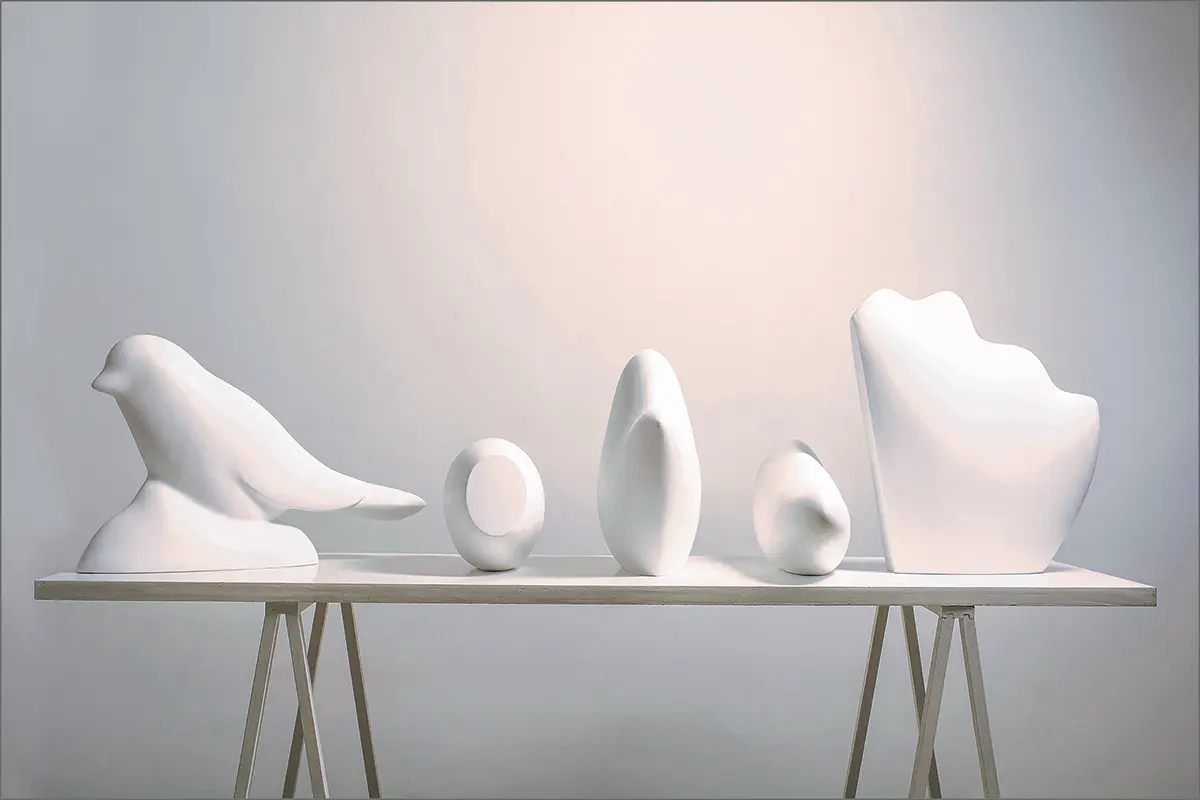
The exhibition at Pasaje 17 consisted of eight works displayed on two tables and a large sculpture of a female figure with a swan presented as the introductory piece to Bairon’s world; a world of few objects where the artist explores the uprooted condition of forms. Oscillating between the figurative or narrative to abstraction, Bairon constructs an altered perception in which she establishes a dialogue between her Leda and the swan and the group of works that include a large bird and a series of undefinable and unsettling geometric pieces whose ghostly nature suggests vestiges of forms that no longer exist.
Another central aspect of the exhibition by Bairon, and one that underscores the particular nature of her artistic production, is the use of the color white to homogenize the forms, which also complements and helps to showcase the smooth, soft, and glowing textures created by this artist. This is achieved through the delicate, painstaking, and patient work with space. While Bairon develops surfaces visually similar to marble, her works are the result of a different approach to the matter. While Michelangelo created his sculptures by directly chipping away at marble, here Bairon works like a patient artisan, first modeling the forms with clay, then casting them in plaster, covering them with superimposed layers of paper clay and, finally, patiently smoothing them until finding the exact point: the curve, the roundness of the volume that allows for the best possible reverberation of light.
In this manner, the smooth curves without ridges prevail and establish a contrast with the straight lines of the white-painted table that supports the pieces. The softness of the female figure is also set in contrast against the rough, also white, the base of bricks that support it, emphasizing the contrast between textures. The unconventional structures on which Bairon places her pieces become a visual element that introduces new meanings into her work; like in the installation exhibited in 2008 at the Galería Braga Menéndez, in which she used iron shelves. The way in which Bairon’s pieces occupy the space—their placement, height, the manner in which they interact with the other works, and the silent spaces appropriated by viewers during their contemplations—is part of the elements considered when arranging the works across the exhibition room.
Today, when artists are prone to statements, conceptual memories, and long discourses, Bairon chooses to explore the uncertainty of silence. Her sculptures are untitled. After this exhibition, she inaugurated the Museo de Arte Moderno de Buenos Aires the largest installations that she has ever done. It was specially created for the museum and was untitled, as the works in this exhibition. According to Giunta’s essay, Bairon prefers not to talk about her works because she believes that the time spent working on them in the intimate setting of her studio is all that she needs to invest in them. In this open space of uncertainties generated by her work, the spectral element is once again present. There is something unsettling about the glow and roundness of the forms that are combined with the ghostly element of images associated with toys from childhood or from another time like antique Lladró porcelain figurines. Nonetheless, anything vaguely familiar is covered by the whiteness of a veil so thick that it pulls the images into abstraction.
AYELÉN VÁZQUEZ