Nothing better to portray a cinematographic event than still photography. In a sound stage, the photo camera can move inside the scene and also outside, it is a mediator at the boundary between fiction and reality. When a movie is produced, a portal opens connecting alternative dimensions curved by time. It is the moment when people become characters and, according to the shooting schedule, time unfolds into footage that will later be cut and edited. In the midst of this dynamic, still photography captures how individuals cross that portal in both directions, how their roles come and go, finding the perfect opportunity to apprehend the precise moment when those two dimensions become synchronized. There is no reality or fiction in a still portrait, only potentially iconic intermediary documents.
Still photography’s intermediate character—and we must be clear that we are not talking about stills from a film or simple registers for the purposes of reporting—provokes the strange sensation we experiment when we see within a single frame the characters and the director, when members of the film crew appear in a reverse angle shot to reveal the complex illusion device required to create an atmosphere, when the producers break into the stage to give instructions, or when the crew and cast simply stop for a beer or two. In every one of these cases, the document moves back and forth between dimensions, between atmospheres. In the same way, the more paradigmatic the movie, the greater the impact of its backstage images.
Eduardo Carvajal is a photographer. Since 1972 he has shot still photography in such films as Angelita y Miguel Ángel (unfinished project by Caicedo and Mayolo, 1972); Agarrando pueblo (Ospina and Mayolo, 1977); Pura sangre (Ospina, 1982); Carne de tu carne (Mayolo, 1983); La mansión de Araucaima (Mayolo, 1986); La vendedora de rosas (Gaviria, 1996); La virgen de los Sicarios (Schroeder, 1999); and Todo comenzó por el fin (Ospina, 2015); among many others. The photographs he took of Luis Alfonso Londoño are already part of our national film heritage. They help us remember this cobbler and natural actor in Agarrando pueblo, who, according to director Luis Ospina, inspired the movie when in 1971, as they were shooting Oiga, vea, yelled at them ¡Con que agarrando pueblo, no! (“So, getting down with the people, are you now?”).
On this occasion, Carvajal exhibits at Museo Rayo his photographs of Andrés Caicedo, a series of extraordinary portraits that depict the young writer in different facets of his life, both on stage and in the street, and are imbued with all the power of the genre, which is to say, its ability to show a character, in essence, focusing on his or her most enigmatic characteristic without needing to prioritize technical values, since the issue is not sharpness and definition, selective focus, or large grain, but how to allude to the anecdotes at the origin of the image; this noise, to give it a name, makes these photographs pertinent, unique and, perhaps more importantly, spontaneous.
In the street, Carvajal is able to make Salcedo play in front of the camera, perhaps seeking to bring something out of the famously shy writer who ends up falling for the seduction of the lens and poses, adopts a persona, and presents himself as a character in that brief encounter. Carvajal is among friends, he moves among filmmakers and writers, and lives with his camera in hand; perhaps he was never concerned with whether his friends were working or “in character”, or were simply being themselves. Perhaps there was no difference for him, and perhaps his grammar was that of the possible image, of the time that can be materialized by light. It is interesting to think that in photography, the exact moment is not sufficient and that some anticipation and some participation are also required. Aside from “being there,” Carvajal was ready to save that “present,” creating a series of documents that seem to escape any ambition to monumentalize. Miguel González, the exhibition’s curator, tells us that these are the best-known photographs of Caicedo, published in books, articles, and magazines, adding that thanks to them the writer will remain forever young.
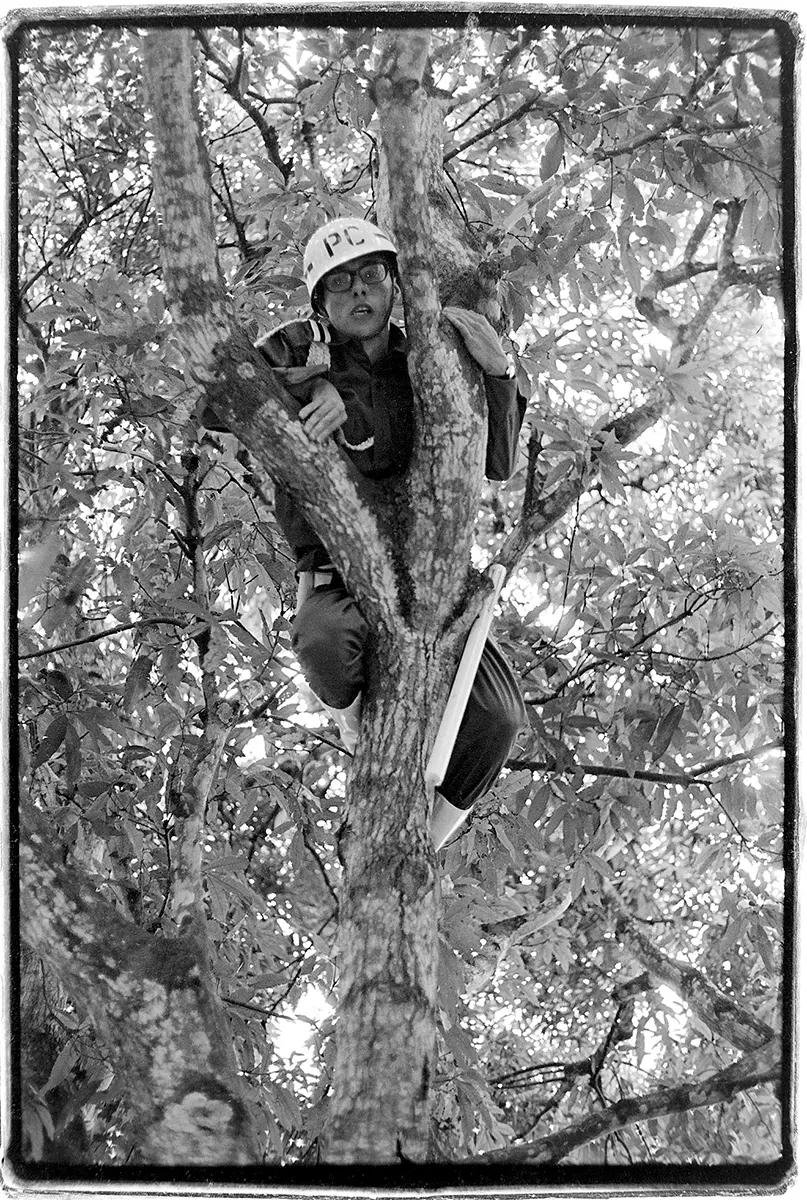
The show also features a series of lesser-known photographs of Caicedo taken during the shooting for Angelita y Miguel Ángel, which have a special effect: we see Caicedo with uncharacteristically short hair since he was playing the role of a policeman, a comic character that was an homage to Jerry Lewis, one of the young cinephile’s heroes. In this guise we see him atop a tree, in a scene in which he grabs a mango and passes it to Miguel Ángel, and also, in a different image, waking up the main character one day when he was late to call Angelita. Carlos Mayolo, who co-directed the film with Caicedo, remembered in an interview how being able to see the shadow of his neck surprised his friend.
These portraits of Andrés Caicedo are exhibited at Museo Rayo in commemoration of the 40th anniversary of his death, a heartfelt tribute by institutions, friends, and readers intent on signaling the importance and of his influential writing, a fugitive passage nevertheless possessed of undeniable power.
BREYNER HUERTAS