Edouard Duval-Carrié’s work has focused on themes connected to his cultural heritage and the presence of elements of colonialism in contemporary Haitian society. To that end, he has created a highly personal style that combines elements of his Western, academic education as an artist with others that are rooted in the culture and the spirituality of his predecessors.
One issue this artist has explored in depth in connection with the presence of coloniality in the structures of power is that of the social conditions created on the basis of economic relationships. One example of this kind of artwork is Sugar Boats, a direct allusion to one of the Caribbean region’s most dominant economic activities: the sugar industry. Here, the industry is represented by two mobile sculptures of white-colored ships, hanging from the ceiling. Shipping has traditionally been the method to transport sugar to Europe, but also the way saves were brought into the “New World”. The structure of the mobiles brings to mind those often given to children, for the suggestive, almost dreamlike presence of stars in them. Behind them, however, lurks an inherent contradiction between form and content. These beautiful, flawless sculptures hide inside the horror that the industry imposed on the region: in order to extract the sweet product it used an enslaved labor force, with the resulting cost in human lives and attendant calamities.
Another group of works, Memoirs, follows a similar formal pattern. In this case, there are eight exquisitely manufactured lightboxes that refer, visually, to structures that resemble cells in the human body. They represent ancestral memories, a genetic connection to the past that determines the present. Duval-Carrié has used this resource to talk about the discrimination to which Haitians, seen as an epidemic, are often subjected. Once again, the recourse to a pristine finish contrasts with the terrible realities of contemporary Haitian society.
A deep influence in the artist’s imagination is The Kingdom of This World, the 1949 novel by Cuban writer Alejo Carpentier (1904-1980). The book is based on real events in the tumultuous, blood-drenched history of Haiti between 1750 and 1830, and it was the result of Carpentier’s painstaking research. Duval-Carrié takes from the Cuban author his main thesis of magical realism, lo real maravilloso, that seeming combo of reality and fantasy that is everyday life in the Caribbean region. Duval-Carrié explores Haitian culture and spirituality, finding elements that allow him to play with the concept as it straddles the real and the imaginary, deities and human beings, in a sort of new dimension. This is what Carpentier is able to illustrate in his literature, and Duval-Carrié brings to the visual arts.
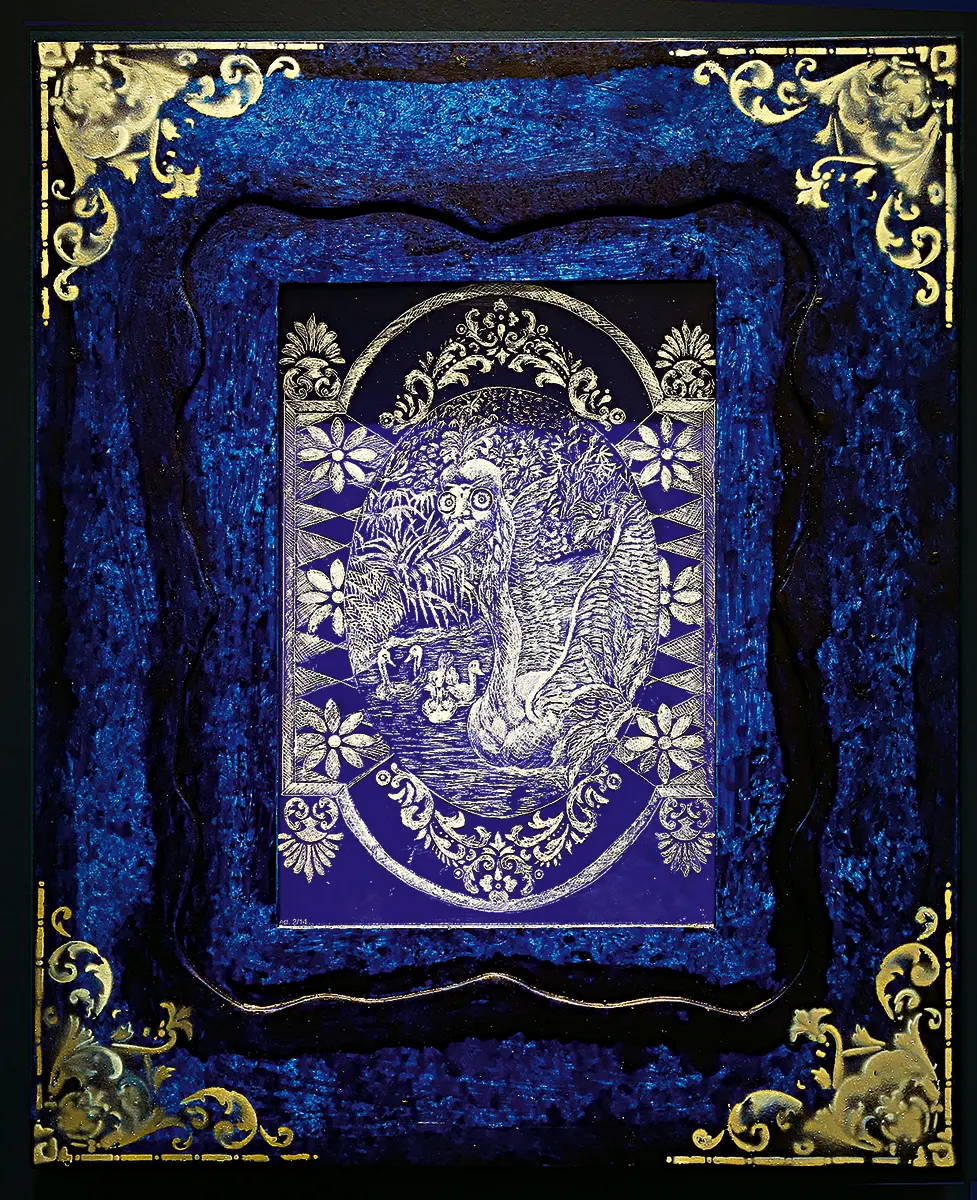
In this exhibition, The Kingdom of This World is represented by a suite of engravings in Plexiglas, titled like the book. It consists of fourteen individual works that function like illustrative vignettes for different passages in the story told by Carpentier. The images are monochromatic engravings of complex white lines on an indigo background. Formally, the series follows a solution that puts us in mind of old engravings where the baroque ornamentation of the frame played an almost central role in the composition. In these works, Duval-Carrié explores in depth the exhibition's main topic, metamorphosis. This topic is reflected in an almost literal way in works like Makandal, titled after one of the book’s main characters. There, Duval-Carrié takes the idea and illustrates it in an evident manner, representing the essence of the character, which is his ability to transform into an animal whenever necessary. Another work with the same concept at its core is La fin de Ti Noel (The End Of Ti Noel), an illustration of the chapter about The Land Surveyors. Ti Noel, who was the connecting thread throughout the narrative, is able to repeat Makandal’s magic process and transform into an animal, in fact into several at the same time.
In a way, Metamorfosis becomes a summary of the issues that have interested Duval-Carrié and driven his work over the last decade. It also presents us with an overview of the intellectual evolution of his philosophy and his artistic thinking, showing elements of his personal collection in installations like Cabinet de Cusiosités (Cabinet of Curiosities). Inspired by the collecting system after which it is named, the installation brings together an assortment of objects from various places and eras. There are paintings, photographs, engravings, books, sculptures, and even taxidermy animals, among others. To a degree, this installation also represents what happened and continues to happen in the Caribbean region, where economic, social, and cultural formations respond to a similar process of syncretism.
IRINA LEYVA