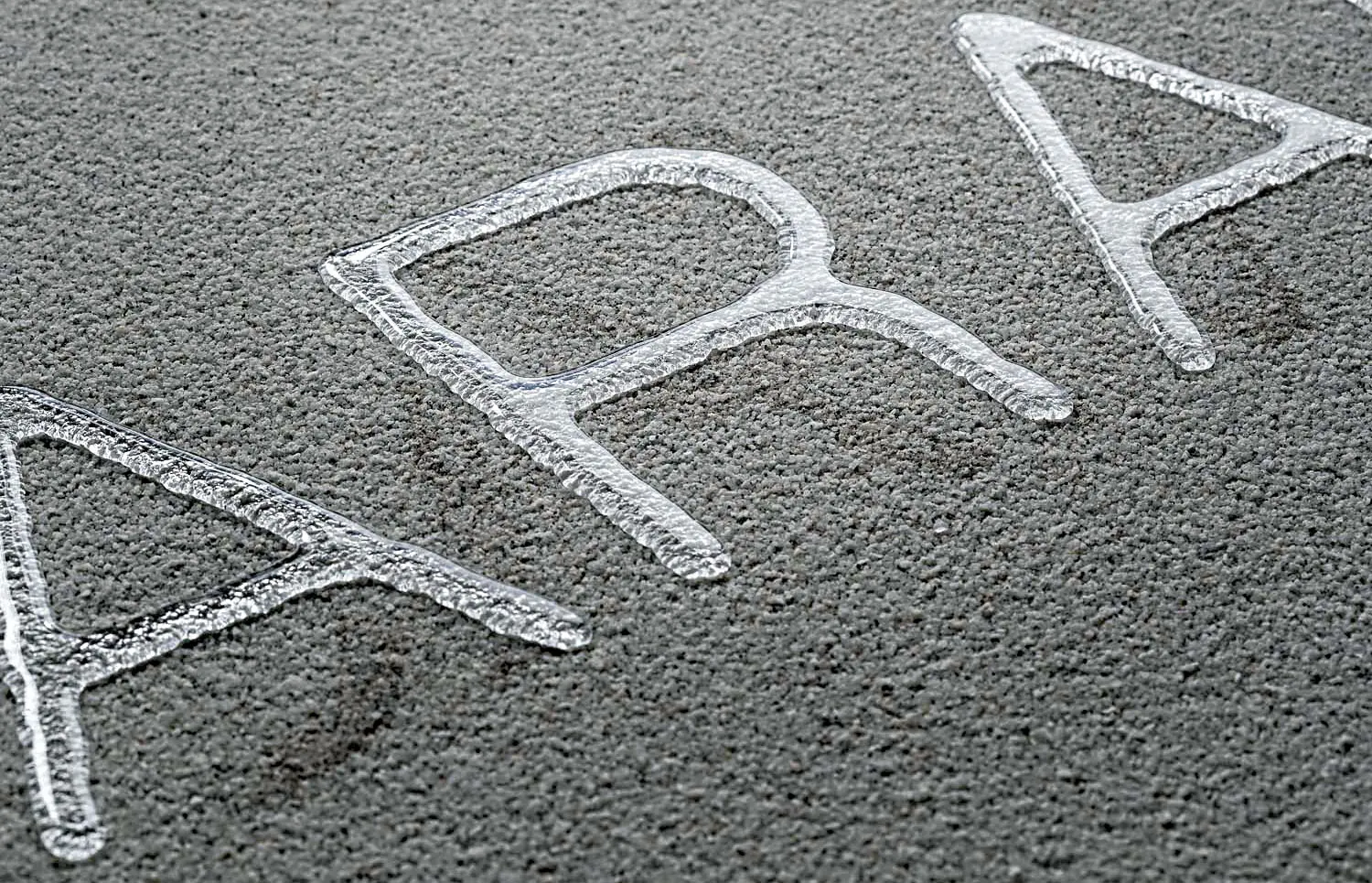
At the feet of the viewer, a few mercuric water droplets appear as though by magic to tentatively form letters that, in turn, take the shape of a name. The apparition repeats with hundreds of different names, following a chessboard logic and transforming the surface of the Crystal Palace into a liquid palimpsest. “A beautiful place,” says the artist, Doris Salcedo, “to give them the dignity they never had in life.” She is talking about the owners of those names on the Palace’s sandy floor: refugees who drowned as they attempted to cross the Mediterranean. That beautiful place is a building erected in the late Nineteenth Century as a human zoo, for the display of aboriginal individuals from the Philippines; it is located in Spain, one of the intended destinations of those who leave their lives in the sea as they seek to escape from misery in Africa.
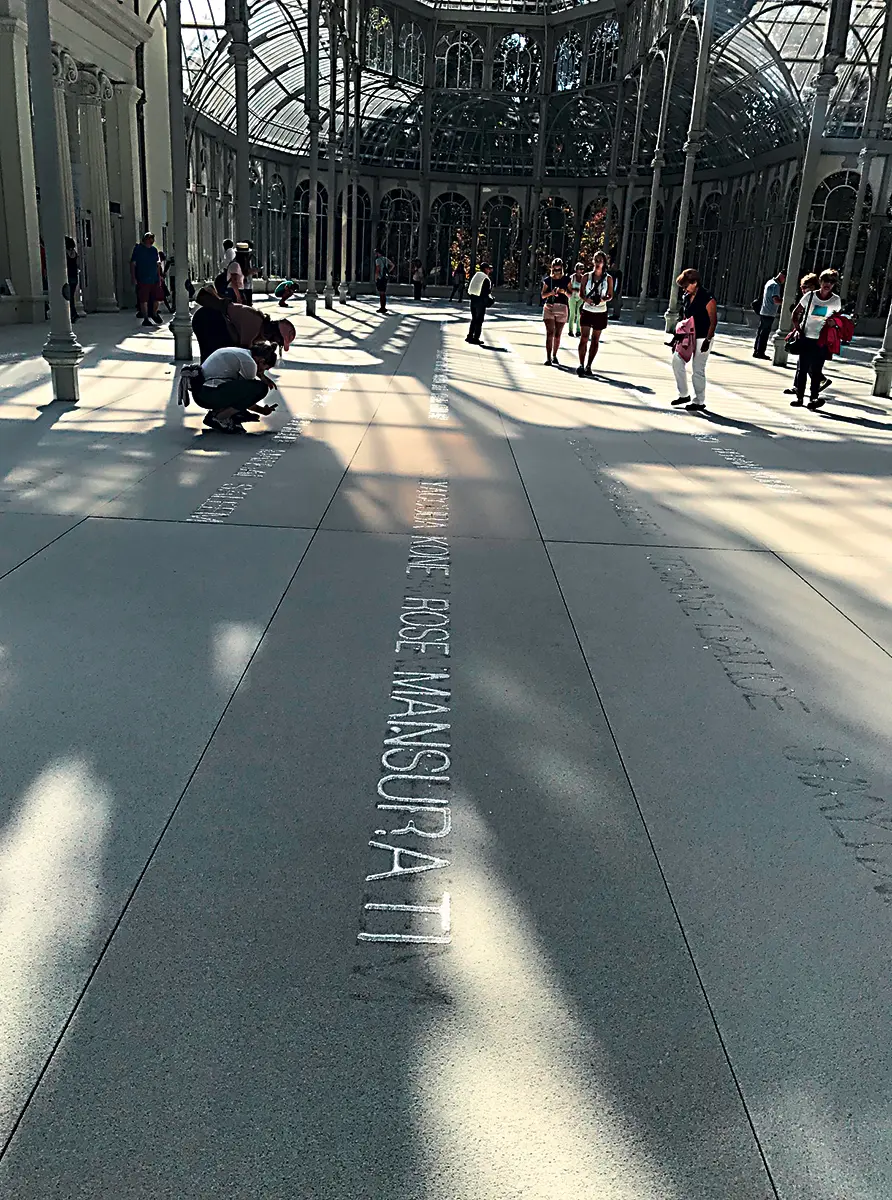
Salcedo continues to model her actions of grieving for those who have no name. On this occasion, the simplicity of her proposal contrasts with the complexity of the (invisible) operative, yet is well attuned, in metaphorical terms, with the simplicity of our reception of news about the death of people who have suffered unimaginably in land and sea. Salcedo builds what she calls a “counter-monument,” since what is being honored has nothing to do with nationalistic airs or identitarian mentalities. It is a memorial to the non-memory, an ephemeral remembrance. A very clear continuity can be traced in Salcedo’s oeuvre through subtle and poetic works that are always presented attached to another space, be it floor or wall, like a bandage or dressing inscribed into another body—an indelible trace, an absence that is felt. We can connect this Palimpsesto (Palimpsest) with her earlier Sumando ausencias (Adding Up Absences, 2016), a collective tribute in which a group of people wrote on a white canvas, using ash, the name of a small percentage (7%) of the victims of armed conflict in Colombia after the “no” option won the referendum about the peace accord between the government and the FARC guerillas. On the opening day for Palimpsesto, that conflict—still ongoing—added even more absences to the unnameable roster. The different timelines (the Colombian work took five days, while its Spain counterpart required five years of arduous effort alongside a team of experts and engineers) are balanced by the spatial similitude, even beyond the fact that in our minds, such innocent deaths come to occupy a shared void.
Perhaps lyricism is a good option to interpret this impermanent work, instilled with Salcedo’s will, and it will surely be the tool that allows viewers to codify the apparitions of those disappeared individuals, making visible those who have been rendered invisible and having them return to a virtual space, to the memory of those who step on their names. Art is capable of this, as are music and film, with for example Roger Waters’ 2017 song The Last Refugee and Gianfranco Rosi’s 2016 film Fuocoammare, both at the opposite end from Ai Weiwei’s opportunism and the imposition of his body on the bodies of those who aren’t there. Art is capable of this. Not of rescuing the drowned, but to save them from the anonymity of their tragedy. The only bitter taste, like sea salt, that Palimpsesto leaves behind (and returns us to the real world, the world not of symbols but of statistics) is a question floating in the air: how are we to interpret a state-owned museum’s expenditure on a work of art that is an homage to the refugees who died in the Mediterranean, while the budget assigned by that same state, Spain, to help those same refugees—not to speak of aid to ameliorate conditions in their lands of origin—evaporates like tears in the basement archives.
JUAN JOSÉ SANTOS
Art critic and curator. Profesor of the University Diego Portales and UNIACC.