The very fact of witnessing an event changes it. The presence of the witness is part of the conditions given, but the witness could never apprehend the phenomenon from outside. The observer creates the perspective and renders the event relative; no matter how strenuously the observer attempts to extend herself, achieving an all-encompassing view will always prove impossible. The objectivity of formal disciplines sets limits and temporal boundaries for the unfolding of law, and requires constant conditions in order to understand itself; in turn, art provides a permanent account of the position of the witness, the fragility of the conditions, and the anxious situation of the observer. Art points out the fact that this is an unknown.
In the exhibition Objetos parlantes (Speaking Objects), curated by Miguel González, Diana Marcela Buitrón (Cali, 1993) positions herself as a witness of a set of circumstances that would otherwise go unnoticed, since they have been naturalized by complex relationships of power, artificiality, and tradition. Buitrón situates herself in the midst of a series of natural, familial, political, and poetic phenomena and moves through them as a theatrical prop master would—someone who is invisible, or seems to be, in the context of stage convention. Dressed in black, the prop master manages the objects used in the play, gathering and installing the various elements according to the script’s specific requirements; hers is an environmental presence that sets everything in motion yet must be ignored by the audience in order to maintain the illusion.
The comparison is particularly interesting if one thinks about the artist as an environmental presence making specific indications and arranging objects so that a larger story can begin to be woven; for that, she makes use of remembrances, random coincidences, and impasses. In this show, references range from the natural world—with the use of cocoa beans and bananas—to the personal realm, Buitrón’s own family.
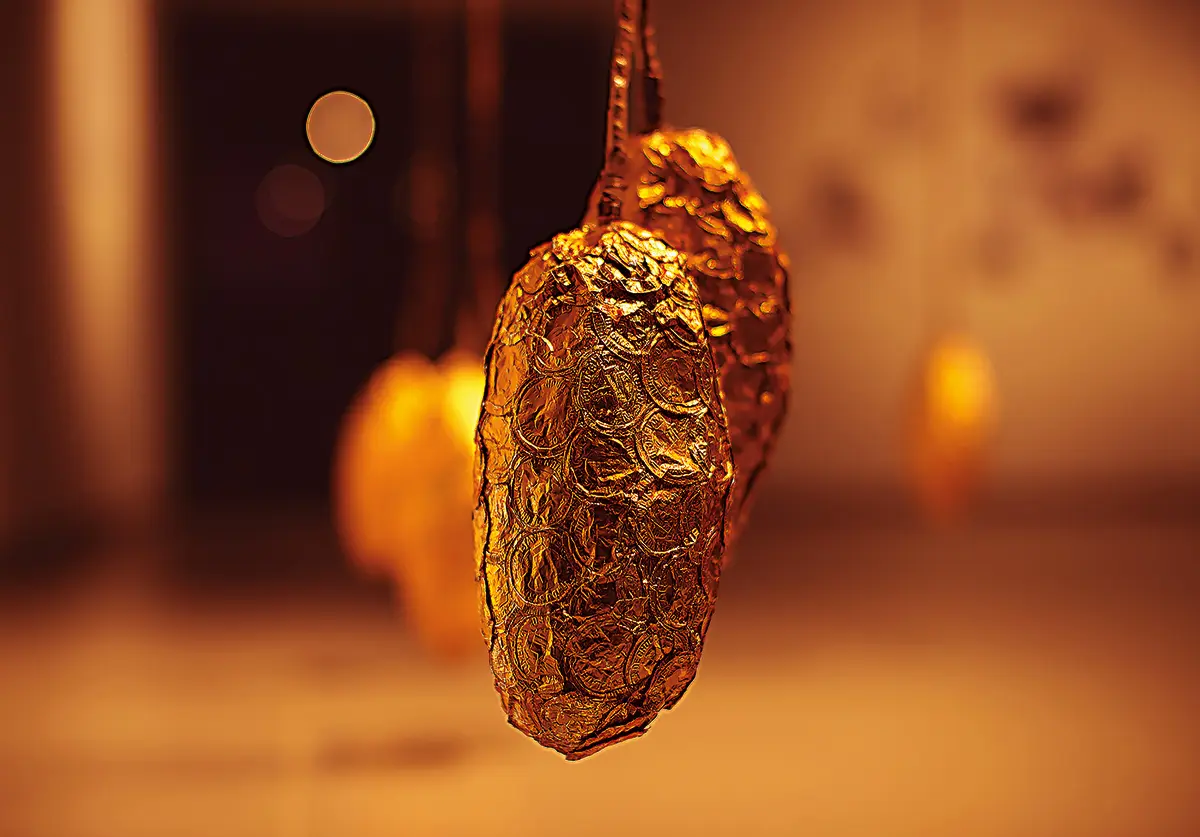
Diana Marcela Buitrón creates two chapters or Objetos parlantes. The first one is an installation titled Amígdalas pecuniarias (Pecuniary Tonsils), with which Buitrón participated in Arte Cámara during ArtBo 2016. This installation features cocoa beans wrapped in gold foil taken from chocolate coins, hanging all around the gallery from threads made from banana fibers. The installation can be traversed; visitors walk very close to the beans and can appreciate their fragility as they begin to rot inside their wrappers. The gold foil, wrapped around the freshly harvested beans, finally begins to crumble with the living material inside, and what looked like a gold chrysalis comes to resemble a dried rock; skin becomes scale.
Chocolate coins are part of a game, a representation (theatrical, perhaps) of the economy in children’s terms, where gold can be eaten. This economic alchemy corresponds to a policy that manifests itself in the mimesis of objects on an almost stage-like plane. The banana fiber threads put us in mind the shade that the cocoa plant needs to grow since banana trees are their first shelter; perhaps the artist and her audience are yet two more providers of shade for these beans.
The exhibition’s second chapter deals with a common farming practice: replacing a goose’s eggs with sand eggs. Buitrón remembers how her grandfather tricked the bird in order to control the gaggle’s reproduction. Eclosión (Hatching, 2017) is the video of an action where the artist, clad in black (like a prop master, thus the simile traced here), picks up and resituates a large number of sand eggs. In the course of the action, she drops several of the eggs; some break, while some remain intact. It is interesting to think of Buitrón’s figure in the midst of her own memories and of these events, like the apparently passive presence of time; times as a privileged, omnipresent observer, which materializes on the scene as a black-clad character who perhaps would rather not be seen. From this point of view, in this stage game, her presence can be read as ambiguous, as the expression of the fact that the witness transforms the conditions.
This convention, to give it a name, is present throughout the exhibition. In both chapters, Buitrón is aware of her ambiguous presence. In Incubabilidad (Incubability, 2017), we see the video recording of a female goose incubating a sand egg. Through some wire gauze, the hidden camera records a deceived goose and gander pair uselessly incubating their eggs. The foliage, the animals, and the eavesdropper are the ecosystem of a small fiction woven as a phenomenon. Another work in this chapter is Alisando el vuelo (Smoothing Out the Flight, 2017), an appropriation by the artist of some plaster bird figures made by her father. In this appropriation, artificiality seems connected to the notion of a sand progeny, with a circle that continues to connect based on previous allusions. However, although a “divine hand” seems to be manipulating everything in these works, in the end, it is revealed that what we are seeing is a chain of coincidences guided—and thus, disturbed—by the artist.
BREYNER HUERTAS