The exhibition Printed Matter by Brazilian artist Daniel Senise (Rio de Janeiro, 1955) can be, on the one hand, literally understood as a reference to a wide variety of meaningful matters printed around the world and, on the other, meant as the recycled matter used to generate other works. Both aspects are deserving of our full attention, and more so when we take into account that here Daniel Senise is setting into motion a change of skin, a rebirth, a reinvention. But the reading of this exhibition—based on recycling to establish epochal significations—does not end there. Like the before and after Christ, Senise proposes a before and after for the digital era with respect to the dissemination of knowledge. Among all the books that were and continue to be treasured, there are those religious ones that because of their subject matter are beyond any mundane associations between knowledge, documentation, and editorial perfection.
Those who have seen previous exhibitions by Daniel Senise may be surprised not to encounter any paintings in this current show. But the changes are welcome if nothing else just for the sake of avoiding stagnation, being daring, and willing to propose something new. The name of the exhibition, Printed Matter, has to do with books, recycling, and with turning them into signs of pre-and post-digital editorial concepts. It is not about appropriating books in order to intervene and render them nearly or completely unrecognizable. The information labels indicate that several Printed Matter works have been created at different times between 2013 and 2017.
Through the title of each piece, Daniel Senise places us in the three different vectors of that period. On the one hand, he encourages us to remember the particular care taken in the impeccable and faithful reproductions by Swiss publisher Albert Skira during the first three-quarters of the 20th century, while also pointing to the fact that the matter once used to reproduce, disseminate, and feature essays about the great masters are now repurposed for works that are in a completely different key. The second vector addresses the level of importance of the material used in the works and equates it to the Bible, the Quran, and the Talmud; the three religious publications that surpass the “printed” reference for being themselves contents. And the third vector focuses on the demise of the once-powerful Encyclopædia Britannica and its inability to survive the advent of the digital era. Senise uses the encyclopedia in a wall installation consisting of 24 pieces, each measuring 32 × 40 cm, rendered in a neutral tone with tiny “freckles,” a departure from the dark red color of the original bind that characterized the once-dominant encyclopedia. The matter that used to occupy vertical bookshelves and sport a highly valued brand name on its spine, has been replaced in this exhibition by blocks similar to the original volumes but displayed frontally and without any words.
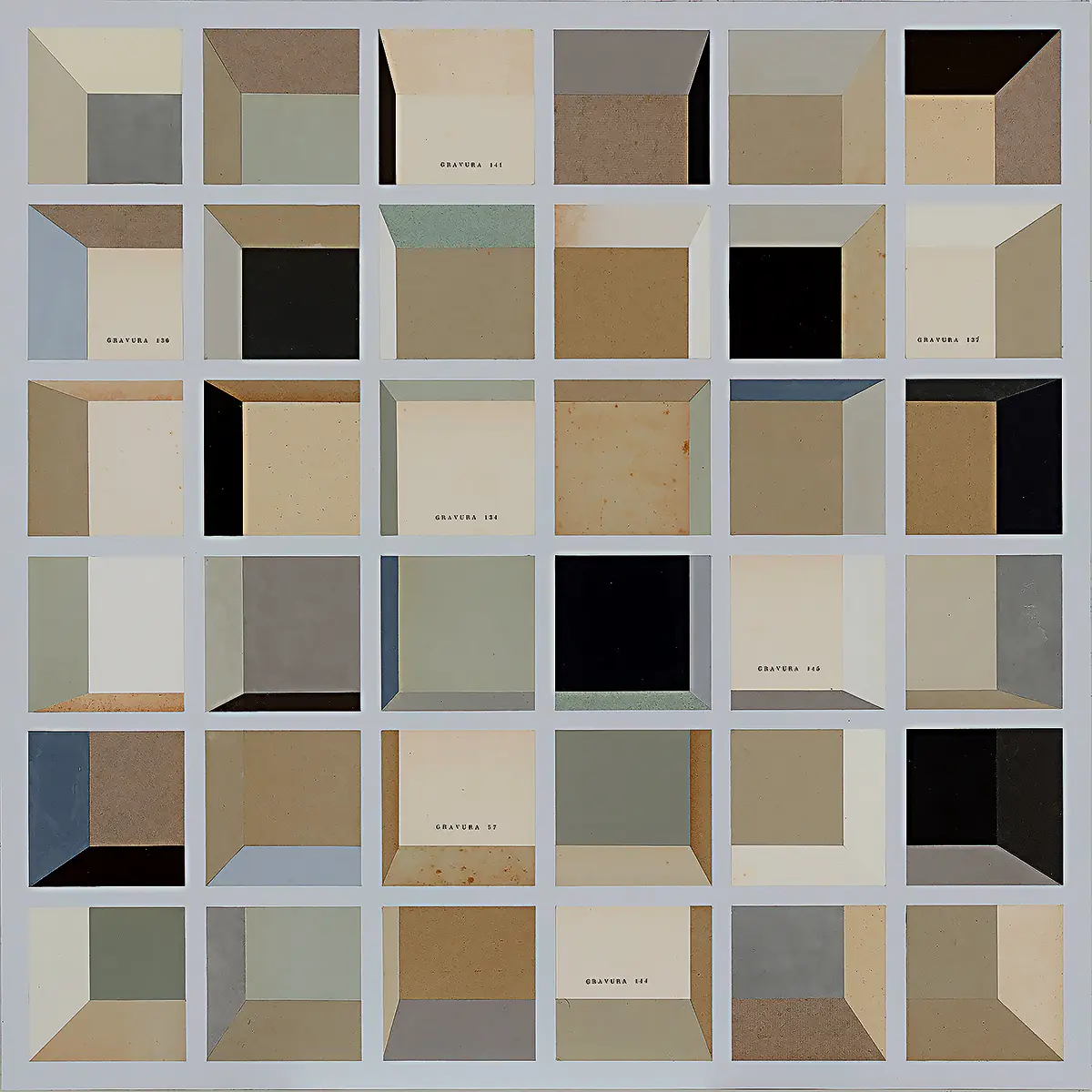
In the piece titled Goya, some spaces offer references to the first life of Skira’s volumes, before the recycling concept was put into action and its matter became relevant again. This skirian series is divided into thirty-six compartments—like research classification boxes—that correspond to the pages on which the images of a goyesque monography were reproduced. Now, what is enumerated is the void left by the images removed, consolidated, and expanded towards the absence of the goyesque drama. Instead of the depth found in Goya’s work the proposal by Senise alludes to a depth of geometric cavities. Reinforcing this perception is the fact that only the reliefs of the “Brit” that have been placed on the wall are frameless.
Entre (Papel Picado do Dufy) [Between (Shredded Paper Strips from Dufy), 2013] is different than the rest of the works in this exhibition for its unconsolidated and voluminous texture, colorfulness, and overall textural focus through shredded paper strips appropriated from Georges Braque’s book. But it should not be misunderstood as a destructive effort by the Brazilian artist Daniel Denise. It is rather a “century/language passage” about the so-called change of platform. The entire process alludes to manual work, even if electric shredders and mixers were used—an aspect that I was not able to investigate. In terms of the aesthetic approach, it is a neo-conceptual adventure with a discourse that dismantles prevalent issues to underscore the all-encompassing contemporary digital world. This other world proposed by Printed Matter does not leave unresolved subjects: it is sensual and mysterious; it alternates past interests with present ones, and it stands out for favoring the printed book over the digital book platform. Throughout the entire exhibition, paper is what survives and transforms, just as stated in the title of the exhibition.
GRACIELA KARTOFEL