Revising ideas advanced by philosopher and sociologist Zygmunt Bauman, this exhibition brings together the work of young Mexican and Spanish artists in celebration of the 40th anniversary of the reestablishment of diplomatic relations between their two countries. First shown at the Museo de Arte Carrillo Gil in Mexico City and currently on view at Artium Centro-Museo Vasco de Arte Contemporáneo, in Vitoria-Gasteiz (Spain), the show is a co-production of both museums, Mexico’s National Fine Arts Institute, the Mexican International Development Aid Agency, Spain’s Aid International Development Agency, the Embassy of Spain, the Spanish Cultural Center, and the Foreign Relations Secretariat (the last three institutions in Mexico).
Based on the volatility of social-life dynamics that Bauman emphasized in different ways in his analysis, show curators Blanca de la Torre, Carlos Palacios, and Paula Duarte, established thematic constellations for the projects by the artists featured and arranged them in the exhibition space. These constellations are Border/Boundaries; Economy; Sustainability; History/Archive; Networks/Communication; and Habitat. The artists featured are Edgardo Aragón, Mauricio Orduña, Miguel Fernández de Castro, Morelos León Celis, Ana Roldán, and Emilio Chapela, from Mexico; Fernando García-Dory, Asunción Molinos Gordo, Elena Lavellés, Carlos Aires, Rosell Meseguer, and Maider López, from Spain.
In certain passages, the art extends between the curatorial nodes, or these serve to contain a rhizomatic or spiral-shaped experience of the exhibit: the projects can be engaged by simultaneously activating different angles of reflection deployed throughout the exhibition space, or these realms of analysis intertwine in the exhibition as they interlace artworks presented under different thematic lines.
One central aspect of this show is the geographical diversification of the social processes under consideration. As artists from two continents collaborate, the locations to which some of the projects allude encompasses different points around the globe and social contexts that determine the phenomena alluded.
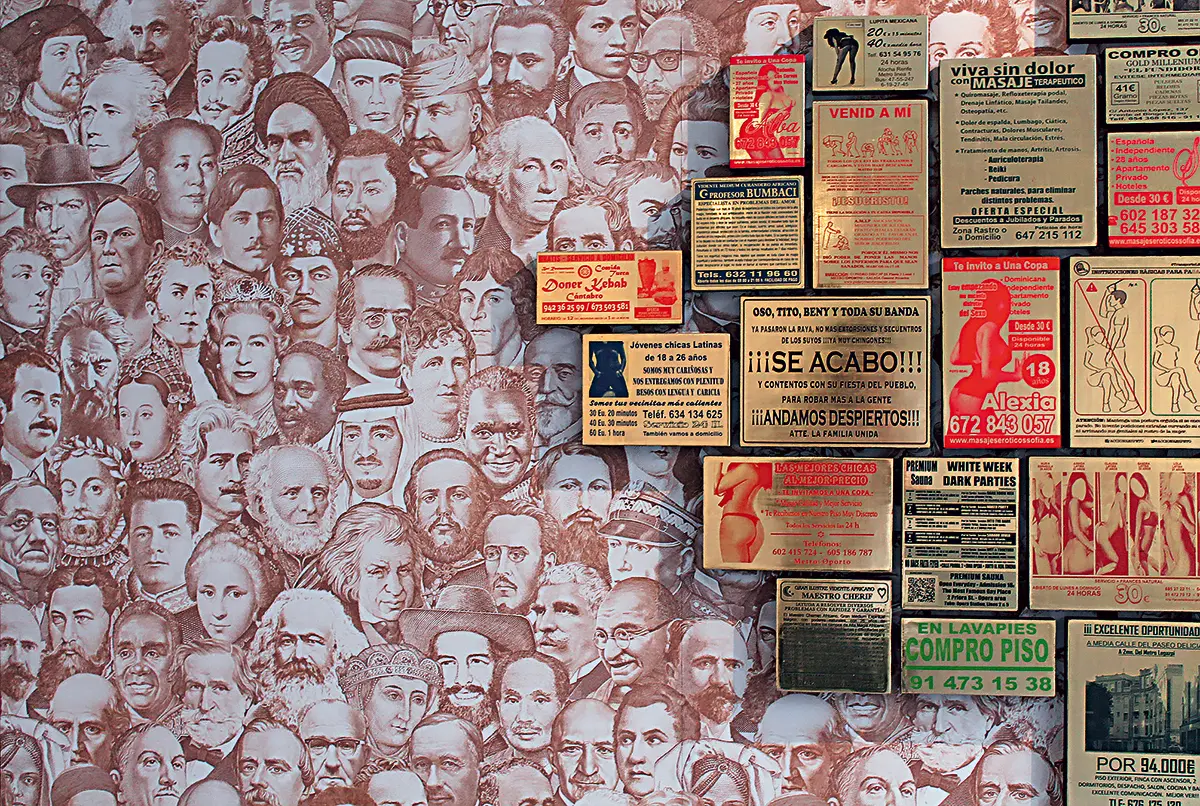
Following the course proposed by the exhibition’s spatial distribution, Spanish artist Carlos Aires—who in previous projects like Desastres (Disasters), Money makes the world go round, or Mar negro (Black Sea, 2013), among others, has explored the recycling of visual-culture and material-culture elements and their resignification into a critical discourse that interrogates the political and economic simulations of contemporary life—presents his installation El ojo que todo lo ve (The All-Seeing Eye), comprised of dozens of eyes culled from the portraits printed on banknotes from around the world, on the skylight over the access ramps to the gallery. Also by Aires 30 euros 15 minutos (30 euros 15 minutes), a wall with hundreds of advertisements collected by the artist. Both works are included in the Economy thematic node, conceptually alluding to macro-structural forces that surpass the individual sphere, in the first instance, and the proliferation of commercial services on offer, in the second.
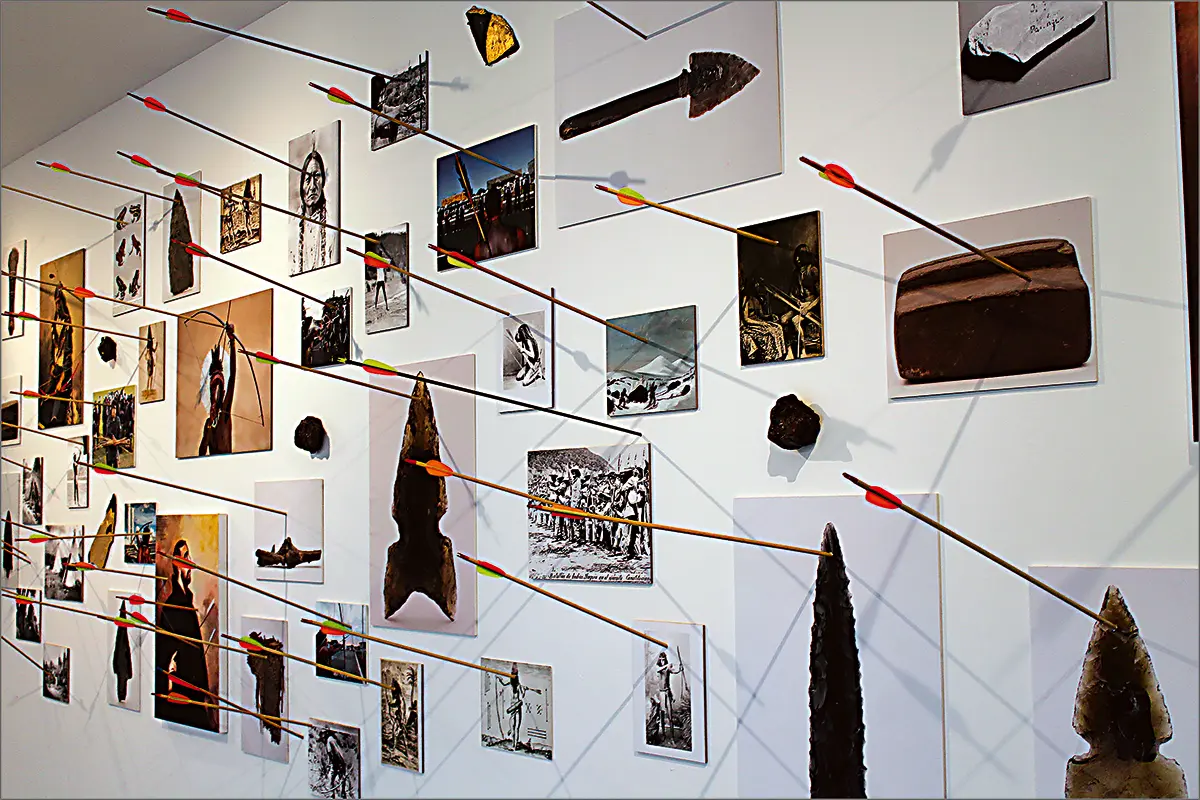
Included in the History/Archive section, the installation El oficio del adversario (The Craft of the Adversary), by Mexico’s Morelos León Celis—a native of the state of Oaxaca whose oeuvre features media and practices that resignify images and functional objects connected to local identities, as in his projects Materia solar (Solar Matter, 2014) or El pueblo unido (The People, United, 2004)—compiles various representations of the indigenous, evangelizes, records of material culture, and natural specimens, affixed using arrows that can trigger in the viewer, via associations at once metaphorical and political, an allusion to the violence implied in the European arrival in the Americas.
As we move to the next exhibition area, Edgardo Aragón—who regularly explores the critical inclusion of artistic action in geographical spaces with have the collective or familial memory of complex processes, as in his projects Efectos de familia (Family Effects), Matamoros, and Simulacros de sustitución (Simulacra of Substitution), from 2010—presents a video and sound work in the Border/Boundaries node: La encomienda (The assignment), a choir singing a Baroque composition inside an abandoned mine, in reference to protests against mining companies throughout Latin America and contrasting the soft harmonies of the song with the work’s subjacent reflection.
Maider López, from Spain, presents Línea de césped (Polder Cup) (Grass Line (Polder Cup)), an installation with video and photograph registers. Included as part of the Networks/Communication node, López’s project unfolds in several sections of the exhibition space (and is perhaps an homage to social practices and interactions), beyond geographical determinants: in the same way that viewers must step over several lines of grass in order to continue their passage through the exhibition, López exhibits photographs and videos of soccer players forced to thread heir way through gullies and canals inside the boundaries of the pitch. Previous projects by the same artist have focused on connections and networks in shifting situations and contexts, and their nature, as was the case in 25 People on 25 Hills, 25 People on 1 Hill, and Zoom In (geographically-determined actions executed in Cappadocia, Turkey, in 2015 and 2016).
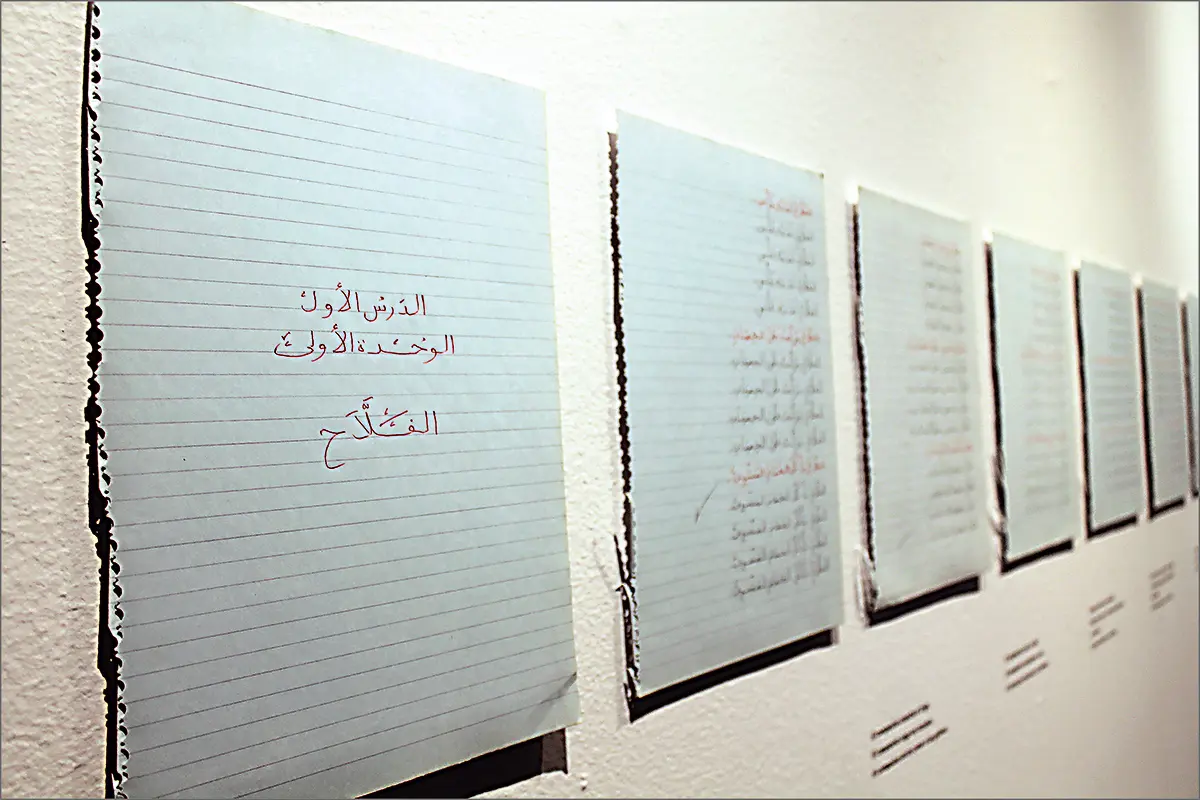
Asunción Molinos Gordo, also from Spain, exhibited El Fellah Ando Fes (The Farmer has a Hoe) as part of the Sustainability node. This work is a conceptual exploration based on phrases written on sheets of paper, which begin describing actions connected to a rural mode of life and gradually incorporate language related to industrial activities and to war, in reference to the transformation of peasant life in Jordan.
In the Border/Boundaries node, Spanish artist Elena Lavellés presented the project Patrón de disolución (Pattern of Dissolution), based on her research about three resources that are central to capitalistic processes of territorial extraction, which blur all geographical boundaries: oil, coal, and gold. Exploring these resources as expressive motifs in their materiality, their historical elements, and their appearance, Patrón de disolución connects with previous projects where the artist revisited situated social dynamics around the issue of housing (Counter sediments, 2016) and housing consumption patterns (From Dust to Mud, in progress), among others, to explore their reflection and sensible visibility.
The exhibition’s period in Mexico activated Emilio Chapela’s Es una catástrofe no encontrar terreno en común (Not Finding Common Ground is a Catastrophe) as part of the Habitat node: it was a walk that started at the Museo de Arte Carrillo Gil and advanced towards Xochitepec hill. On exhibit from this project are photographic records of a previous edition, emphasizing the power of sharing and walking along paths of spatial and temporal astonishment that bridge seemingly abysmal chasms—nature and culture, secularity and religiosity, the city and the countryside, the public and the private—as they give continuity to the artist’s territorial experiences in the apprehension of geographical spaces, such as his video art project Radio Latina (2014), one among the many artistic practices Chapela has explored (installations, technological devices, and abstract expressiveness in itself).
Also on exhibit (in the Economy section), Batuc, by Mexican artist Miguel Fernández de Castro, is a critique of the tourist-recreational uses of hydro-electrical dams built over older communities like the town’s titular one, established in 1629 in the state of Sonora and flooded in 1964, an act of dispossession that is normalized by the capitalist system’s perspective on the exploitation of natural resources and territories. Fernández de Castro is a Sonora native, and in previous works—like Tambos quemados (Burnt Barrels), Fin del camino 3 (The End of the Road 3), and Casa hundida (Sunken House, 2012)—have proposed similar explorations.
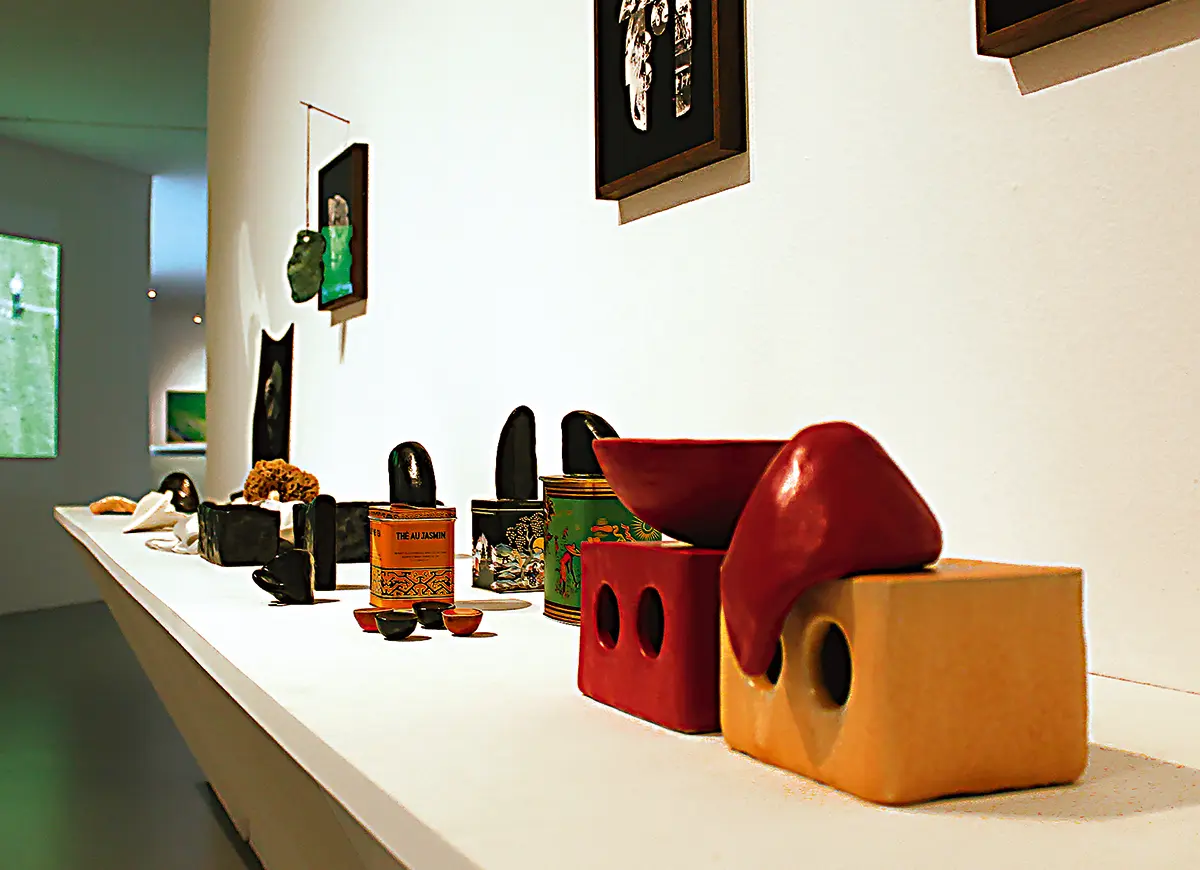
Ana Roldán, also from Mexico, whose earlier projects have explored different ways to dislocate elements of the real, be it natural forms or utilitarian objects—for instance, Banderas Latino Americanas (Latin American Flags, 2009-2010) and Indian Files (2015)—presented as part of the Networks/Communication node her series Strangers at home, featuring three-dimensional collages of pre-Columbian images dealing with the subject of death; Strangers at home is allusive to Roldán’s earlier Displacements (2011), which also deconstructed pre-Hispanic images of death, as both series are activated by installations and small-scale reproductions of objects, textiles, and pottery, arranged in altars.
In the Habitat section, Spanish artist Fernando García-Dory exhibited the installation Tierras raras (Rare Earths), a compilation of widely circulation objects, arranged in the manner of herbariums with simulated geographies (muddy, desert, in settings that recreate elements of the natural environment) inside traditional museum display cabinets, like an invitation to question that which we see as primeval nature and the material culture that could be spread out on it, following an axis of inquiry and resignification of exhibition devices towards a critical review of phenomena that is characteristic of Garcia-Dory’s work, as can be seen in such projects as A dairy museum or Land use. Blueprint for a new pastoralism (2012).
In the final portion of the exhibition, Spain’s Rosell Meseguer activates, as part of the History/Archive node, her project OVNI Archive, analyzing methodologies and processes for the set up of documentation about the topic announced in the title, promoted by MoMA in New York, The Tate Britain in London, of the Centre Georges Pompidou in Paris, in order to reflect about the expressive potential of the archive in the museum space. Other projects where this artist elaborated on the registers and documentation of strategic, defensive, and tactical events of the past in a kind of updated archivists, include Mocha Island (in progress) and Memoria, recuerdo, olvido (Memory, Remembrance, Oblivion, 1999).
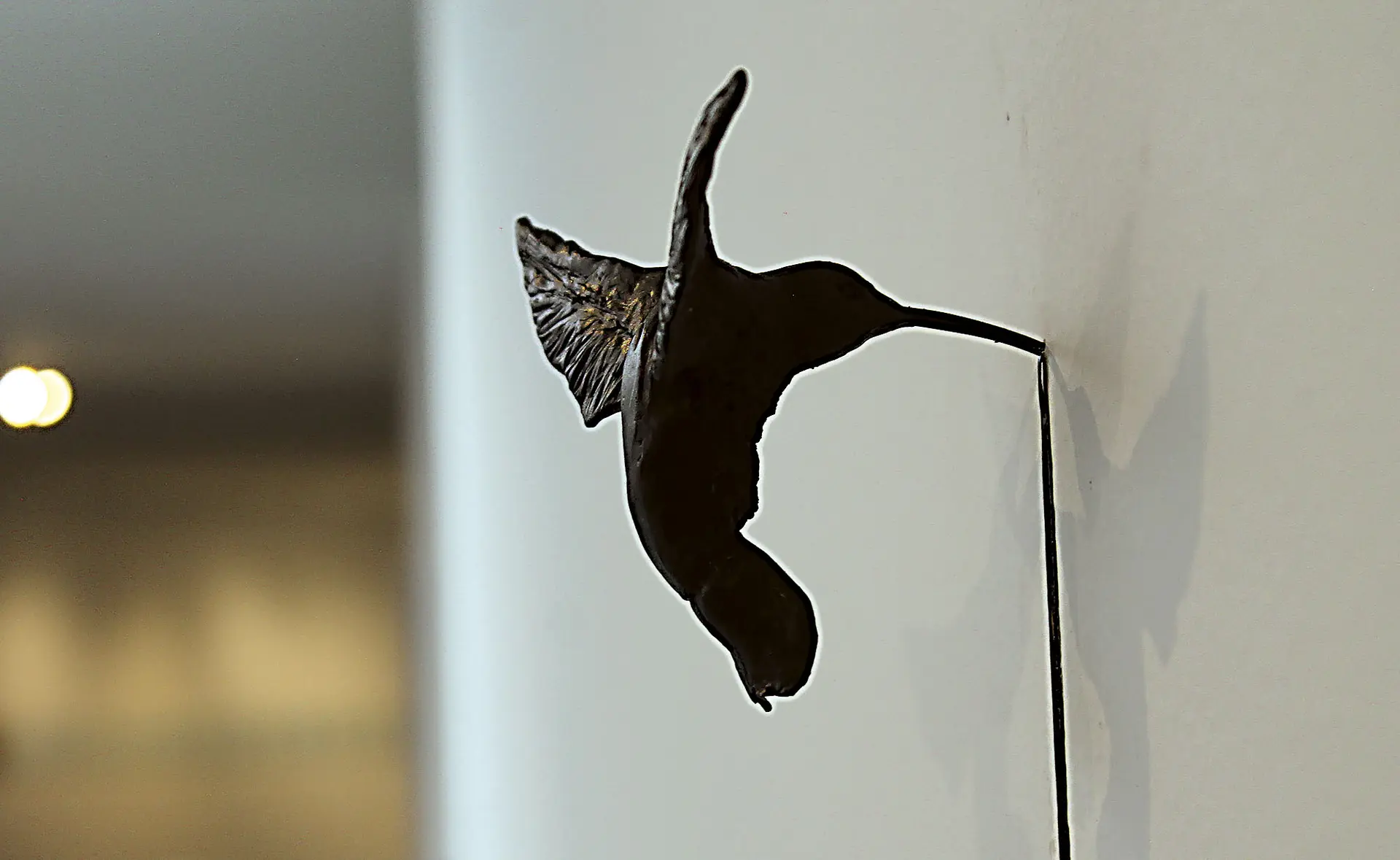
In contrast, and as part of the Sustainability node, Mexican artist Mauricio Orduña’s project Combustivel. Haiku: para Arto Linsay (Combustivel. Haiku: for Arto Linsay) takes advantage of the exhibition space’s architecture to articulate sensible and metaphorical processes of critical representation of the clashes, very often catastrophic between nature and industrial activity—in this case, a hummingbird covered in a dense, leaking oil-like substance. This work is also a pretext for structural and formal experiments about our apprehension of the relationship between motion and stasis, weight, and levity. This kind of exploration has been present in other projects by Orduña, such as Tridimensión (Three-dimension, 2008, about soccer) or Satatic Hudson 1549 (sound installation, 2011, about an airplane accident).
The projects in Liquid Cartographies are connected to Bauman’s claims through the thematic nodes that the exhibition highlights, suggesting to viewers pathways—never unilinear or univocal—for tracing out and exploring the theoretician’s analytical contributions on the basis of artworks engaged as devices for the sensible experience.
EUGENIA MACÍAS