Although there is but one title to Carlos Ginzburg’s second exhibition in New York, it is typical of his installations: several projects intertwined into a conversation. He has added a critique of capitalism through a concept he has pursued for years, that of tourism. What capitalism and tourism share is a sense of temporal and spatial displacement. But his primary concern is to revitalize his prior artistic orientation by conceiving it through the analysis of the changing nature of capitalism. It turns out to be a good, creative, if somewhat chaotic, match!
Ginzburg has installed literally hundreds of objects on, and propped up against, the four gallery walls as well as spread across the ceiling; an arrangement one expects from an unrepentant member of the Conceptual and Arte Povera art movements. Yet he establishes a clear sense of his ideas, simply stated.
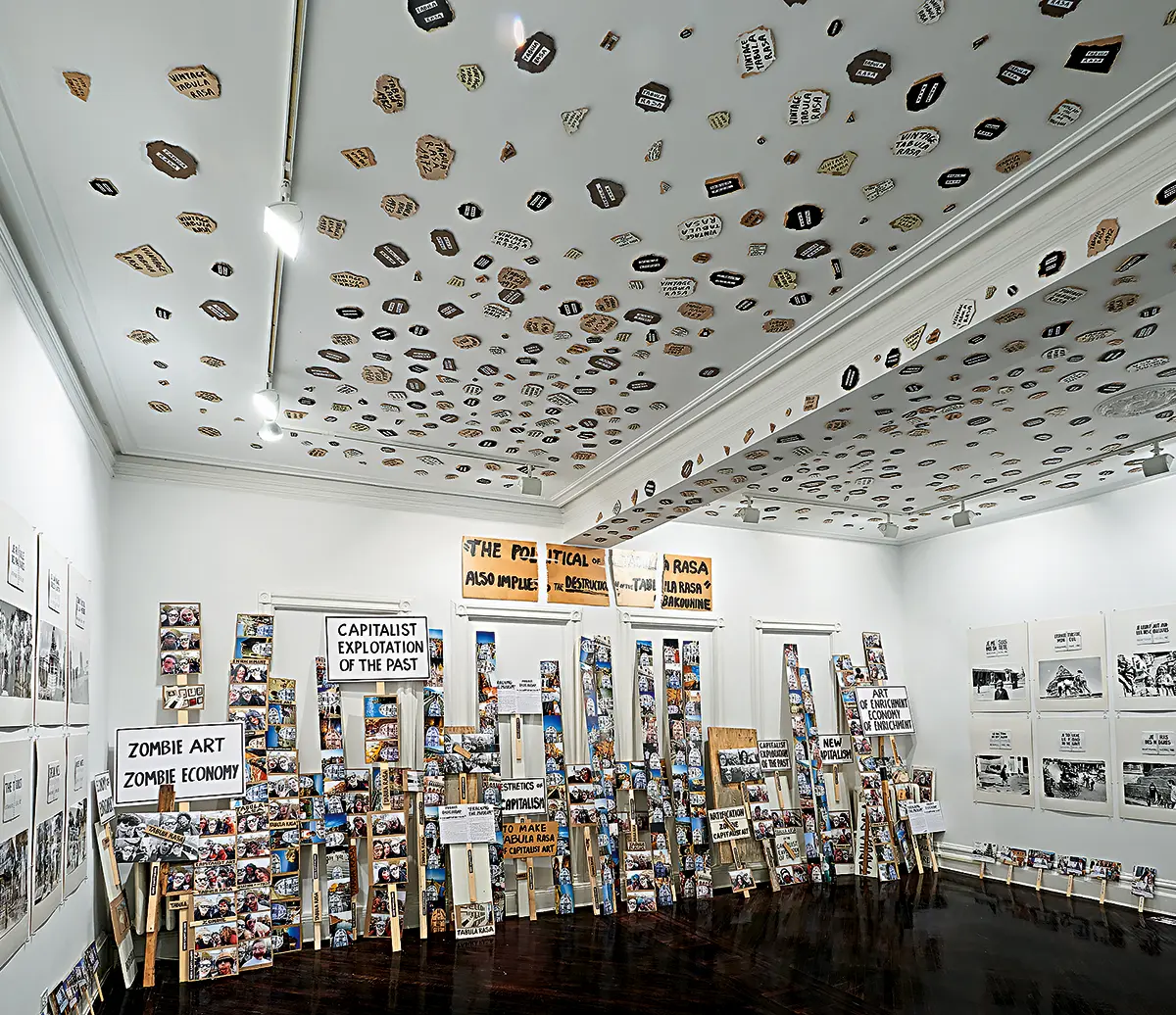
The densest accumulation, titled New Capitalism, which also serves as the title for the exhibition, are the signboards and the vertical wooden poles that have multiple photographs attached to them and lean against one wall. The fewer printed signs starkly proclaim the themes of the exhibition, which are Ginzburg’s creative extrapolations on the nature of the current phase of capitalism as guided by his readings of the French sociologist Luc Boltanski’s thesis that we are not in the much-proclaimed post-production form but in its opposite: an “enrichment” phase based on merchandise.
Ginzburg’s antidote is writ large above this onslaught of photo images with a crudely written phrase “The Politics of Tabula Rasa also implies the destruction of the Tabula Rasa.” It is attributed to “Bakounine,” the Russian revolutionary anarchist Mikhail Bakunin, who, despite his arguments with Karl Marx, equally aimed at an egalitarian society. To drive home the point, there are several hundred small, ragged pieces glued to the ceiling that call for “tabula rasa” and “vintage tabula rasa.” And here is where we see his conceptual turn.
Ginzburg does not merely parrot or illustrate but builds an original and playfully critical esthetic position for his art and this exhibition. The white signboards declare both the nature of the argument and his proposed solution. This “New Capitalism” has an “Aesthetics of Capitalism” currently based on an “Art of Enrichment; Economy of Enrichment” that uses a “Capitalist Exploitation of the Past,” one he considers a “Zombie Economy” that produces “Zombie Art,” a type of his own art he believes he has re-engineered for this installation.
In Ginzburg’s extrapolations, the temporal and spatial play at work in this new form of capitalism are visible in – are the basis for – the art market. The capitalization of art objects is a bet placed on the here and now to become the past for a future payoff in the same way that old art, once here and now, has its future capitalized. In devouring a past that now makes the present a past-perfect tense to the future, the world cannibalizes itself, zombie-like. And that is what and where Ginzburg chooses to appear.
Many of the color photographs on the placards leaning against the wall are of the artist in 2016-2017 with others in facial make-up, his grinning face painted white and wearing very dark glasses, posing in public squares at a “zombie rally.” As Alexandra Schoolman, the gallery Exhibitions Manager neatly phrased it, he “interacted with the people there, turning it into a performance playing on his idea of drawing life from his ‘dead’ past” to become “a quotation of his former self.”
The conversation is made more concrete as Ginzburg provides zombie cannibalization – a “null” set he calls it – of his own past work on the other three walls, titled Vintage. The 39 standard-sized wallboards are a 1982 extension of his earlier project The Voyages of Ginzburg, 1972-1982. They are black-and-white vintage photographs of supposed tourist locations in India or Nepal, many with local people included. These were records of what Ginzburg felt were performance pieces designed to ironically simulate typical tourist photos and display the arrogant entitlement of Westerners abroad in the exotica of the so-called “Third World.” The strategy enforces his refusal to make new objects in a merchandising economy that relies on the present-past-future model; “vintage” is proposed to defeat the newness demanded by merchandising.
Many succeed too well. Despite the artist’s intention, many have little irony present. To help clarify the relationships, there is above each photograph a double page from a spiral notebook that gives not only the date and place but a title, usually ironic, and often brief texts taken from the writings of philosophers and sociological critics of tourism in the 1970s, all in French.
Taken together, Ginzburg shows a creative rethinking that integrates the ideas of others and demonstrates the strength of conceptualism. But yet, here we are, in a gallery, with works for sale, however, they are repurposed. That is the irony we all live with.
RICHARD LESLIE