Ivonne Pini: On several opportunities, I have heard you comment on the importance that your family environment had in your engagement with the arts. Could you tell us why?
Beatriz González: My engagement with the arts comes in a way from my family, because even though in my home we didn’t have any musicians or painters, there was a desire on the part of my mom to find pretty pictures to hang around the house. When we had our First Communion, she gave us furniture and some little framed images; mine was Raphael’s La trasfigurazione (Transfiguration). I didn’t even know who Raphael was, but I kept the image over my bed. And my mom clipped images from an Argentinean magazine, Para Ti, and framed them; there she found paintings by Van Dyck and others who did not appear in Colombian publications. That shaped me.
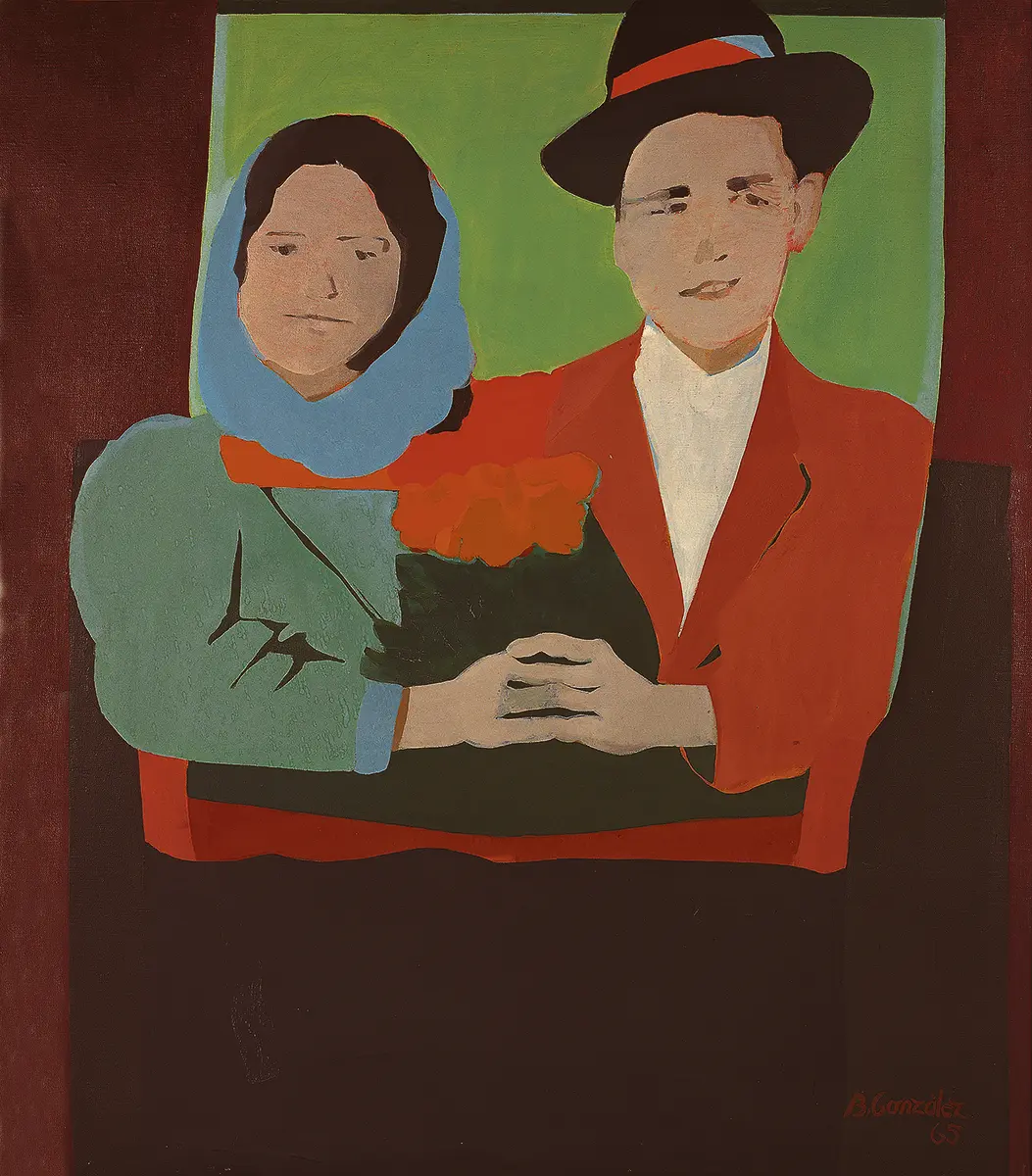
My dad was an important public figure, the President of the Coffee Growers Committee in Santander for most of his life, and when he was elected to the Chamber of Representatives we resettled in Bogotá. That also meant a shift in taste, in our way of looking at things, and when we returned to Bucaramanga, I was already six or seven. We lived in a beautiful house, where my mom had hung a number of French prints; the living room carpet had a Cubist design and our furniture was Cubist as well, a very refined detail for that place and time. In general, families there were very conservative; we were liberal, which meant that we were open to other options.
I. P.: Was the move from Bucaramanga to Bogotá too difficult for you?
B.G.: That question cuts close to the bone, because it was indeed difficult, in the sense that I had already lived in Bogotá, and had lived a good life here. But coming to study was trickier. I don’t know why, but I felt a certain dislike for Bogotá people; for no reason that I could tell you, I perceived a tendency towards hypocrisy and my entire life I had wanted to tell it as it is. I was very quiet, very shy, but when I spoke, I noticed that people laughed; I felt that here I couldn’t be like that, and I felt constrained. For two years I studied Architecture at the National University. I left because I realized that architecture was not as artistic as I had imagined. I searched long for a new career; people told me to study Fine Arts because I could draw well; since elementary school, people always said, “she is an artist!” and even my dad always told me “Come with me, little artist, let’s go see the sunset.”
I searched a lot! Choosing a career was very difficult. I decided to return to Bucaramanga; I worked making display windows for the Colombian Tobacco Company, but my boss always said, “Why don’t you go back to Bogotá? There is no future for you here.” And a friend of my father’s said to him, “Send the girl to Bogotá to study graphic design and I’ll set up a graphic design company for her here, we don’t have any.” So, I came to Bogotá to study graphic design.
In 1957 I had audited the excellent class on the Renaissance that Marta Traba taught at Universidad de América. I wanted to learn about art. I got a subscription to Prisma, which never made it to Bucaramanga. I bought the Skira collection about art. I thought, “I must study graphic design,” and after some research, I found that Universidad Javeriana offered Art and Decoration, but not Graphic Design, but Universidad de Los Andes did have that course in its Art School, so I enrolled in Art in order to study graphic design. But the school was a disaster, the professors were really bad and Hena Rodríguez treated the whole thing like her private property. My start there was not good, but I did take two wonderful classes, Art History with Marta Traba and the Humanities that were required for all students. We read from the Iliad to Thomas More’s Utopia, and that was great, and it made me happy.
However, I thought I should change careers again because there was only one Graphic Design professor, a cartoonist whose name I can’t remember. All I was able to do was one project, which he did not like. I complained to Hena Rodríguez, the program director: “Had I known it was like this, I would have stayed in Bucaramanga; this is awful.” She was furious. She reviewed my work and insisted it was incorrect. Her contributions to the arts dated from the 1930s; her time had passed. She was not the right person to helm a Fine Arts school. He had a group of mediocre professors. So, I again contemplated changing schools. I enrolled in Philosophy and took classes with Andrés Holguín and later with Danilo Cruz, and that compensated me for how bad Art had been. I lasted for three years there—six semesters studying Metaphysics. You can imagine, I felt fulfilled, but the Santanderean practice pushed me in a different direction. Because I wondered: What is the fate of a philosopher? To teach. And I thought about my mom, who was a schoolteacher, and about my aunt, Esther Aranda, a highly distinguished educator, and I did not want to be a teacher. That is why I did not stick with philosophy. Fortunately, when I was in my third year Roda came in and the landscape changed. My experience in my third and fourth years was different. We traveled to New York with Marta Traba, we visited museums, and that trip caused a true transformation. Also, Ramón de Zubiría gave us a house inside the university, and that space became the place where we painted, went to class, had lunch, and painted again; there were five of us, including Camila Loboguerrero, Gloria Martínez, Anita Murillo, and Elisa Gómez. We competed with each other… Who was the best painter…
I.P.: In the 1960s, when you started gaining visibility, reactions to your art were contradictory. There were some, like Obregón, who referred to you as the painter of the future, while critics like José Gómez Sicre, for example, were resistant, despite the fact that you created works as emblematic as Los suicidas del Sisga (The Sisga Suicides). Did you feel this duality in the response to your work?
B.G.: I was aware. In an interview with Marta Traba, I said that my work couldn’t circulate in Europe, other than as a curiosity. I felt—and this even though I’d already made furniture—that I wanted to do something different. I was in favor of originality just as originality was falling into disuse. I wanted to do something different, but I did feel the pressure. For example, in my first group exhibition after graduating, from the Sociedad Económica de Amigos del País, I realized that my work was clearly different. There we were praised by Jorge Moreno Clavijo and Adalbert Meindl. Not by Casimiro Eige, though; I noticed, and it was clear that he had not liked my work at all.
I was always the transgressor; Beatriz González, the controversial artist; I was repeatedly saddled with that adjective. I didn’t like the word controversial all that much. Nevertheless, I began to win prizes with Nirma Zárate in Cali, at the Women Artists’ Salon, and later at that Salon where Obregón said I should have been the winner (It was the Intercol Young Artists Salon), I was given a Mention. Another juror, Gómez Sicre, didn’t want me to get it. Obregón had to fight for it—he loved the work. When he said that, it was a revelation. Imagine that! To have Obregón say that about you! But it was difficult to think of doing something different because many continued with a pseudo-abstraction with Obregón’s own work as a point of reference. The group of Luciano Jaramillo detested me; so did Jorge Zalamea. When I won with Los suicidas del Sisga, a number of very aggressive articles came out against my painting. I was aware I was swimming against the current.
I.P.: Even when you worked with the images of heroes, the accusation that Arturo Abella made against you—on TV and in El Siglo newspaper—that the prize you won at the 19th National Artists’ Salon was plagiarism, of a painting by Figueroa.
B.G.: That was interesting, because Botero had already painted his Giocondas, yet the accusation came when I made those heroes. Colombia’s national heroes cannot be touched. The fact that I painted them in such forceful colors and with deformities in their faces did not sit well at all with that man, so he accused me of plagiarism on the front page of his paper. Can you imagine what I thought? I didn’t want my parents in Bucaramanga to think that of me. But Hernando Santos defended me well in El Tiempo, and so did Marta Traba, and I wrote to wonder how was it that Botero was allowed to do versions of the Mona Lisa, but I was not allowed to paint national heroes.
I.P: From that point on, an important process started in your work: a growing interest in news photography and the discovery of images that prod you in the direction of folk cultural practices, exploring the social variations of taste.
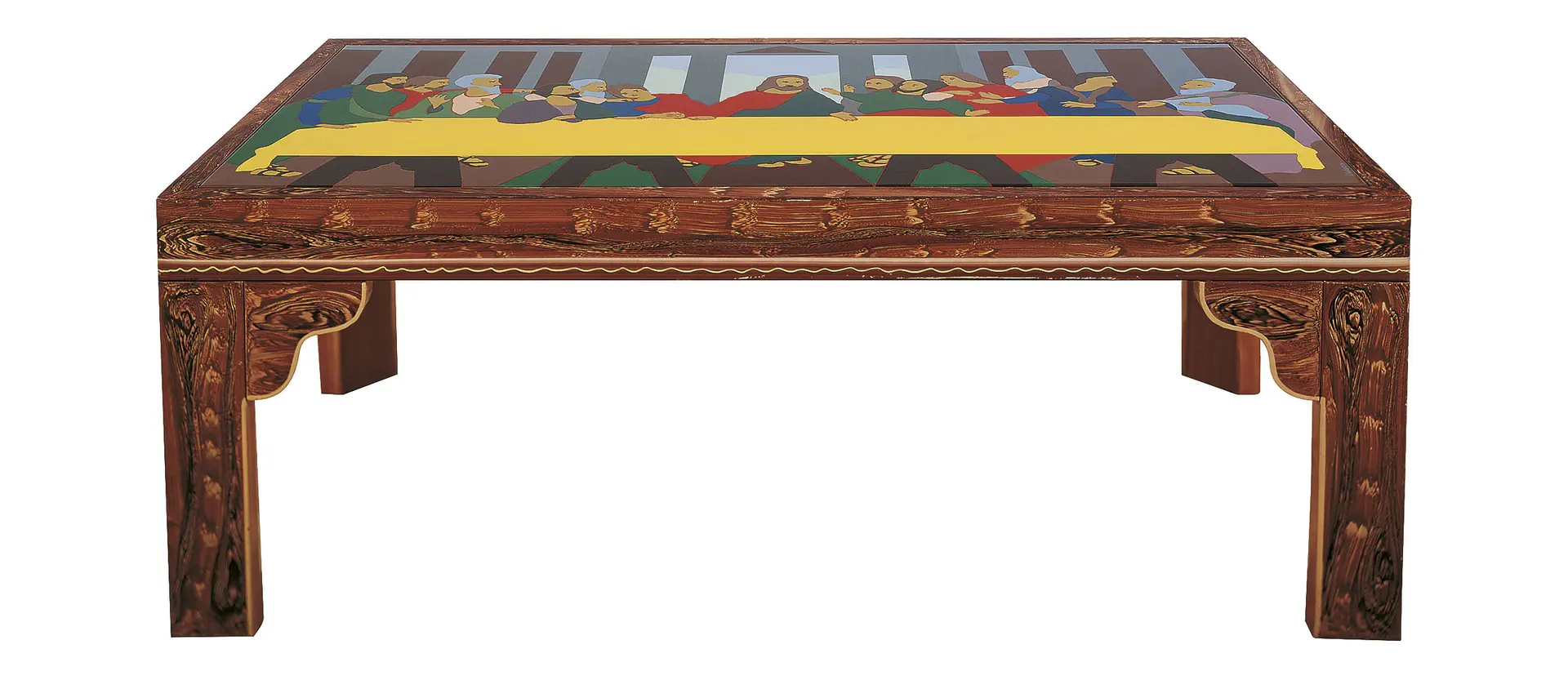
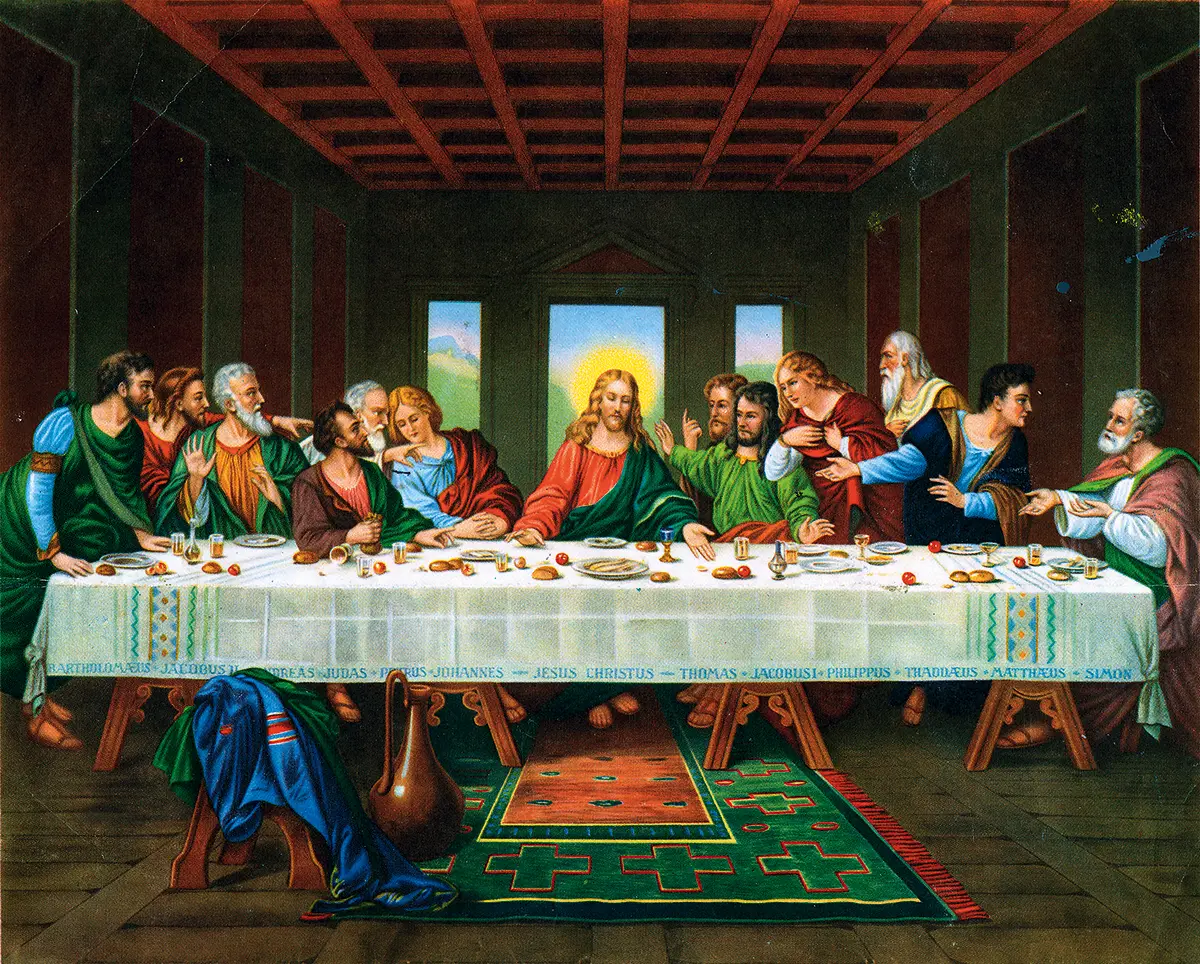
B.G.: I was very clear about that. I don’t know where those ideas came from, in philosophy I didn’t get to the study of Kant, I was stuck on Plato. We spent three years with Danilo, studying Plato. I came up with those ideas about taste because, as I told you, since childhood the issue of good taste, of refinement, was very present via my mom. Her admonitions about bad taste perhaps made me reflect on taste in general. I said, “I don’t care whether it is good or bad taste, what I want to know is why people surround themselves with these objects.” That was a key formulation: Why do they surround themselves with those objects? What is the reason? In São Paulo, when I brought my furniture there, they were aghast. The jurors were Barney Cabrera’s age, and they thought it was terrible. Some journalists in the city supported me and said, “This is great, this is will win First prize,” but in the end, that wasn’t the case. My furniture was the only colorful thing that time at the Biennial. Everything else was black and white and there was a lot of conceptual art. So during a guided tour of my work, I said, “I could have set out to create conceptual work telling you ‘Come see my hairdresser’s home’,” but that does not interest me; what I do is furniture using Leonardo’s Last Supper, which is found in every home, and I do it as a common furniture item. I think I was a pioneer in Colombia in terms of thinking about folk or plebeian taste, and that’s why I caused such a stir.
I.P: The furniture and the curtains for a time had you exploring images from Western art. Those images have great weight there. On the other hand, there was a powerful irony when you sold your 10 metros de Renoir (10 Meters of Renoir). How do you see all that?
B.G.: That begins by chance. The painting I was working on,
Señor Caído de Monserrate (Fallen Lord of Monserrate), was the same size of a bed we had purchased with no purpose. Going with my husband to inspect the material, then seeing the bed, buying it, bringing it home, and realizing the coincidence when I placed the canvas on it—that was like magic.
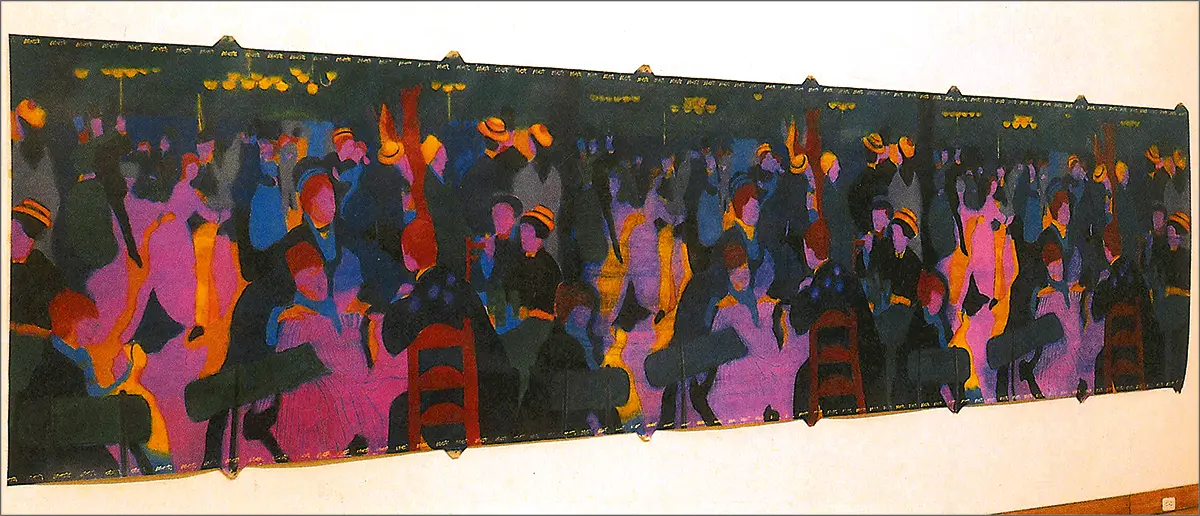
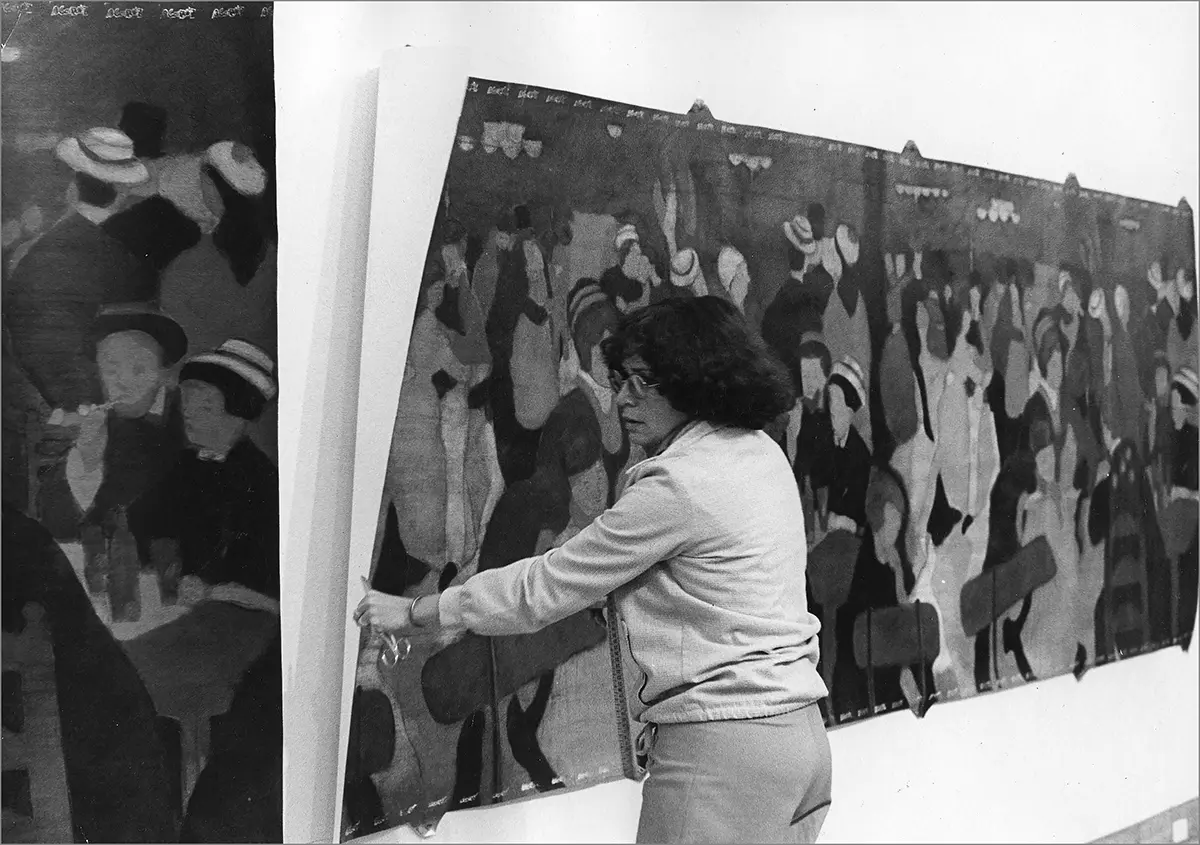
At that time I already had the precedent of paying attention to ads, with an attitude similar to that of Pop artists of the 1950s who walked around London and noticed that they liked things they didn’t find in museums. For me, seeking out things that were deemed bad taste, like the fake wood made using paint in the case of the beds, really was a whole process. I like that you ask about the curtains and all that, because they came up along with the furniture, and there came a point when the objects themselves asked me for changes. When I saw Le Déjeuner Sur l’Herbe inside a Jiménez Avenue food shop, it triggered a process that took me to the 10 metros de Renoir, because the 10 metros de Renoir was really a 10-meter roll of paper that Luis Caballero had given me as a gift, on which I started to repeat and repeat the work until the end It had a beautiful color, and so when I place it there, at Alonso Garcés Gallery, I told Alonso: “I am going to sell it by the centimeter,” and he thought that was brilliant. And people coming to the studio would ask what I was going to do with it, and I answered “I am going to sell it like Coltejer and Fabricato sell their fabrics, by the centimeter,” and they said, “Well, and how are you going to sign it?” “Upper corner and lower corner, like a canvas.”
There are some who call this a premature performance because I came in and said: “Bring me the golden scissors that Pastrana got to inaugurate the Coltejer building.” Alonso brought me scissors, I started measuring and cutting, and people said, “She is crazy, don’t let her damage the painting, ask Banco Popular to acquire it.” And I kept going: “How much do you want? Five centimeters? Seven?”
This work is the culmination of that whole process with the history of art. I had to destroy it, and even though later I did the Guernica because I already it had it in my mind and I had to do it, that moment when I cut the work with scissors was the end, not a single work of art more.
I.P.: To speak of the issue of violence in Colombian art is to speak of a vast range of diverse responses on the part of artists. What drove you to set aside humor and irony and to approach this dramatic reality in your visual work?
B.G.: I think it was the burning of the Justice Palace. The burning of the palace… You can imagine how it looked from my home, so close to that building. It was impressive. I was not in Bogotá when the building was first seized, I was giving some lectures in Pasto. I heard things about the M-19 but it was only when got back home, very tired, that I turned the TV on and saw a military tank entering the Justice Palace. I thought it was a movie. When I realized the gravity of what had happened, I thought: “They burned Justice.” I became obsessed, and I said to myself: “I can’t keep on laughing.” I had laughed my way through the Turbay administration. I had also laughed plenty at Belisario, but at that moment when they were all there, the ministers and the functionaries next to Belisario, everything changed. This is a farce, this is a wound. “What is this? What is it that I am feeling?” It is as if a curtain had been raised, and I began to see the entire situation of violence that the country was experiencing. So at that point, I made the decision of being very clear, I knew we had to protest and rally, and to show the terrible things that were taking place in Colombia.
I.P.: Starting in the 1980s, your interest in the history of art turned you into an observer and researcher. Why the Nineteenth Century?
B.G.: In 1976 Emma Araújo became Director of the National Museum. She called me and asked me to join her team, and I became part of a committee that included, among others, Eugenio Barny Cabrera, Acuña, and Eduardo Serrano. That when I discovered the marvel that is Espinosa’s drawings and got interested in the Nineteenth Century. A century that produces a draftsman like him is not just any century, so I started to investigate the Botanical Expedition. I had already written about Humboldt for the Congress of Americanists, but at that point, I realized that more research was required, and I began with the caricatures and holding exhibitions.
In 1984 they called me from Banco de la República to join a committee, organized by Juan Manuel Ospina, of people who would advise the collection. I began to do caricature schools at the Bank with Grosso and the young caricaturists of the time, the graphic humorists; those eight volumes on the subject came out and that furthered my interest in the Nineteenth Century, especially in the Botanical Expedition.
I.P.: Besides your work as a researcher, there is an interest in two different aspects: teaching, and the role of museums in the art field. Based on your experience, what are the main roles that museums must play?
B.G.: This might sound too old-fashioned, but I think that museums should promote more their education systems because hanging artworks on a wall are one thing, but creating coherent, movie-like scripts that can attract people is something else. I understand that museums have little money and that the Ministry of Culture doesn’t seem to care that they work in education, but since I started at the Museo de Arte Moderno in 1971, I understood what the approach was and began to search for strategies. I call them strategies in the sense of how to hook the audience and reel it in. It is like that, isn’t it? To make people see, to free them from their armor. Remember, Marta Traba’s struggle in that direction was fierce. Today there are those who attack her efforts, but they don’t realize what the country was like and how rigid people’s attitudes were with regards to art. Marta ran against the Berlin Wall and brought it down; bringing that wall down and helping people get closer to the arts was the main priority.
I followed that idea, in a way, and, as I was saying, I began to invent strategies to expand the audience base in the museum, informing people of what they would see beyond just distributing a leaflet. Meanwhile, museums have two or three specialists, when they should involve the entire staff: offer training, inject curiosity, because it is not about having a handful of bureaucrats.
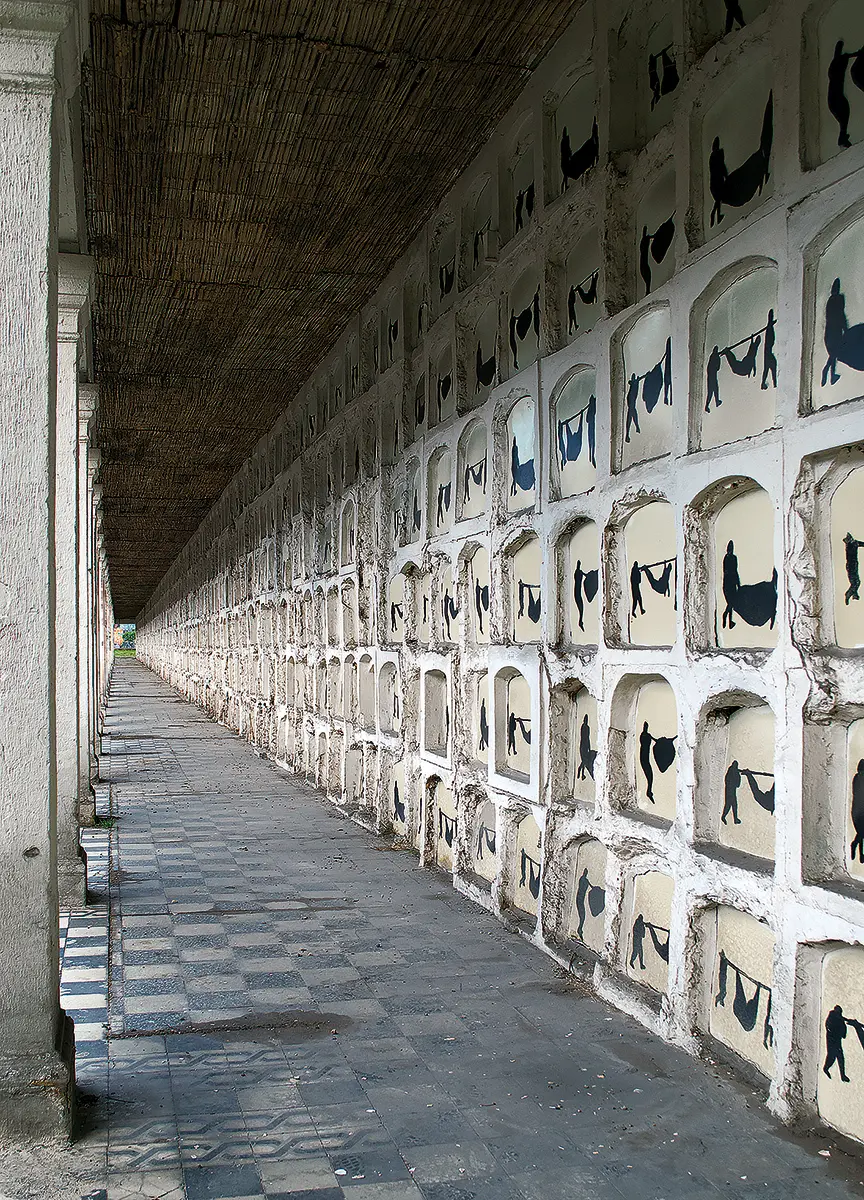
I.P.: In your more recent work, an interest in salvaging collective memory is very present. For instance, we could cite the intervention at the Central Cemetery as a reference. Are you worried about the loss of what could be considered ceremonial sites?
B.G: That was in fact the intention at the cemetery. When I learned that the cemetery was going to be razed to build a soccer field and a skating rink in its place, because it was the working-class cemetery, not the one for dignitaries and presidents, I was shocked and called Doris Salcedo. That phone call was a good idea; it prompted Doris to launch a crusade to save it. There really is a number of buildings one would like to remain there forever, and they are important, not because of the quality of their architecture but because they are inscribed in memory. I say that people forget that the death of April 9 is there; we forget that poor people come to the cemetery and remember their relatives. This is why the work is titled Auras anónimas, (Anonymous Auras), in memory of all those who passed through these structures. To be able to recreate the nearly ten thousand gravestones was a kind of testimony based on repetition. I believe strongly in repeating things for a country with no memory. We have to repeat; history must be told and retold in different ways, and we need to persist.
I.P.: Despite the changes in your painting throughout your career there is something that is always present: it is as if each one of your works wanted to provide an account of a piece of history. Is that the case?
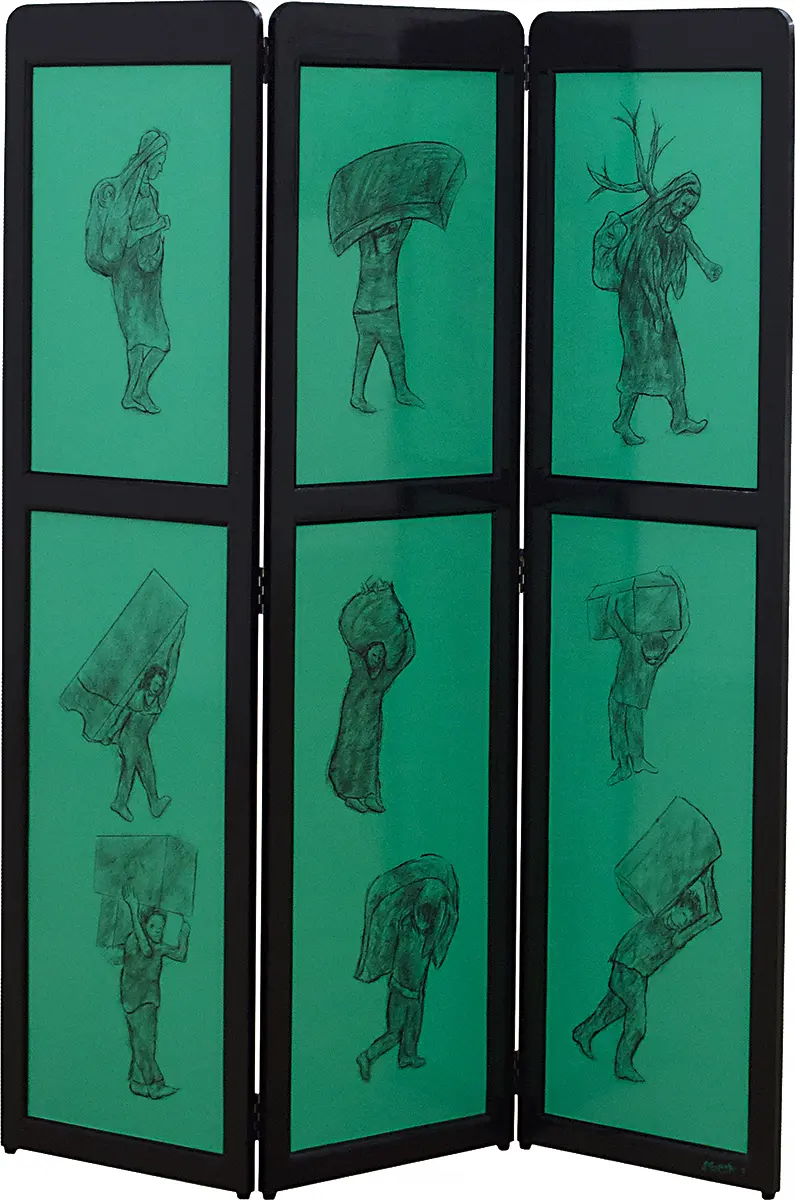
B.G.: I could put it all together for you like a giant puzzle because from the start with Los suicidas a pattern was set: there is memory there, and there is image… This idea of finding images in newspapers and giving them permanence. The terrible thing is that press photographers are outstanding, yet their work ends, it is evanescent. The next day, it is gone, nobody remembers it. My mission—I feel it as a mission—is to take that from photojournalism, keep it in an archive, and work it in my own way so that, to an extent, it remains. It is like a maneuver I do with the image. Like playing.
I.P: When we think about what will be the trajectory of your exhibitions this year, France, Switzerland, Germany, Greece, Spain, to mention some of the countries where your work will travel, the question arises: What happened to the definition you gave of your painting as “an underpainting for underdeveloped countries with long histories.” What changed, in your view?
B.G.: As I said before, my art circulated as a curiosity, and all I know is that I haven’t changed, I am still doing the same things, with different possibilities. However, and despite the fact that I don’t like to speak of globalization, I believe that this discovery people are making of my work has a lot to do with a curiosity about archives. For whatever reason, the cultural world is intrigued by archives, and I started researching and creating archives in order to do my work; in this way, that interest of mine that materialized into works of art now coincides with more widespread interest. Because, look, first comes to Athens, then Documenta, then Documenta Kassel, then an exhibition in Zürich; then come two exhibitions, one in Nîmes and another one in Arles; then in Frankfurt; and after that an exhibition in Bordeaux that will later travel to the Reina Sofía and to the KB in Berlin. Next year we will start the exhibitions in the American series, which will start in Miami and might go to Houston and Mexico.
I.P.: I think it may be difficult for you to say it, but what one feels exploring your work is that it contains a large number of elements that anticipate future developments in Colombian art, that in a way you anticipate in your works things that will later be assimilated and reworked. Perhaps this is why there was an element of surprise, or rejection, or shock in the response to what you were doing, but looking at the works now we feel that you were ahead of the times.
B.G.: That has happened often, and I have even identified interesting things around that, for instance, the time I found a picture of John Paul II; I had with me the hat used by Luis Alfred Jiménez, the Mexican singer, which I put on the Pope’s head for a silkscreen. This was in November. I was very surprised the following March to see the Pope during a visit to Mexico, sporting a large Mexican hat. I kept saying, “But I made that already, I saw it first.” That is an anecdote, but it goes to show that anticipation of certain events; I don’t know whether it is random chance or other things, more difficult to define.
I.P.: Of course, but I also think that your works are anticipatory from the standpoint of artistic proposals in themselves, and that might be why they were difficult to understand in the local context.
B.G.: And they were shocked because I for sure wanted them to be shocking, you must be clear about that. I wanted to bother people. With my work of the 1960s, I wanted to bother people, and when I decided to paint on metal, that was also my intention, to have people reject my work, I liked that. When the jurors in São Paulo were disgusted, I enjoyed it. There was a certain type of people I wanted to shock. I identify myself with Débora Arango; she had the same transgressive attitude. There was a desire to push the boundaries, to do things that were different. And I think that it is in part due to my characteristic of being a shy person; I think that all shy people want to transgress and make others uncomfortable.
* Courtesy of the artist and BADAC Banco de Archivos Digitales de Arte in Colombia, Universidad de los Andes.
IVONNE PINI
ArtNexus executive editor. Professor Universities of Los Andes and Nacional de Colombia.