This exhibition brings together twenty international artists to engage the idea of place and the cultural markers it establishes in a world that constantly dislocates our relationship with the territory.
The geographical span represented by the roster of participants is suggestive of the regional, international, and global exchange that characterizes contemporary art: Allora & Calzadilla, Jonathas de Andrade, Taysir Batniji, John Bock, Mónica Bonvicini, Abraham Cruzvillegas, Mario García-Torres, Carl Michael von Hausswolff and Thomas Nordanstad, Mathilde ter Heijne, Sanja Iveković, Brad Kahlhamer, Los Carpinteros, Paulo Nazareth, Rivane Neuenschwander, Walid Raad/The Atlas Group, Alex Rodríguez, Santiago Roose, and Do-Ho Suh.
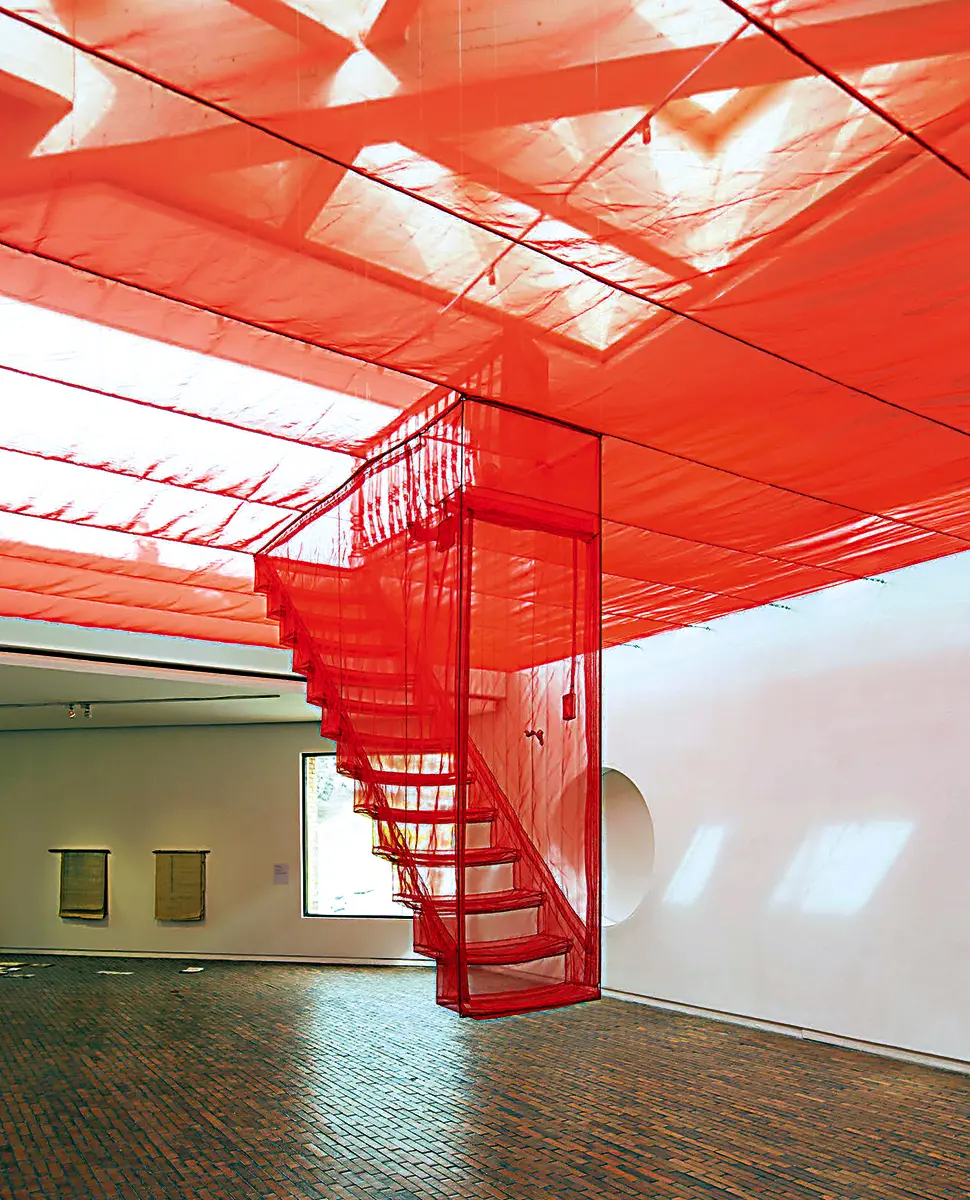
The exhibition, featuring works of contemporary art from the Thyssen-Bornemisza Foundation’s Art Contemporary collection (TBA21), opens with the installation Staricase-V (2009), by Do-Ho Suh, a replica in translucent red polyester of the staircase in the artist’s New York apartment. It is an effective start, as Do-Ho Suh’s ghostly replica of the staircase evokes the idea of delocalization and operates as a thematic framework for the exhibition as a whole, and because in becoming the axis for the spatial arrangement of the selection of works on display, the museum’s own space is reconfigured.
Here, the notion of place operates above all in spatial terms. A series of works for outdoor spaces have been distributed in various areas of the museum that, given their specific architectural characteristics, impose different conditions of visibility and foster differentiated modes of interaction with the audience.
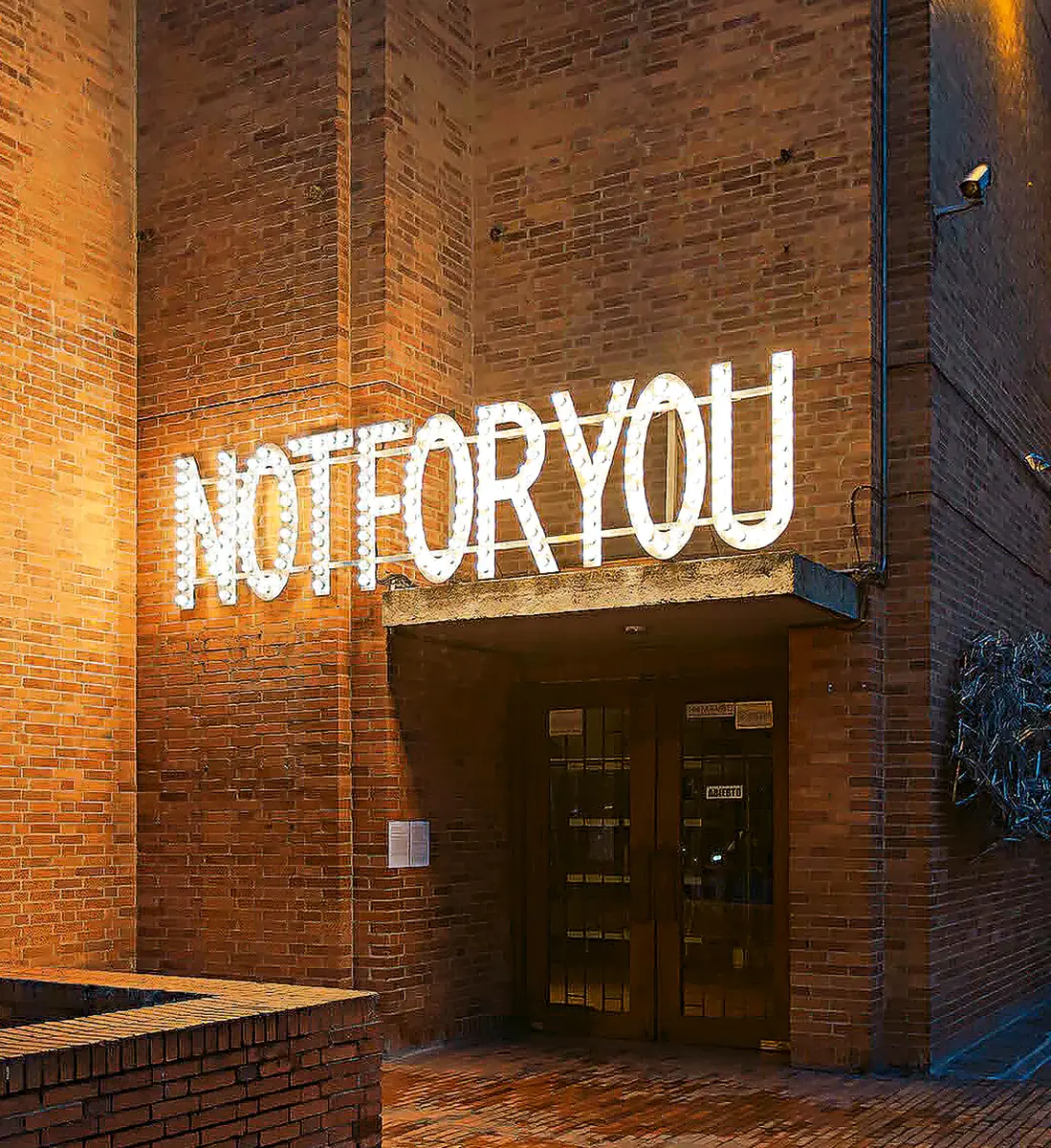
Thus, for example, Mónica Bonvicini’s NOTFORYOU (2006), a lighted sign announcing that its message is not addressed to us, is exhibited on a sidewall in the exterior of the building, where it is not visible for visitors inside the museum. Moreover, it can only be viewed from the garden. This is not a minor detail, since it frames the message in terms of public and private space: the garden is part of a municipal park, free and open to the public, while the museum is a private institution charging an entrance fee.
Something similar happens with Autorretrato fronterizo y chispeante abrazando el retrato de Gilberto Bosques, escuchando pirekuas y tragando esquites afuera de la catedral (Self-portrait as a sparkling frontiersman embracing the portrait of Gilberto Bosques, listening to pirekuas and gulping down esquites outside the cathedral, 2014), by Abraham Cruzvillegas. Installed in the museum’s pond, the work can be seen both through the gallery’s large picture window and from the garden. This inside/outside dialectic, relative to architecturally enabled points of view, refers to the public, the private, and the points at which both poles meet.
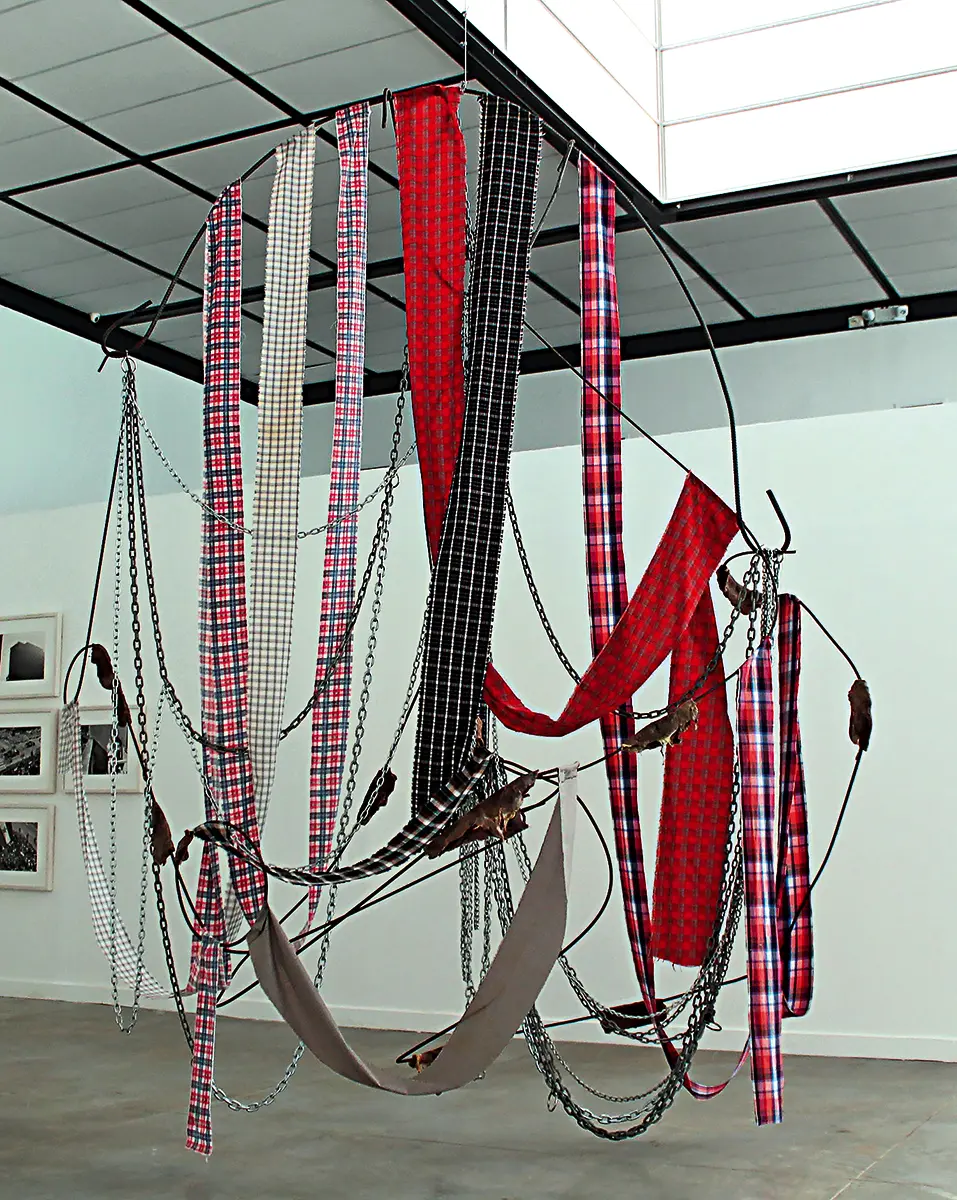
The same logic of location was used for the placement of another work by Cruzvillegas, his Autorretrato queriendo ser Fray Tomás González y escuchando abajeños con la banda de Zacán, incapaz de comunicar la frustración de no poder reconocerme como un narciso iracundo, pobre, obediente, casto y para acabarla de chingar, desplazado (Self portrait attempting to be Fray Tomás González, listening to abajeños with the Zacán band, incapable of communicating the frustration of not being able to recognize myself as an irate, poor, obedient, caste, and, for the final fuck all, displaced Narcissus, 2014), which has been situated in an intermediate area: the entrance patio. These works by Cruzvillegas, made from found materials, allude to self-construction and the precariousness that drives it, contrasting with the surrounding environment and the discourses (even the real state discourses) that undergird and enable all cultural institutions.
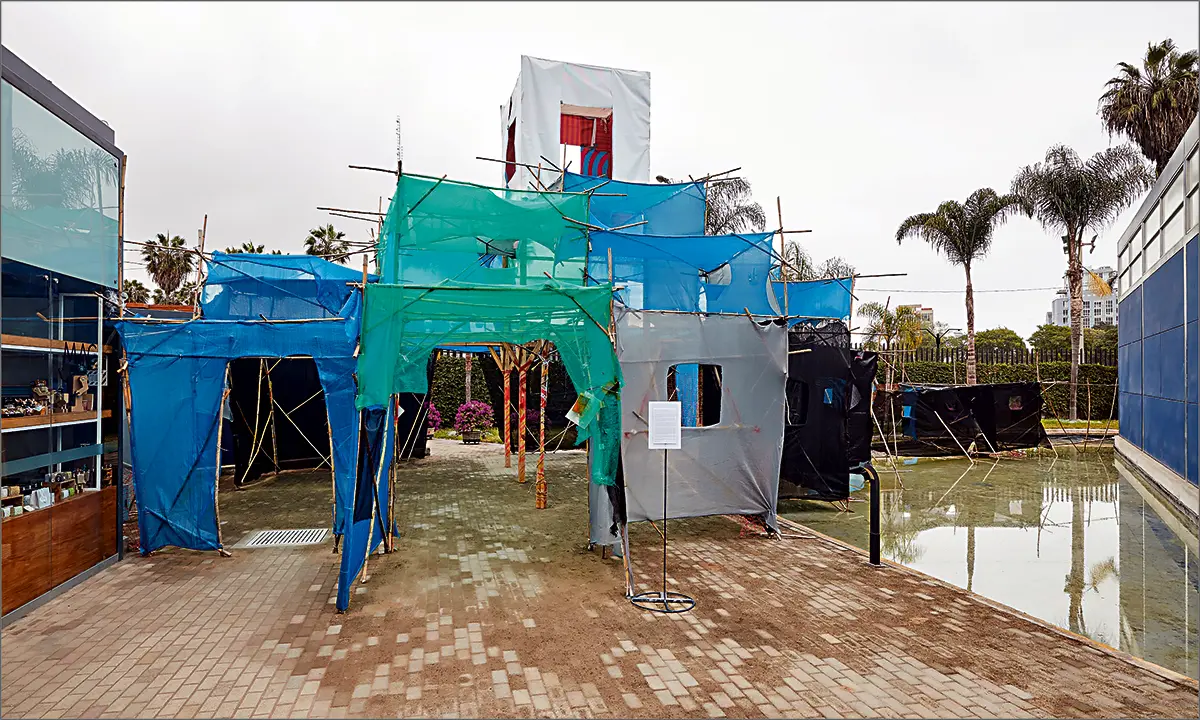
Some of this is also present in the installation presented by Peruvian artist Santiago Roose, Determinaciones socio-territoriales: Colonia (Socio-Territorial Determinations, 2017), located in the entrance patio next to the pathway to the museum’s administrative offices. Roose’s complex three-level construction, made using reeds, wood, and plastic fencing, brings to mind, on the one hand, the precarious lodgings built in poor neighborhoods, and on the other the ambitious architectural projects that have driven the process of gentrification now underway in the area where the museum is located, where prices by square meter are among the highest in Lima. At the same time, while touching on both economic extremes, Roose’s work brings to the fore the total absence of urban planning—be it with or without permits, with or without high-end financing—that characterizes the city.
Also by Santiago Roose, Tierra ebria (Inebriated Earth, 2017) is an installation in the form of a stepped dirt pyramid atop which are various tools, a beer case, and bottle caps, and whose base is surrounded by empty beer bottles. This work makes reference to construction work and its rituals (for instance, the traditional shared drink when the roof is finished) as well as to Peru’s agricultural roots (the pyramidal structure has the shape of the cultivated terraces used throughout the Andes since ancient times).
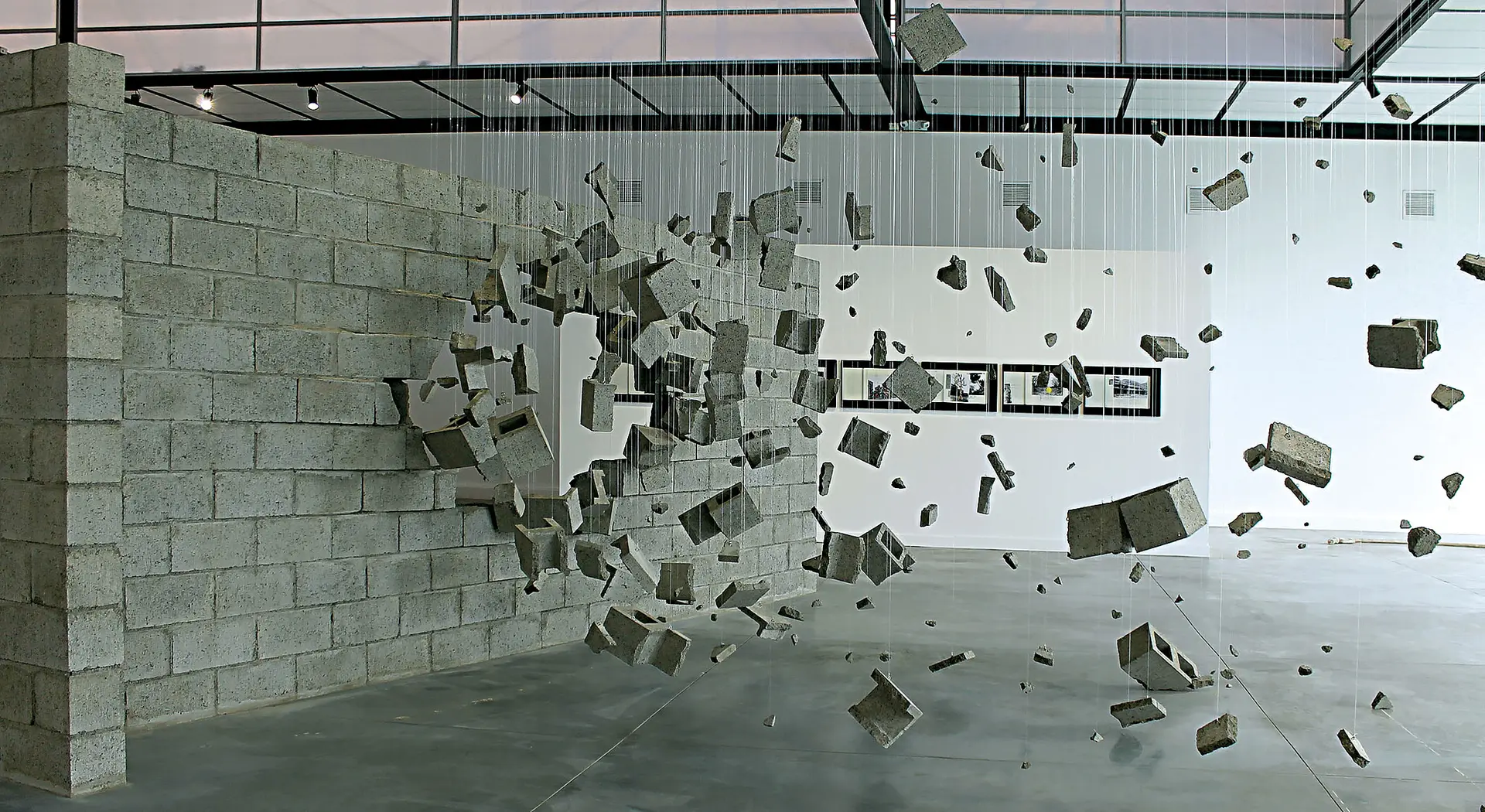
Another work set advantageously in the museum space is Frío estudio del desastre (Cold Study of the Disaster, 2005), by the Los Carpinteros collective. It is a brick wall in the midst of an explosion, its fragments suspended in the air as though the fleeting instant of its destruction had congealed in time. There is, however, no trace at all of whatever broke the wall. Placed in parallel to the museum’s large window, it can be seen from outside and, even more importantly, the museum can be seen through it, so that other works on display are partially visually accessible from the park.
The video Golden days (Remedios, Colombia, 2012) (2013), by Carl Michael von Hausswolff and Thomas Nordanstad, explores the issue of gold mining in Remedios, Colombia. With its vibrant images, sound effects, and its use of voices, this work contrasts the miner’s surroundings, the locations social landscape, and the chimeras of gold, all particularly resonant in Peru given the weight of mineral exploitation in the country’s economy, and the social and environmental ravages that informal mining has produced in the Amazon basin region.
Ecological themes also appear in Petrified Petrol Bomb (2010) by Allora & Calzadilla. This work replicates a gas pump in fossil-rich limestone, giving the idea of a fossilized dispenser of fossil fuels. In other words, Petrified Petrol Bomb appears to be imagining the remnants of the modern world as they will survive in a post-human world, paradoxically preserving the lifestyle that did away with our world.
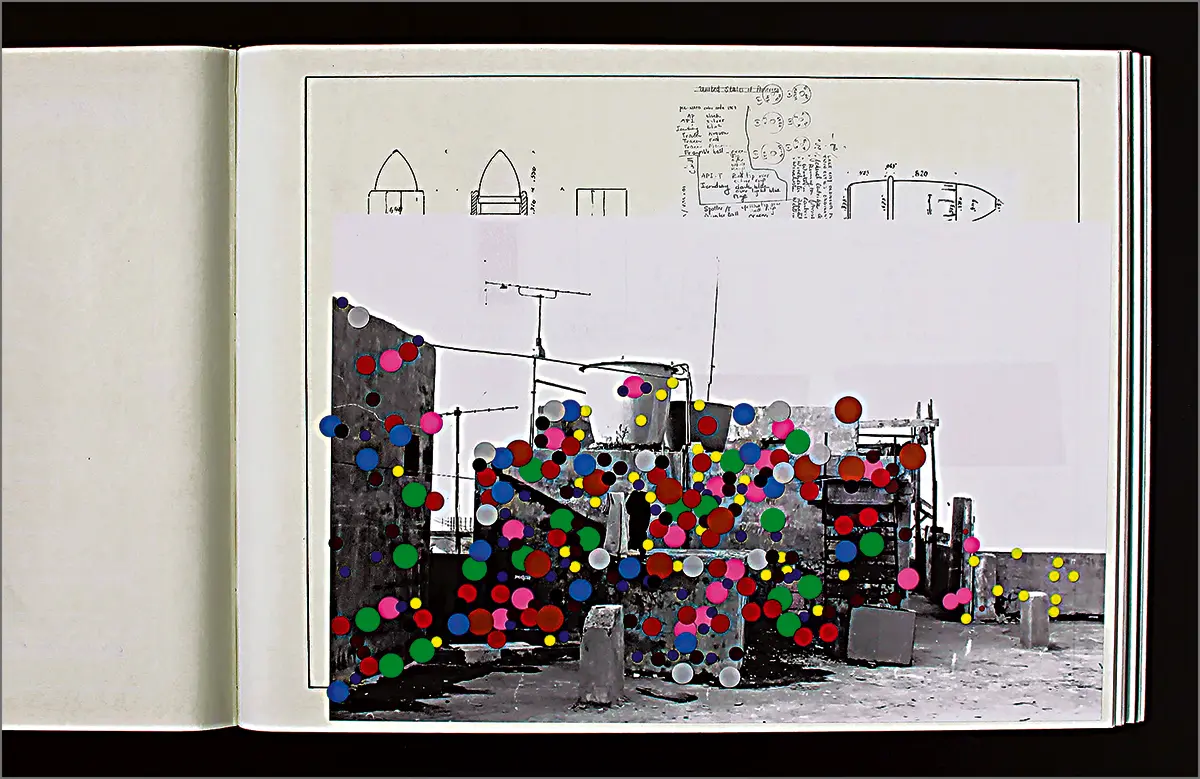
The idea of death is also present in Let’s be honest. The weather helped I (1998-2006), by Walid Raad/The Atlas Group. It is a series of prints reproducing pages from notebooks recording the traces of political violence in Beirut. The images document bullet holes on the walls, using the standard color codes that determine the ammunition’s country of origin. In this way, design patterns are created that both illustrate the violence and abstract it visually.
Violence and displacement are clearly paired in Taysir Batniji’s GH0809 (2009-2010). Starting with a fictional real estate agency supposedly selling properties in Gaza that were destroyed during the 2008-09 war, the artist speaks about the forced displacement of populations and the limitations to their mobility—Batniji himself is barred from returning to his country. In this way, his work reveals how the nation and home are places whose boundaries are political, not geographical.
This idea of boundaries is also present in the work of Jonathas de Andrade. His video O Levante (The Uprising, 2012) records the first-ever horse-drawn cart race in the center of Recife (Brazil), the organization of which required a pretext and a legal loophole: the making of a film. Only within that fictional framework was the artist able to secure the necessary permits for the race, as there was no official way to do it otherwise for a government bureaucracy for which the pre-modern aspects of rural life are no longer visible.
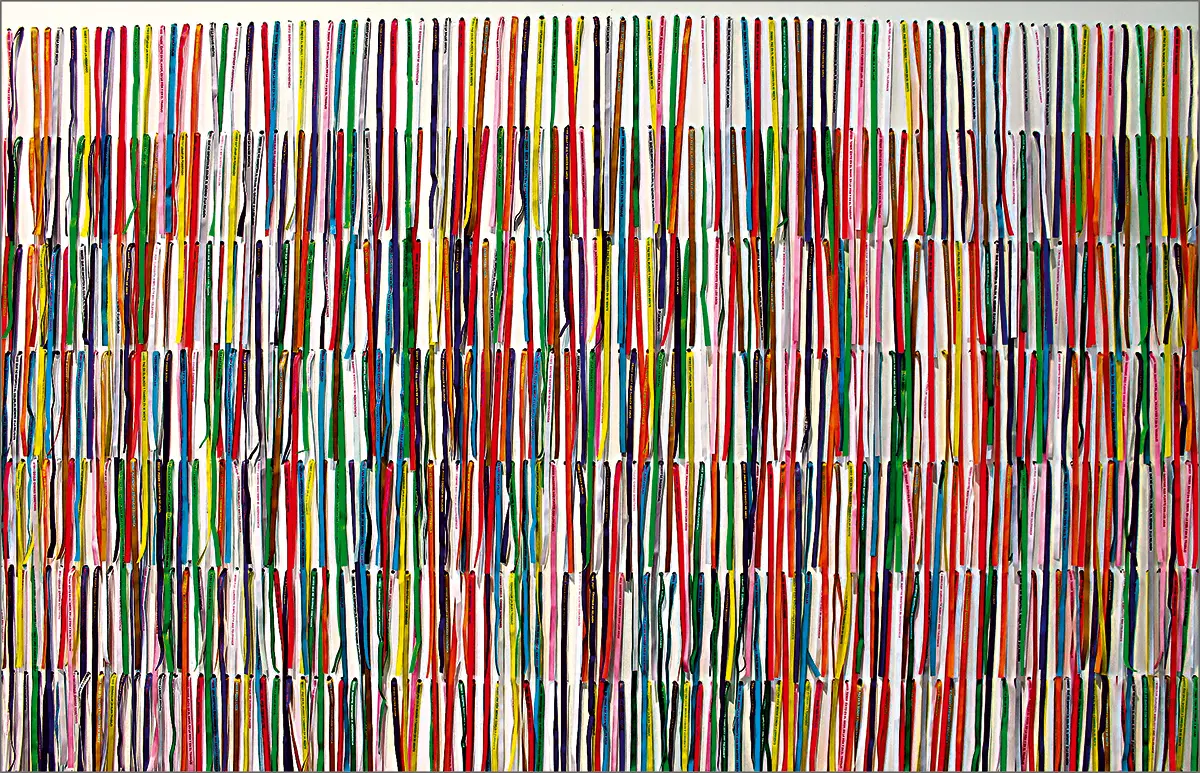
Rivane Neuenschwander, meanwhile, records the emotional territory of hope in her installation Eu desejo o seu desejo (I Wish Your Wish, 2003). Hanging from a large wall are hundreds of multicolored ribbons with wishes printed on them, an echo of a tradition of the Our Lord of Bomfim Church in the Brazilian city of Bahia, where the faithful tie such ribbons around their wrists to have their wishes granted. The artist proposes a kind of wish exchange: when one takes a ribbon with someone else’s wish (Neuenschwander collected them from sixty individuals), the artist asks that we write our own in a piece of paper, to be placed in the empty space left by the ribbon. The range of wishes highlights not only people’s different aspirations but also the different situations and contexts from which we formulate our wishes, from “I wish I had a puppy” and the stereotypical “I wish I won the lottery,” to others in a more social spirit, such “I wish for the crisis to end,” and yet others that are radically individualistic, like “I wish to live free from anxiety” and “I wish to fund a cure.”
Also noteworthy among the many works on display are those by Brad Kahlhamer, Alex Rodríguez, and Sanja Iveković.
Atopía is an interesting exhibition offering a fresh presentation of contemporary works about themes that are relevant to the current political and economic context of the city of Lima. One thing to be missed, though, is greater gender parity in the selection of artists.
MAX HERNÁNDEZ CALVO