It was during the mid-1980s, back when the actions of radical left movements in Latin America were gaining momentum, when Arturo Duclos was at the beginning of what promised to be a brilliant artistic career after his 1985 breakthrough exhibition titled Anatomy Lesson at the Galería Bucci in Santiago, Chile. The protest songs by Víctor Jara were still listened to with passion in communities of political exiles in Cuba and radical political films were screened around festivals throughout the Latin American continent. Later on, during the 1990s, Duclos would continue his international projection as one of the representative figures of the art produced during Pinochet’s dictatorship. Those same radical movements that Duclos references today through symbols and flags in Utopia’s Ghost delivered their last swan song before disappearing at the beginning of the 21st century with the expansion of neoliberal capitalism.
Utopia’s Ghost is presented in the exhibition rooms of the Museo de Artes Visuales (MAVI) at a time when those emblematic flags, slogans, and ideologies appear to have become a thing of the past by losing their initial meaning and significance. The inquiries made by those utopias and the legitimacy of the actions by radical movements of the past in the current context are showcased by Arturo Duclos in his most recent exhibition curated by Paco Barragán. The four museum galleries presented an almost ethnographic layout of those emerging symbols that, once turned into museographic objects, represented taxonomies classified in Banderas (Flags), Caporales, Escudos de Armas (Coat of Arms), Memorabilia and Machina Anémica (Anemic Crane). And finally, Cuartel General (Headquarters), a tent placed in the entrance courtyard of MAVI, served for the duration of the exhibition as a meeting place with the public and a space in which to talk about, analyze and discuss those ideals advocated by the radical left with some of its protagonists and survivors of history.
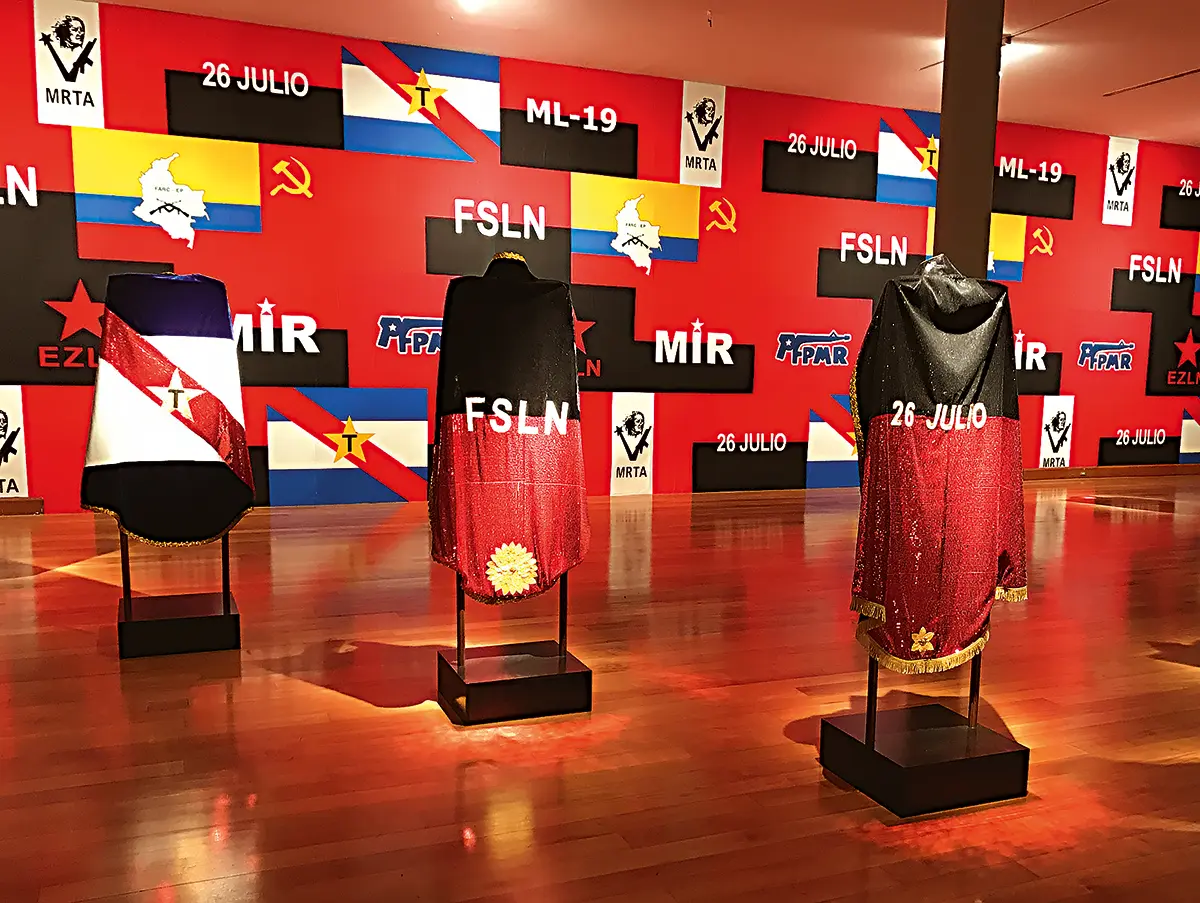
In the architectural fluidity of MAVI’s independent and yet connected exhibition rooms, Duclos painted the walls in tones that ranged from grey to blood-red in order to build a mise-en-scène with flags, logos, and symbols belonging to far-left movements like the Shining Path and the Túpac Amaro Revolutionary Movement (MRTA) in Peru, the Revolutionary Left Movement (MIR) in Chile, the Sandinista Front of National Liberation (FSLN) in Nicaragua, and even the 26th of July Movement (M-26-7) in Cuba, among others. In one of the galleries, flags became pictorial iconographic signs that were reminiscent of Jasper Johns’ gesture of appropriation of the US flag. Conversely, in other exhibition areas, Duclos formally took that gesture even further, beyond the artistic, by presenting the insignias and symbols like product brands; displaying in his fantasy some old revolutionary flags like logos of some product, as if they were perfumes or fashion clothes. By playing with the design and symbology of emblematic signs, Duclos merged the brand aesthetics with already obsolete flags.
This Chilean artist once again relied on the use of engraving in advertising as a strategy to occupy semantic structures that displace painting and question its identity as a discipline in order to make a comment on the contextual political reality. The repetition of the mechanical reproduction of the symbol goes back to the question of whether art continues to be an immediate, interpretative significant, or if it is just part of the same advertising agency used in both political and sports campaigns within the world of entertainment, where they appear as the background for the presenter or star of the moment.
Likewise, Duclos uses the flags of revolutionary movements and takes them into the world of design in a way that is reminiscent of the presentation walls for business logos in the world of entertainment—they are also transformed into costumes used in the Caporales. The caporal capes serve the double purpose of appearing as the capes used in Andean dancing parties and religious processions—like those in Tirana, in northern Chile, or in Bolivia—or as those used by high-ranking military officers. Duclos’s proposal of transforming the flags into a clothing item designed in a carnivalesque or kitsch fashion—using a combination of sequins, golden embroidery, velvet, and tinsel—call into question the idea of a revolutionary movement that pushes the symbolic boundaries between the military and religious spheres. The Escudos de Armas (Coats of Arms) also evidenced the same transculturation strategy present in Andean popular imagery, but incorporating objects from several realms—like the private home environment with its embroidered tablecloths and weaved ponchos, or personal spaces with teddy bears combined with preserved animal skins, flowers, tools and paintings of the symbols rendered like heraldry.
Infused with all the symbology of the ultra-left movements, the ghost of utopia here became part of a performance in which the historical past was projected on today’s reality. In this manner, the exhibition concluded with Memorabilia and Machina Anémica, works in which the biographical historicism on the subject of utopia was contrasted through the installation of white flags that barely showed any of the movement or life generated by the action of fans. The mockup of a monument to all insignias and flags, which appropriated the architecture of Lenin’s Mausoleum, along with the video Polvo de Estrellas (Star Dust)—showing a performance in which Duclos destroys a human skull until turning it into dust—closed the cycle that began during the 1980s with his Lección de Anatomía (Anatomy Lesson).
Just after a little, less than thirty years have gone by, and following a series of political and economic readjustments in Latin America, when the radical left groups have been assimilated into the so-called pseudo-democratic political organizations and parties, and in the context of a carnivalesque implementation of tropical interpretations of socialism, the exhibition by Arturo Duclos from its title takes us back again to the question of whether art can play a legitimate role in intervening and questioning the avatars of politics and the failure of utopias. This time around, the ghost does not hover over Europe, but persists and continues to be projected as an uncomfortable presence in the ambivalent reality of Latin America, sometimes appearing as Hamlet’s dead father claiming for vengeance.
DERMIS P. LEÓN