During a recent trip to Guatemala, I had the pleasure of seeing the exhibition by Guatemalan artist Antonio Pichillá titled Grandparents at the recently inaugurated Galería Extra in Guatemala City. The space of modest dimensions echoes other galleries in the city dedicated to contemporary art like Proyectos Ultravioleta, The 9.99, and Sol del Río. The desire to share the production of living artists—and any other similar initiative within the Latin American region—is of course welcome.
Antonio Pichillá’s artistic career spans over a decade and focuses on the development of inquiries connected both to western traditions of the so-called “abstraction” as well as textile traditions from his Mayan family history. Having recently received the Juannio Award (2017), an important recognition for Guatemalan artists, and having participated in three editions of the Arte Paiz Biennial (2002, 2010, and 2014), his work is becoming increasingly more appreciated as his institutional acceptance grows. Therefore, a solo show represents a welcome challenge and a good opportunity to showcase his explorations in a thoughtful manner.
Taking into account the commercial nature of the gallery, it is understandable that Pichillá chose to favor his more objectual works over the installations that had been more predominant in previous exhibitions. According to the text by Alexia Tala, the title of the exhibition, Grandparents, speaks about the connections with the past through the materials employed in his work. Pichillá’s formal intelligence became clear as one walked through the exhibition space; the works did not exceed the boundaries of the average human body and clearly conveyed Pichillá’s experience exploring highly subtle geometric drawings.
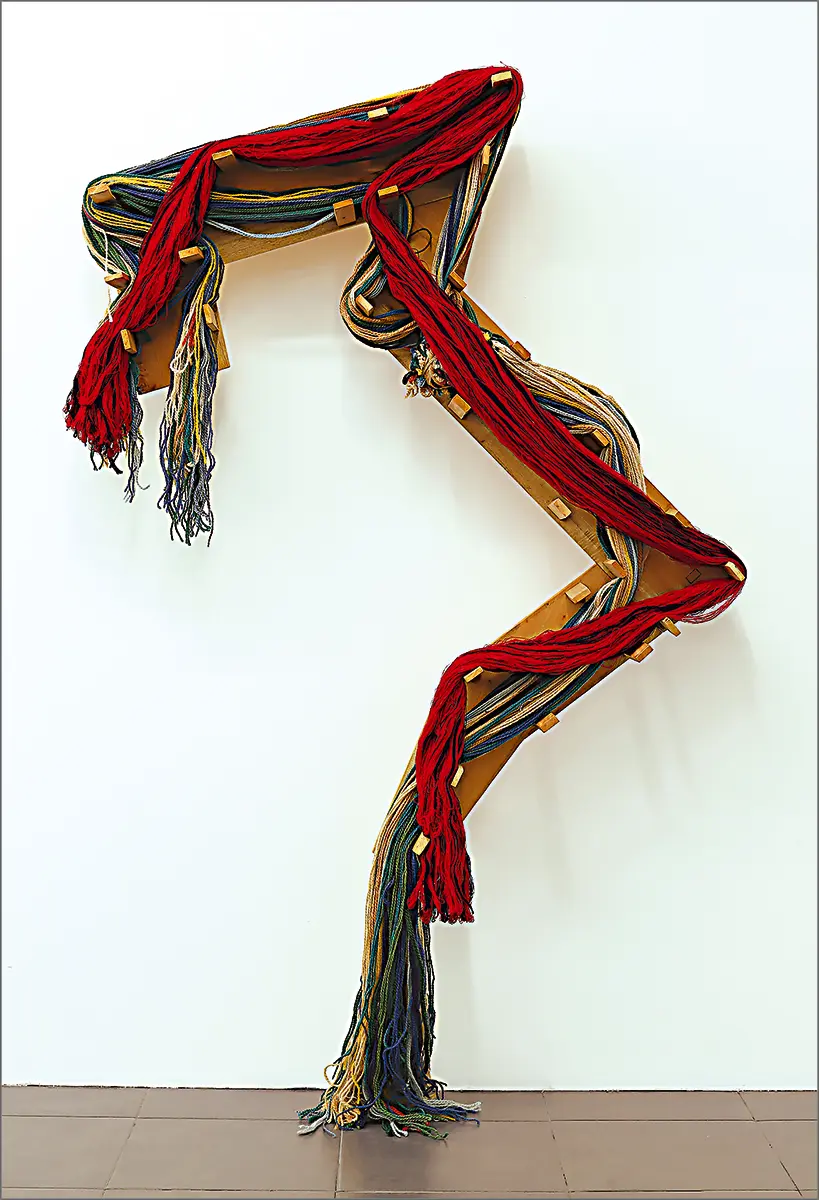
Some pieces like Abuelas (Grandmothers), Aire (Air), Fuego (Fire), Agua (Water), and Espantapájaro (Scarecrow) were completely created with thread. Other works used thread in combination with other materials and appealed to capture color in its purest state, while others described twists that offered texture contrasts and awoke the senses of viewers. It is interesting to note how the apparent simplicity of those forms was accompanied by titles that added a more phenomenological semantic range associated with elements in nature. Anything essential for the human experience—family, air, water, agriculture, mentioned alongside the scarecrow—was concentrated inside an exhibition space in an equivalent abstract, formal, and silent manner. It is possible—Pichillá appeared to be telling us—to bring very different traditions together in a series of images.
It is important to point out that the use of thread is not synonymous with textile; in other words, by looking at the works it was possible to know that the material was used as part of very diverse techniques, poetics, and formal results. This variety in the exploration of materials made those pieces masterfully created with textiles even more interesting, precisely because of how they contrasted with the pieces made with thread. Abuelo (Grandfather) and Rojo (Red) were excellent examples of the rhythm and constant repetitions in the geometric tapestries by Pichillá; they also represented another line of inquiry when compared with the larger fields of color and forms created with thread.
There were also pieces based on the contrast between wood, thread, and textiles. The wood pieces did not seem precarious or quick appropriations: small sculptures, structural components used to explore both the act of tying the threads as well as supporting the textile pieces, they were somehow reminiscent of the human figure and served to place Pichillá’s research in a more unexpected place less dependent on the usual perspective offered by paintings on a wall. It was precisely in those instances—among those rare combinations between languages and more physical experimentation with the use of materials in the exhibition space—when the work by Pichillá was at its most compelling.
An excellent comparison can be drawn between those works and an untitled piece in which Pichillá fills with thread the replica of a work by Marcel Duchamp. A sort of point out of the curve amid the group of works presented in the exhibition is the appropriation of something that had already been appropriated. In other words, Pichillá appropriates a classic piece from the European avant-garde and anthropophagizes it in tropical fashion. The contained peculiar sense of humor notwithstanding, there is also the referential moment and explicit charge between modus operandi—roughly speaking, between the paradigm of western contemporary art and the vernacular tradition of handcrafted work—when his exploration loses some creativity and appears to be showing the public that he is aware of what is expected to be covered in a solo show at a commercial gallery.
It is certainly not a piece that compromises the rest of the exhibition. But it leads us to conclude that experimenting without compromising—as opposed to that readymade and what it represents for Pichillá’s fateful 10th anniversary—is a braver stance for young artists to take, not only in Latin America but also in any other region perceived as non-hegemonic by the western expectations of what visual arts ought to be. And in this small exhibition, Antonio Pichillá certainly demonstrates that he does not lack courage and that his name will be increasingly worthy of attention.
RAPHAEL FONSECA