Antonio Manuel’s exhibition at Cássia Bomeny gallery in Río de Janeiro will inevitably be seen as a celebration, both of his 70 years of life and of his 50-year career as a visual artist. Manuel’s unique place in the history of contemporary Brazilian art cannot be disputed, and neither can the experimental character of his work since the 1960s. His paintings in dialog with newspaper layouts and his appropriations of stereotype printing flongs are essential to understand the generation of artists active during the years of military dictatorship in the country. Manuel’s most famous work, O corpo é a obra (The Body is the Work, 1970), an ephemeral event that had him enter Rio’s Museu de Arte Moderna entirely in the nude, cannot be forgotten either.
As is the case with other artists of his generation, such as Carlos Vergara, Ana Maria Maiolino, Regina Vater, and Antonio Dias, after the upheavals of the 1960s, 1970s, and early 1980s, Manuel’s work followed different paths, languages, and avenues for experimentation. Once the need to activate in opposition to the military junta became attenuated in the 1980s, he developed a greater interest in installation and painting, creating images and physical experiences that addressed formal issues already present in his younger works. The same elements are in evidence in the selection featured in this exhibition, mostly unseen by the general public before.
The exhibition comprises eighteen paintings, almost all dating from the last four years. The only exception is one work from the Ocupações/Descobrimentos (Occupations/Discoveries) series, first presented at the MAC-Niterói in 1998, and installed in a new version in Brazil Pavilion at the 2015 Venice Biennale. Here are two elements that seem key to the artist investigation, both prominently present in the paintings gathered in the gallery: the vibrancy of color and the relationship between figure and ground, inside and outside, solid and hollow, provided by the hole carved by the artist, using a hammer, on his sculpture’s brick and cement structure.
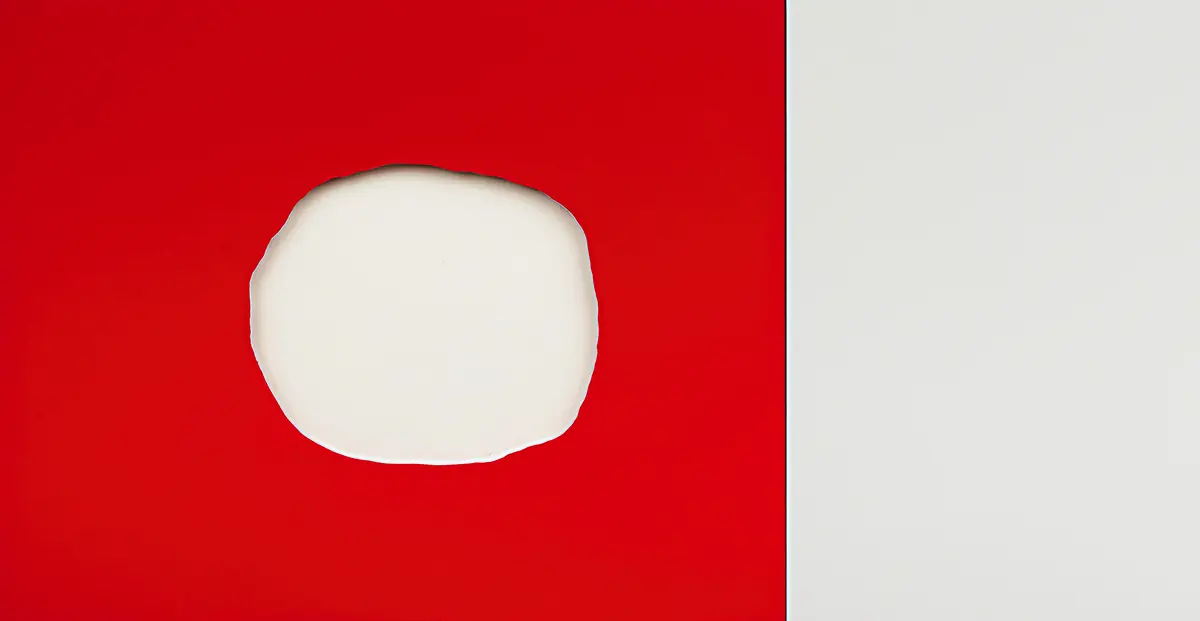
The formats of Manuel’s canvases vary between large but not monumental (more than two meters) and small but not tiny (around fifty centimeters). Acrylic is dominant in his compositions and tends to be presented in contrast with collages of fabric and paper, underscoring the importance of the relationship between various materials and layers of images that are common to Manuel’s exploration. Political and agitprop messages are cast aside from these images; with titles like Retas e brilho (Straight Lines and Shine), Campo gráfico (Graphic Field), Círculo vazado (Hollow Circle), and Vermelho e branco (Red and White), these works can mostly be understood as formal exercises and ways to continue experimenting inconspicuously that are nevertheless restless in terms of the composition of images.
It is interesting to note, for example, a work like Vermelho e branco, where the act of perforating the canvas—and the entire Modernist history that this action harks back to—is recoded by Antonio Manuel and appears as a quotation of his own installation, reviewed here. Although in medium-scale and attached to the wall, it makes clear the relationship between Manuel’s images and his invitation to the viewer to explore them physically. His experiments with such different textures as corrugated paper and jute reinforce this physicality and bring us back to the uniqueness of Manuel’s position in terms of the relationship between body and image in the visual arts in Brazil.
After visiting the exhibition and inevitably looking at these images in the broader perspective of Antonio Manuel’s long career, it is interesting to confirm the continuities and the shifts in his production. It would certainly be an interesting project to study and research the work of artists of his generation after the military dictatorship era, to see how painting, and abstract painting, in particular, provided outlets for many of them. New dialogs and projects could be proposed on that basis, and so could a new way of looking at Brazilian art after the 1980s.
RAPHAEL FONSECA