The memory of art production in the 1980s records the
participation of Silvia Gurfein (Buenos Aires, 1959) in the stage arts, her
main interest in those years, alongside philosophy and music. To these concerns
she later added video, drawing, painting, and writing, even establishing a
writing workshop for artists in 2010. A self-taught artist, Gurfein’s CV notes
that her first solo exhibition was held in 2001 and that she has presented her
work both inside Argentina and abroad regularly since then.
Almost 10 years later Gurfein’s pictorial installation Origen y Fin won first prize in the 15th Klemm Visual Arts Prize, which included the opportunity of a solo show at the Klemm Foundation gallery in 2013. A month prior to that, in October, anticipated at Praxis Gallery the awareness and the questing spirit that connect both shows, philosophically and aesthetically. In both she worked with what remains in the studio after the day’s labor: she manipulated residues of matter and pigment in palettes and canvases. Her works even reflect the time of the creative process, the hours of physical effort, and aesthetic and intellectual pondering.
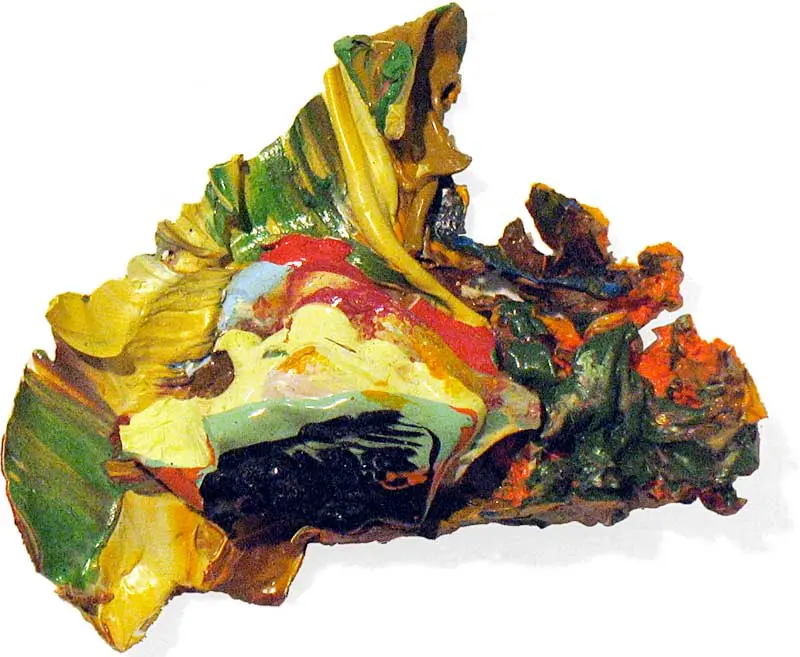
Years ago Gurfein said that a recognizable axis in her oeuvre was “the connection between contemporary ways of seeing and the historical practice of painting.” As a painter, she situated herself “at the intersection of two times,” that of her “digital mind” and “the ancestral time of oil painting,” and that is the terrain where her art takes place. In her current works, Gurfein travels to the “origin” and the “end;” she traverses history and the death of painting.
In Silvia Gurfein. La celebración de la material, el color y la forma, her show at Praxis International Art, curator Ana Martínez Quijano notes that the emphasis is placed on the “memory of painting,” which can be “analyzed with an archaeological focus.” In that sense, Gurfein worked with impastos, with the patient superposition and accumulation of thick layers upon thick layers of pigment mixed with oil, to create artworks with volume, like Astilla Estrella or the colorful spheres supporting tiny wooden dolls in Dormida-despierta and Yo como Atlas.
Also, the show included some oil-on-canvas works that hark back to the principles of abstraction, reiterating lines, shapes, and rhythms; harmonious variations, with different times and resources, of a single scheme from the center of which painting dazzles us.
Traces of the artist’s prior works in stage productions, music, and writing are found throughout her visual art; they are as well in Lo intractable, at Klemm Foundation.
Here, the titles of the works and the word in general play a central role. For example, Su obstinación en permanecer y en extender allí donde debería rendirse y cesar, or La ceguera táctil del cerebro frente al cráneo (o) La psique está extendida, no sabe nada de ello. Texts by Barthes, Benjamin, Capra, Deleuze, Lispector, and Gurfein herself, are framed and displayed on the wall alongside the paintings’, some with their veilings and vibrant undefined boundaries, evoke Mark Rothko’s color planes.
There is a stage-like element in the canvases distributed and arranged on large boards, on easels; grouped by color, the crude fabric pieces in different shapes are painted irregularly at the center, almost stained, and show their unraveling edges. Also central and solitary is the iris in La pregunta del que no sabe a una vision que sabe todo. Single and blue, there like an interpellation: the circular membrane of the artist’s own eye printed on the canvas. “We see things with the intermittence of our eyelids opening and closing,” the artist writes.
The canvas receives painting and its remains. On occasion, pigments seep through the surface and filter through to the other side, like in the famous rags of Argentine painter and sculptor Líbero Badíi, used to dry his brushes and then transformed into “paintings” presented as gifts to visitors to his studio.
In her meditations about “origins” and “ends,” Gurfein associates and finds “funerary echoes” in the voices “canvas” and “remains.” She questions the practice of painting and revisits debates about its successive deaths, which began thousands of years away by Pliny the Elder, who argued in his Treatise on Painting and Color, written during the first century of the common era, that painting was ars moriens, a dying art.
These two accomplished exhibitions at Praxis and Klemm show both the delicate intimacy and the intricate thinking that buttress the work of this sensible multi-disciplinary artist.
Coincidentally, the National Fine Arts Academy invited Gurfein to participate in the Alberto J. Trabucco Acquisition Prize for Drawing 2013, exhibited at the Recoleta Cultural Center in Buenos Aires.
VICTORIA VERLICHAK