“My work is to bring Marta Minujín over and present an authentic Latin American artist engaged in subversive practices,” said Hungary’s Gabor Altorjay in Stuttgart. With such an invitation, the artist traveled to Germany in late May to participate in Subversive Practices. Art Under Conditions of Political Repression in the 60s-80s / South America / Europe, the festival was held at the Württembergischer Kunstverein.
Accustomed to generating surprise and bedazzlement, Marta Minujín (Buenos Aires, 1943) relates in this way the origin of her outrageous work: Altorjay appeared pushing a large cardboard box labeled ‘Marta Minujín to Gabor Altorjay, from Buenos Aires to Stuttgart’, and I emerged from there wrapped in an Argentine flag to a stage made of white balloons, with projections of our previous actions on the bodies of five pregnant women, also in white. Then, we placed microphones on ourselves and, while the pregnant women swayed, we asked the audience who was jealous; those who said yes received as a gift an ear of corn signed by both of us. After giving away the 50 ears of corn, I tied to Altorjay’s head, with a plastic ribbon, a video camera, an image projector, and a recording device that played very loudly the song Martha My Dear. In this way, he filmed and, at the same time, projected the actions on me. At a given point we danced frenetically while the pregnant women distributed popcorn (the main material in the work of this Budapest-based colleague of Fluxus). The performance ended when I returned to the box, which was closed by Altorjay, and we retreated from the auditorium in procession.”
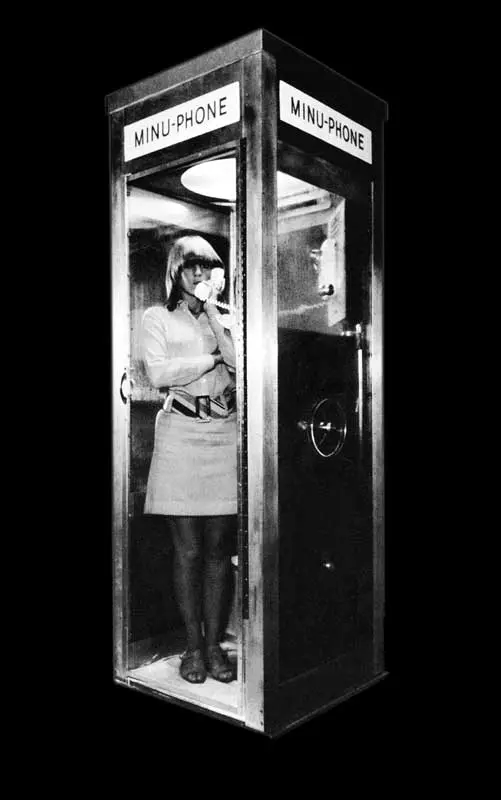
Marta Minujín. Minuphone, 1967. Technological electro-mechanic technique. Height: 7 ft. (2,20 m.).
This most recent performance is but a sample of the unprejudiced posture adopted by Minujín regarding art, and at the same time, it is yet another action using ears of corn. Before, in 1985, she did a symbolic action of the Pago de la deuda externa argentina a Andy Warhol, giving the artist corn at Exit Art Gallery in New York; there are photographs of this exchange of the true “Latin American gold.” In 1996 she repeated the action and attempted to mediate the conflict for the Falkland Islands between Argentina and Great Britain, paying with corn to a Margaret Thatcher impersonator. Solving International Conflict With Art and Corn was presented at Corpus Delicti, a performance festival organized by the Institute of Contemporary Art (ICA) in London.
Although it couldn’t be carried out for protocol reasons, the artist intended to pay Queen Sofia in the same currency in Seville in 1992, on the occasion of the Fifth Centennial of the Discovery of the Americas (conquest, colonization, genocide, encounter between two cultures, according to the point of view used to name the event). Paying Spain? Shouldn’t it be the other way around? Minujín states that, in order to “end the extortion,” she wanted to “return Latin American gold, corn, in exchange for the jewels that Isabella gave Columbus to finance his voyage.”
The Artist’s Fame
Marta Minujín remains as current, requested, and active as when she was barely an adolescent. A pioneer and in tune with the mass media, the artist has had a 50-year career that includes fellowships and awards, happenings and works of ephemeral art, sculptures, and video, glass reliefs on glass, design for utilitarian everyday objects, urban interventions, and tens of shows in Argentina and around the world.
Mostly, her production turns on several axes: massive audience participation and the alteration of its participants’ perception; the modification of her surroundings; and the creation of popular art. Before most, she created ambient art and installations, worked on land art, and realized the importance of mass media and technology, as much in her art as in her life, and in everyone.
Inspired by Marshal McLuhan’s theories, she created several works connected to those topics, such as Simultaneidad en Simultaneidad (1966). The artist remembers they were three different but simultaneous actions (Three Countries Happening), planned with Allan Kaprow in New York and Wolf Vostellin in Berlin (in contact with Minujín through telex and radio), where Minujín, from Buenos Aires, used every medium within reach to “create an instantaneous media invasion.’ Later, among others, we would have Minuphone (1967). This was an electronic phone booth, installed in New York’s Howard Wise Gallery that, depending on the number dialed, produced nine sensorial effects (lights, smoke, helium, breeze, colored water), including a Polaroid shot.
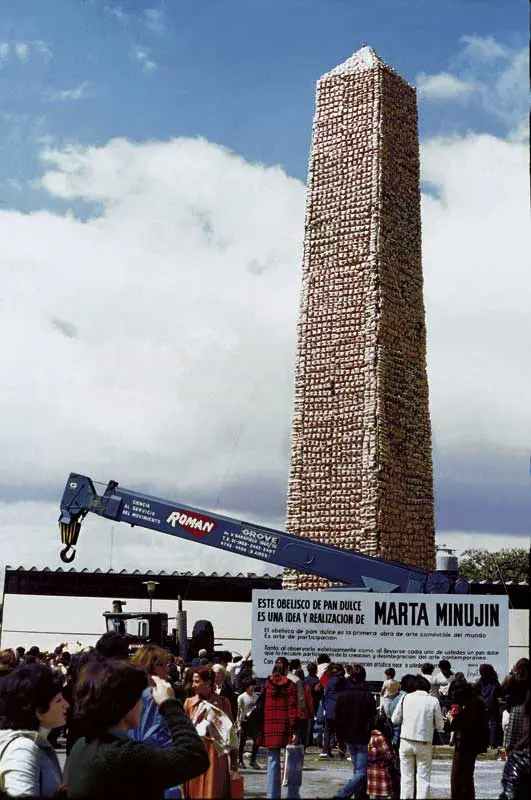
Marta Minujín. Sweet Bread Obelisk, 1979. Iron structured covered with deployed metal and covered with 30,000 sweet breads. Height: 98 ft. (30 m.).
Like very few people, Minujín was able to establish her presence in the mass media from an early age. Always dressed in worker’s coveralls —yet coquettish and fitting, in rough materials when working, silk for parties— the artist wears her hair in a white-blond hue and covers her eyes, night and day, with several models —she owns thousands— of her trademark dark shades.
Her fame precedes her everywhere, and at times her elaborate way of presenting herself to the world, along with some commercial aspects of her world, have conspired against a true appreciation of her work. Without abandoning her proverbial boldness, the artist is currently undergoing a period of reflection and serenity.
Family life was never an obstacle to her artistic project. Married since very young to the same man —an economist who has an extensive international career— the artist has two children. Minujín was educated in local art schools and started exhibiting black and white, kinetic-tinged drawings in 1959. In 1961 she won a fellowship and traveled to Paris.
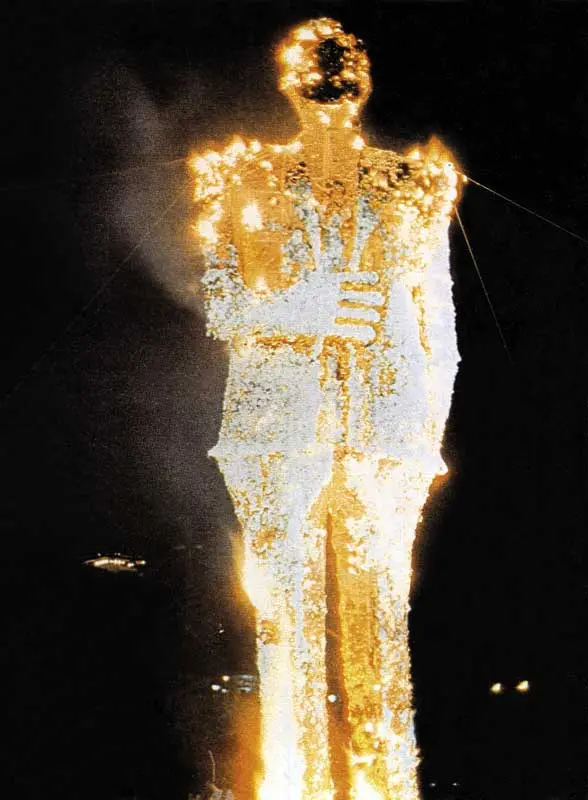
Marta Minujín. Carlos Gardel of Fire, 1981. Iron structure covered with deployed metal and covered with cotton. Height: 56 ft. (17 m.).
One of the world’s earliest participatory works of art was La Chambre D’Amour (1962), by Minujín and Dutch sculptor Mark Brusse. The artist wrapped Brusse’s wood structure in foam painted in many fluorescent colors, and placed a bed —springs and chains— that moved as the audience entered; a reconstruction was exhibited in 2008 at Lara Vincy Gallery, in Paris.
There, before returning to Argentina in 1963, she did her first happening, which ended up being somewhat violent. In La Destrucción, she staged her commitment to the conjecture about the “death of art,” inviting Christo among other artists, as well as the audience, to contemplate the destruction and burning of her work —research with mattresses— while she freed hundreds of birds and rabbits that contributed to the general delirium.
The legendary critic Jorge Romero Brest, who would later announce the “Death of Painting,” met Minujín when he served on the jury for a blotch competition. A student at the Escuela Nacional de Bellas Artes, she was 16 at the time and her work stood out. In a 1962 text, Romero Brest —director of the storied Instituto Torcuato Di Tella between 1963 and 1970— acknowledges Minujín’s revolutionary spirit and the current value of her work; above all, the “passion that drives Marta.” In 1964 she won the prestigious national award given by Instituto Di Tella with Revuélquese y viva, a construction in multi-colored mattresses that the audience could enter and “frolic” in, feeling moved.
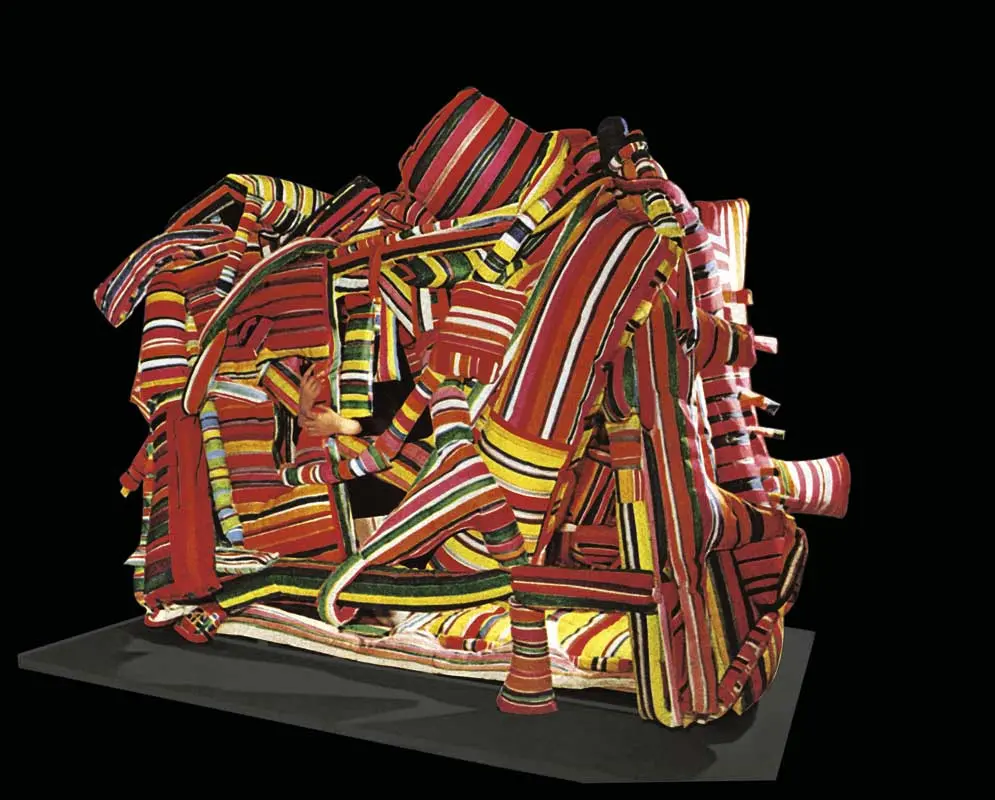
Marta Minujín. Wallow and Live, 1964. Wood, feather rubber and mattress fabric. 8 x 7 x 6 ft. (2,40 x 2,20 x 2 m.).
Minujín believes that one must “live in art” because art is for life, and all of her work responds to that existential attitude, which includes a large element of playfulness. Pop artist? Nowadays, she prefers to define herself as a conceptual artist: “I was always conceptual. I am pop in the colors I use. My personality is pop, I am exuberant, I have fun, I am not afraid of embarrassing myself… I live inside a comic book,” she tells ArtNexus.
Whoever has sufficient age and memory will remember the mass media success (praises and condemnations, as well as befuddlement) and the resonance of La Menesunda (1965), a walk-in ambient piece —created with Rubén Santantonín (Argentina, 1909-1969)— that shook Buenos Aires, where viewers experienced a great variety of emotions by traversing more than a dozen areas with multiple objects and sensorial stimuli, including a freezing chamber and a couple in bed.
Art to the Streets
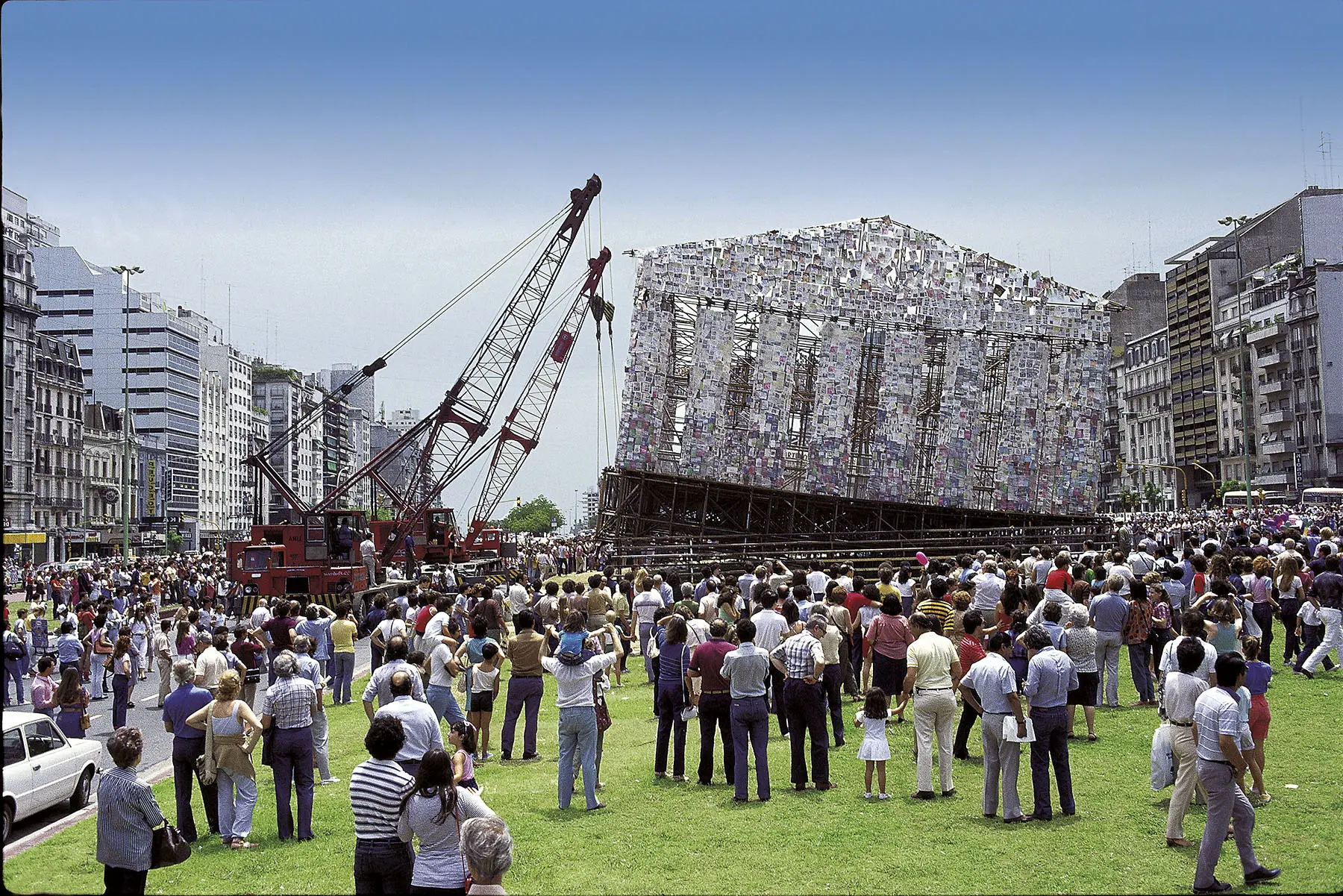
There were many documents in Minujín’s retrospective at the Museo Nacional de Bellas Artes de Buenos Aires, in 1999, since it is not that easy to reconstruct her ephemeral work. Now, Malba-Fundación Constantini announced a large show for 2010, but one cannot imagine that a moment of enthusiasm like the one around El Partenón de los Libros (1983) would come about again. This replica of Athens’s Parthenon was built to celebrate the advent of democracy in Avenida 9 de Julio, covered with 20,000 books banned during the 1976-1983 military dictatorship, which the audience could carry home after three weeks on exhibit. Minujín participated with documents of this imposing work in Arte (no es) Vida. Actions by Artists of the Americas 1960-2000 (2008), at El Museo del Barrio in New York City.
A repeat of the scandal and the intentional confusion she conceived for Suceso Plástico (1965) is also unlikely; inside the Peñarol soccer stadium in Montevideo, Uruguay, she invited motorcycle riders, bodybuilders, prostitutes, fat women, and tied-up couples to kiss each other, while she dropped from a helicopter live chickens, lettuce, and flour on a surprised audience convened by the newspapers to “live in art.” Playing with food? Promoting chaos? Perhaps it was a better experience than it seems now, almost 45 years after the fact. “It was a genius creation influenced by Fellini’s films, a violent happening, people entered as Bach’s Mass played. I was rather crazy and very young,” she says today, with a smile.
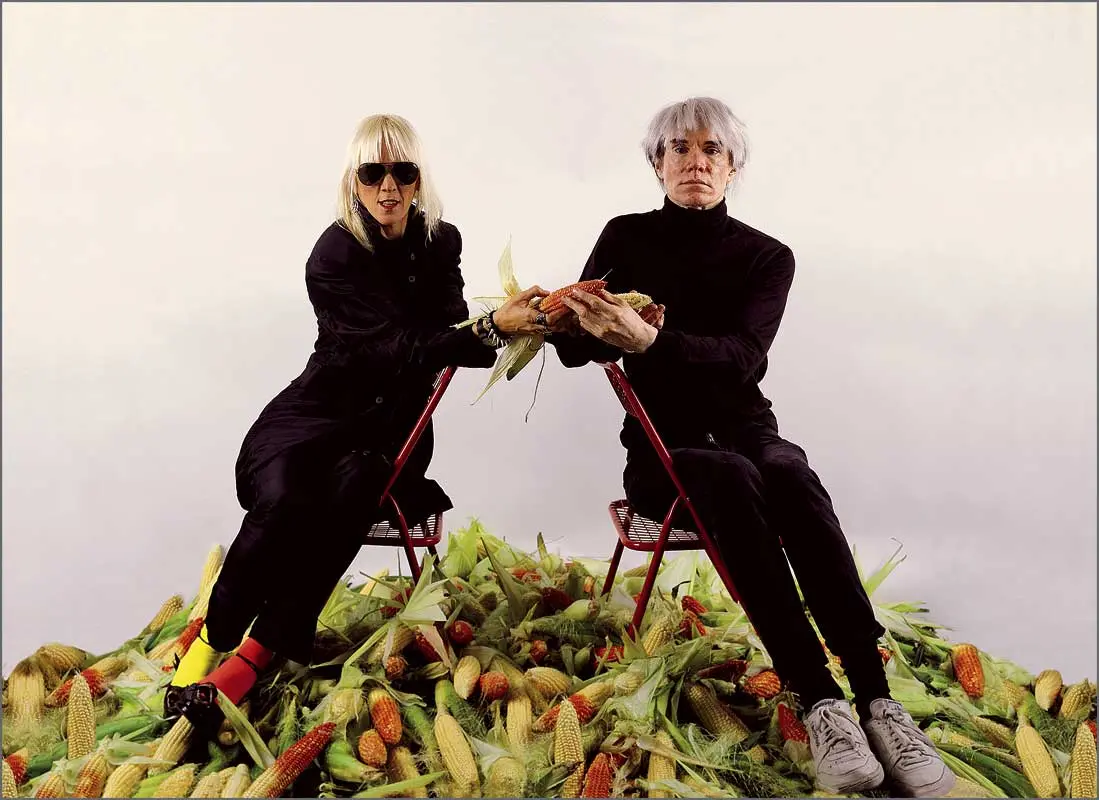
Marta Minujín. Payment of the Argentinean External Debt to Andy Warhol with Corn, 1985. Variable dimensions.
Long before Nicolas Bourriand started talking about relational aesthetics and Rirkrit Tiravanija started cooking, Minujín established relationships between her work and the audience and fed thousands. In her exploration of consumption, she distributed food among her viewers —an essential element in several works, such as the replica of the Obelisco de Buenos Aires (1979), covered in 10,000 packs of sweet bread, or the Venus de Queso (1981); La Torre de James Joyce en Pan (1980) in Dublin, Ireland; and more. “Agricultural Art in Action” in works where the artist fosters relationships between Latin American countries, combining art with nature: Repollos (São Paulo, 1977); Toronjas (Mexico, 1977); and Oranges (Buenos Aires, 1979).
Comfortable with spectacle —and as part of an investigation on the de-mystification of myths, like in El obelisco acostado, São Paulo Biennial, 1978— for the 1981 Medellín Biennial, Minujín designed a metallic structure with the figure of Carlos Gardel 17 meters high, covered it in cotton, and set it on fire: Carlos Gardel en Fuego was a sensation among the citizenry. We must remember that the famous tango singer, mourned by millions, killed himself in an airplane accident in Medellín.
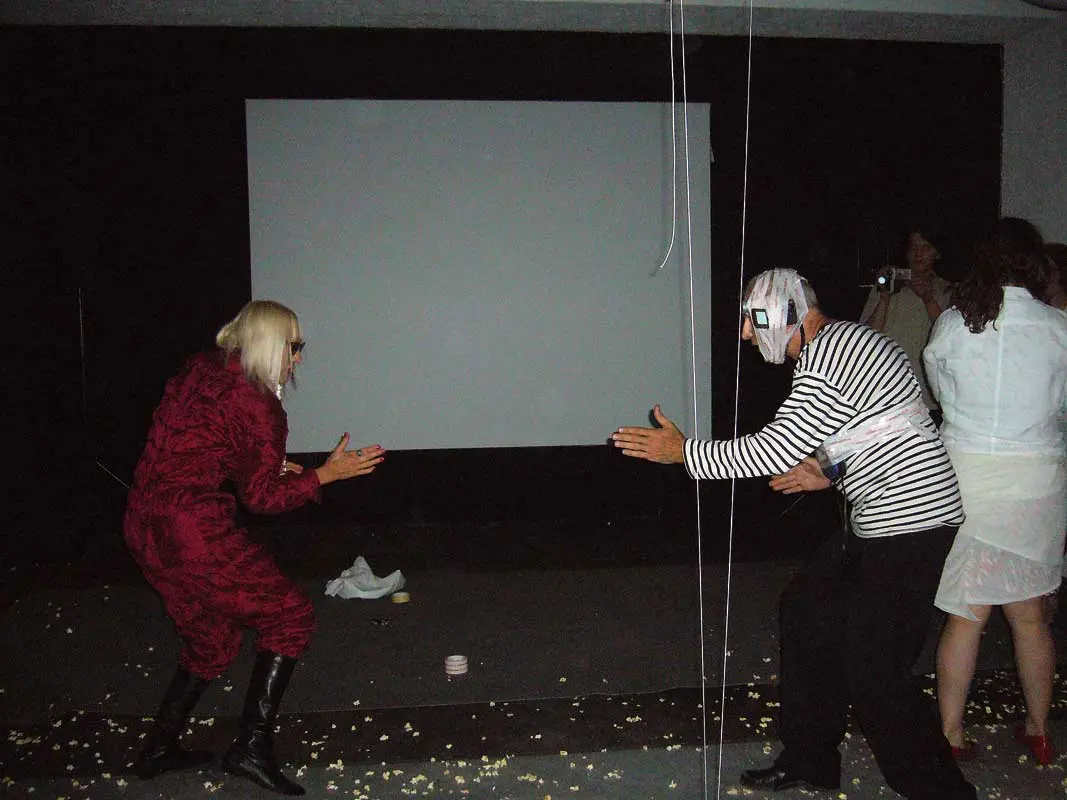
Marta Minujín. Happening in Stuttgart, 2009.
It remains to be seen what works will be selected for the Malba show, but whatever the case, Minujín is receiving one recognition after another in recent years. Already in 1998, when the Los Angeles Contemporary Art Museum presented a historical review of the irruption of actions in the visual arts for the show Out of Actions: Between Performance and the Object, Minujín was cited among the form’s precursors alongside Kaprow, Yves Klein, Piero Manzoni, and the Gutai group. At the same museum, in 2007, the group show WACK! Art and the Feminist Revolution, which the following year traveled to PS1 MoMA in New York and the Vancouver Art Gallery in Canada, included a recreation of Minujín’s Galería blanda (always the same, always different for the amount and provenance of the mattresses), generating a new space with some 150 mattresses as walls, ceiling, and floor —first created with Richard Squires in 1973 for a gallery in Washington— for viewers to enter, walkthrough, play, remain seated listening to music and watching videos, and be in touch with softness, modifying their perception and also the notion of an art exhibit, as happened with the version of Galería blanda at ArteBA 2009 in Buenos Aires. It was rebuilt for the first time in 2000, for Lebenserfahrung, at Generali Foundation in Vienna, and —the artist tells us— it was part of the first happening ever broadcast via the Internet. “I made my entrance on a horse and pulled a cow, like the Milka Chocolate icon, and I milked it, drank the milk, and shared it with the famous people in attendance.”
With the return of democracy to Argentina, and in sync with the rest of the Western art world, the 1980s were characterized by conciliation and the mixing of different styles from previous eras, as well as the rebirth of old movements and the recuperation of painting (trans-avant-garde, neo-expressionism). In that sense, Minujín returned to sculpture and, from a contemporary stance, looked toward the classical arts.
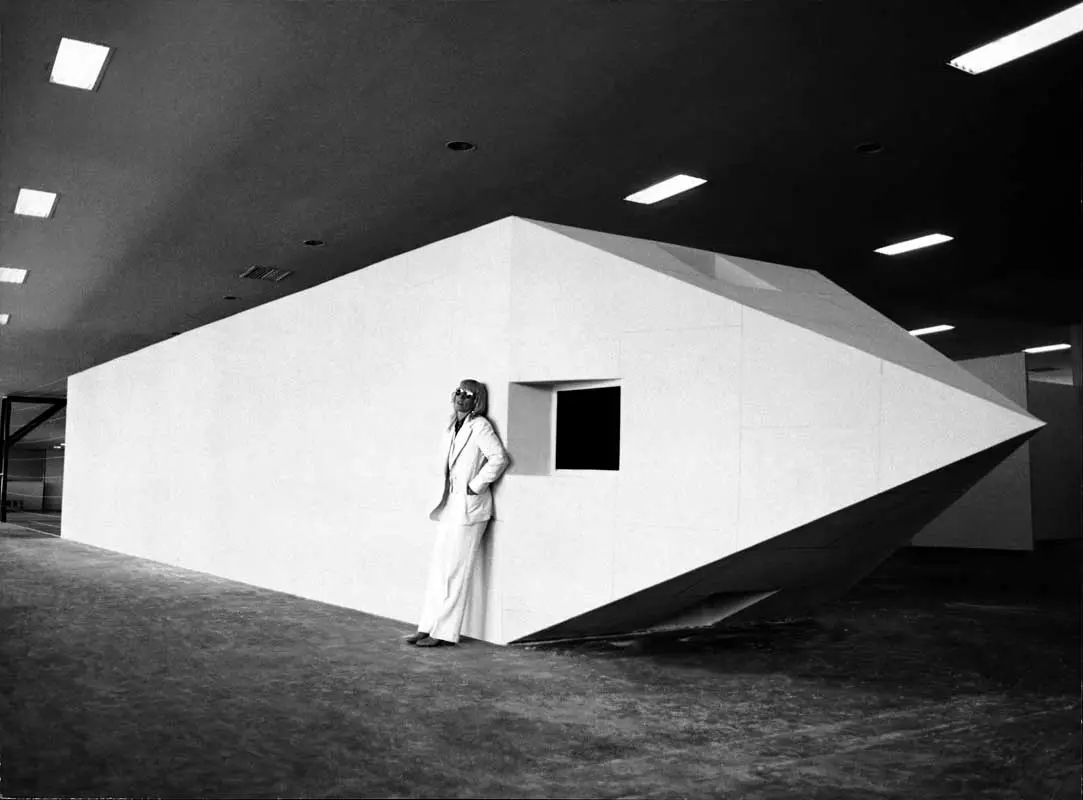
Marta Minujín. Obelisk Laying, 1979. Wood and TV monitors with videos. Length: 24 ft. (74 m.).
These days, in her studio, she alternates sculptures —“which are conceptual, I work with the fragment”—glassworks works using mattresses —“I need the manual effort to think about my conceptual work”—and interventions on the urban space, like her performance Operación Perfume. Reedited in Cali, Colombia, for the 41st Artists Salon in January 2009, the action consisted of the fumigation of five city blocks with jasmine aromas, appealing to the sense of smell to rouse sensibility and imagination: “It was beautiful, people joined us with great enthusiasm.” Next November, she will present drawings from the 1970s and 1980s —for projects realized and unrealized— at the Mercosur Biennial.
The emblematic, very wide Avenida 9 de Julio, with a section cut off from traffic, was once again the stage for the artist’s most recent action, which combined music, literature, and visual arts in a tribute to Julio Cortázar, in the 25th anniversary of the writer’s death last March. Blandishing a megaphone and calling “art, art, art,” Minujín greeted the people (who, in order to participate, had to bring a book, a story, or Cortázar’s name written on a piece of paper) who came to play in the 120 hopscotch that invoked, of course, the magic of Cortázar’s book. Later, the artist signed the pebbles used by the winners, while 60 saxophones played music inspired by Charlie Parker, just as Cortázar used Parker as an inspiration for his story El Perseguidor; Minujín in her purest state.
VICTORIA VERLICHACK
Curator of the Argentinean Delegation sent to the Cuenca Biennial in Ecuador.
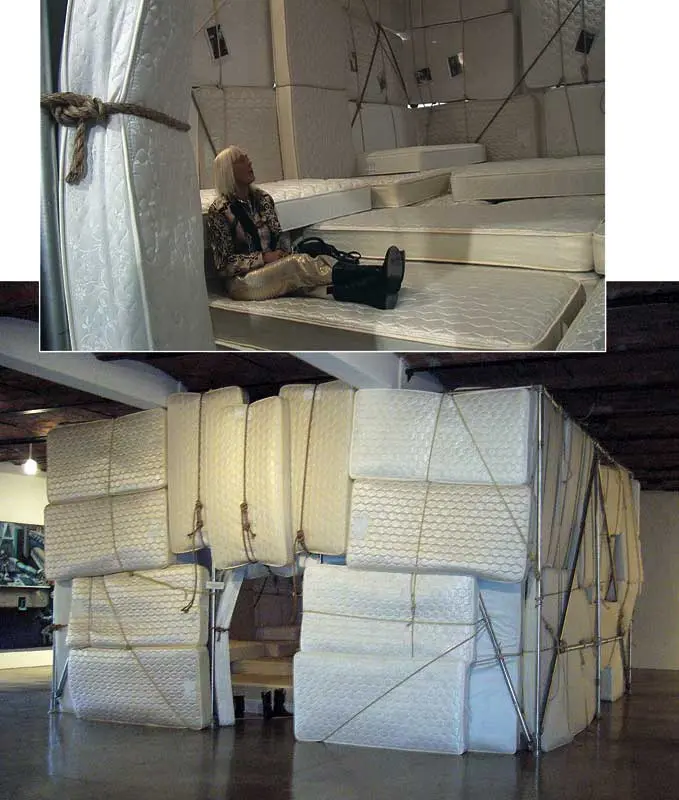
Marta Minujín. Soft Gallery, 2008. Rope, mattresses, tubular metallic structure. 19 ¾ x 19 ¾ x 13 feet. (6 x 6 x 4 m.).
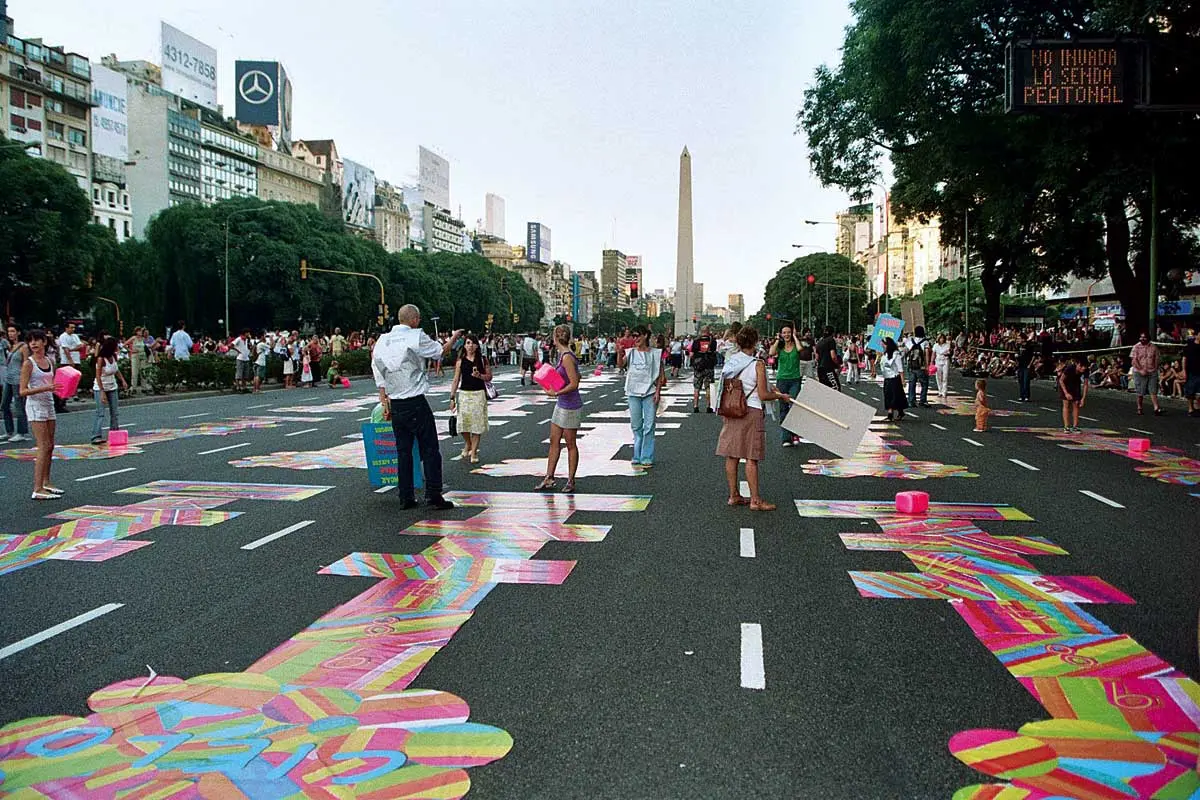
Marta Minujín. Rayuelarte (Small line art) 2. 1 block, 12 central lanes at Av. 9 de Julio with 120 small line stickers made of plotted vinyl fabric and 120 painted Styrofoam rocks.