The first object in the Indianapolis Museum of Art’s mid-career retrospective of María Magdalena Campos-Pons is Everything is Separated by Water, Including My Brain, My Heart, My Sex, My House (1990). This medium-scale mixed-media relief, from which the exhibition takes its title, consists of a painted column of cascading water flanked on both sides by half of a female form. Seven rows of barbed wire encase the two halves of the woman’s body, a gesture emphasizing the fact that these halves—this woman’s body—will never reconcile with their—its—another side. Instead of feet, the woman stands on renderings of small Aztec temples, suggesting that this figure is also bound by and tied to a long history of cultural hybridity in the Americas. The fissures and cuts in this work, and others from the same year, including Talking About Trees…and I am a Fountain, nicely articulates the multiple alienations generated by the experiences of gendered subjectivity, forced migration, and economic status. In essence, the spaces visualize separation both physically and psychically. These works function, then, as a perfect introduction to the exhibition, which focuses on themes of exile and displacement, and identity and memory.
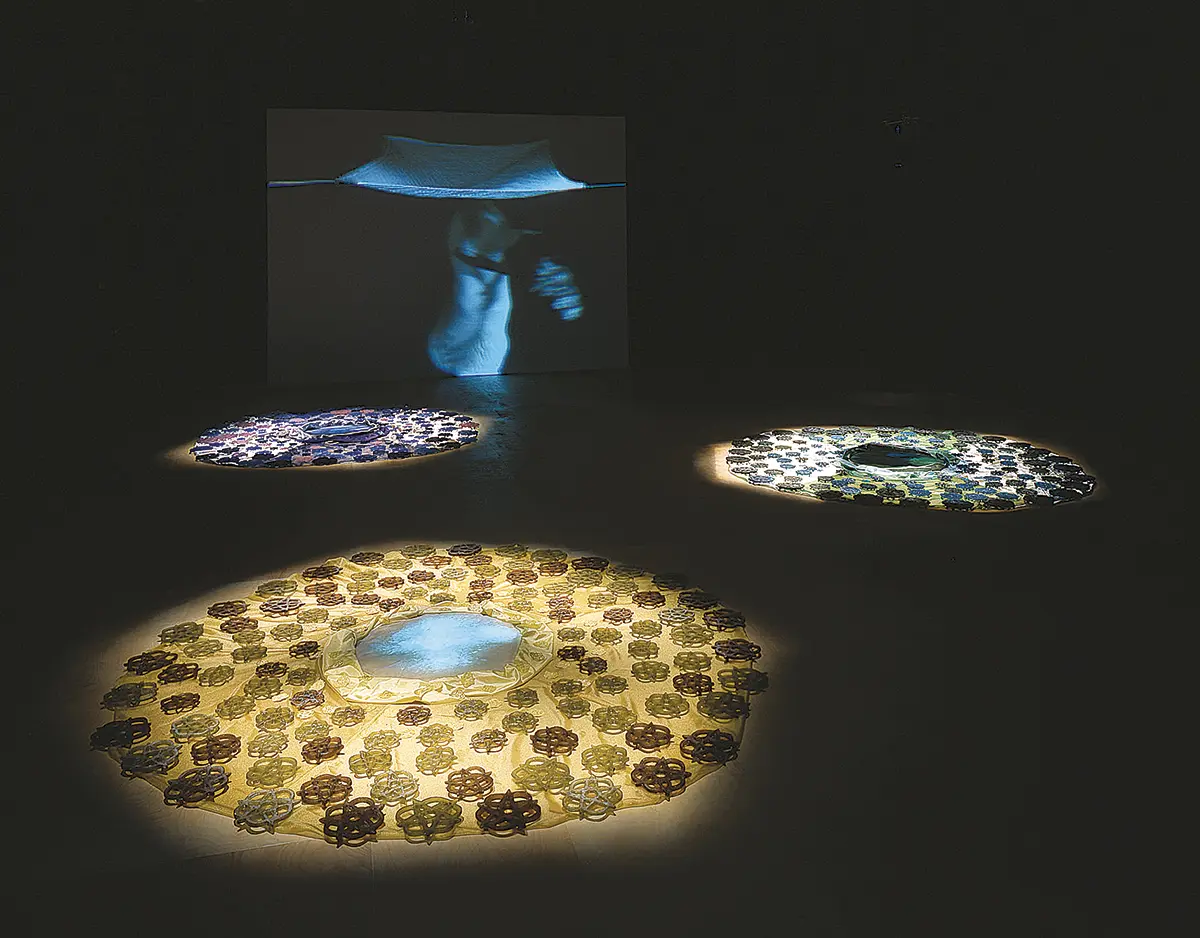
María Magdalena Campos Pons. While the Girls Were Playing, 1999-2000. Mixed media, installation. Variable dimensions.
The great-granddaughter of a Nigerian slave, Campos-Pons grew up in Matanzas, in a landscape populated by sugar plantations, and in Havana, surrounded by the creolized cultural legacy of Africa. She left in 1988 to come to the United States as an exchange student, and in 1991 she became a permanent resident. Initially, Campos-Pons believed travel back and forth to Havana would be possible, but the U.S. embargo against Cuba has restricted her movement. This unforeseen complication has reinforced and deepened her diasporic identity and has undoubtedly informed the structural mark of doubleness that codes her artistic production. Indeed, it is the clear and thoughtful articulation of double displacement—black Africans’ forcible removal from Africa, and then Campos-Pons’s own exile from her homeland—that makes Everything is Separated by Water (the specific piece and the entire exhibition) poignant both on a sophisticated political plane as well as on a personal level, as a reflection on memory and loss.
The force of Campos-Pons’s vision expresses itself best in her photo-based conceptual work: her multi-paneled Polaroid photograph arrangements, in which performance plays a pivotal role, as well as her video installations. In the series When I am Not Here/Estoy Allá (1994-1997), Campos-Pons photographs herself as she performs rituals connected to Santería, the Afro-Cuban religion derived from traditional Yoruba beliefs. One diptych in this series references the river goddess Oshun, who is also associated with fertility and motherhood. In the left panel, Campos-Pons holds out a carved wooden boat as an offering to Oshun; in the right, honey—one of Oshun’s signs—drips from Campos-Pons’s fingers into a second wooden boat. Throughout this series, Campos-Pons uses her body as a canvas, and in this twin set, she transforms her naked torso into an image of the sea by painting it with yellow dash marks over a blue field. As her skin mutates from biological matter to a painted surface, her body appears suspended in a state between stasis and narrativity, between sculpture and painting, or, in the context of the exhibition’s exilic thematics: between the historical and the contemporary. The honey’s viscous consistency allegorizes this state of suspension, while the wooden boats, again an offering to Oshun, refer not only to the Middle Passage but also to the complex history of the migration of Cubans to the United States since Castro’s revolution.
Also noteworthy are Campos-Pons’s media installations such as Spoken Softly with Mama (1998), an homage to her mother and her aunt, who both did housework for wealthy women. The installation layers various media: an audio track plays songs and sounds associated with Campos-Pons’s childhood and projections of the artist and black and white photographs of deceased relatives appear on large ironing boards whose shapes also refer back to slave ship decks. The simultaneous reference to the Middle Passage and domestic work effectively illustrates a continuum of displacement, while the appeal to both sight and sound demonstrates how memories evoke and are evoked by various senses. One of the last works in the exhibition is Threads of Memory (2003), a five-screen video installation featuring shots of people walking on city streets interspersed with contrasting images such as a close-up from behind of a woman lifting a basket of fruit on her head. As images of different ways of life flash on the screen, the viewer sees how individual and collective memories interact in public spaces and inform our ever-shifting identities.
The exhibition featured 34 multimedia installations and large-scale photographic works from the past 20 years and is accompanied by an excellent catalog with essays by the exhibition’s curator, Lisa D. Friedman, and the scholar Okwui Enwezor.
TERRI WEISSMAN