Cildo Meireles is recognized internationally as a member of a Brazilian avant-garde that not only has set its own contemporary agenda but also maintains the country’s reputation for establishing new definitions of modernism and artistic activism that dates back to the early years of the twentieth century. This same activism may be seen as the impetus for the foundation of the São Paulo Bienal in 1951, and for its longstanding reputation for innovation. Brazil is a country of extraordinary paradoxes with an amazing legacy of visual culture that has long inspired artistic creativity and encouraged participation. Beginning with the Semana de arte moderna (Week of Modern Art) in São Paulo in February 1922, artists sought to create new paradigms of national identity that would move beyond merely appropriating European antecedents and would distinguish them from the other nations of Latin America. The incorporation of local materials and the re-invention of international trends to conform to their own interests resulted in an intellectual approach to image-making that welcomed the possibility of physical engagement in works of art. The Concrete and Neo-Concrete movements in Brazil immediately come to mind, particularly in relation to the development of Cildo Meireles.
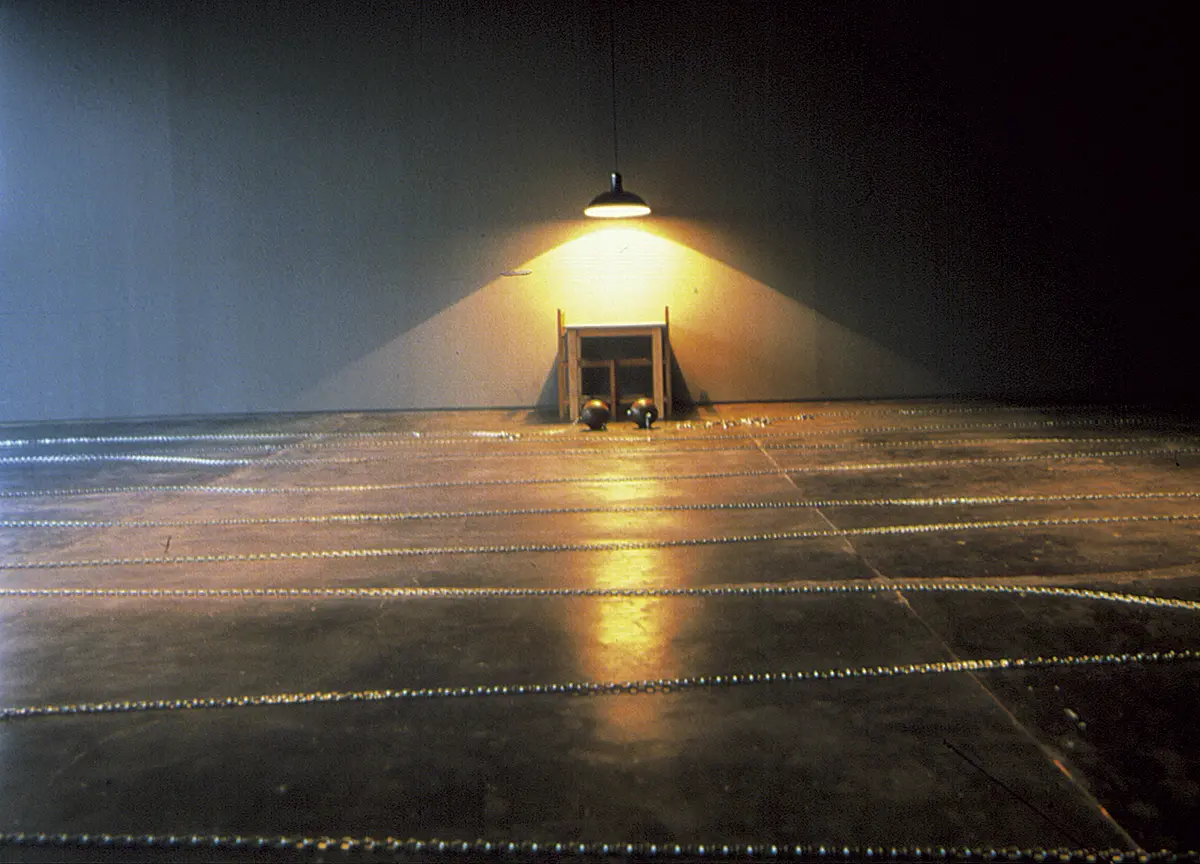
Cildo Meireles. Strict, 1999. Installation detail. Courtesy: Galería Luisa Strina.
For Meireles, the multisensory approach to the art object that was introduced by the Neo-Concrete artists (Hélio Oiticica and Lygia Clark, in particular), had significant aesthetic and social implications for his own work. Their heightened awareness of space and the movement of artists and viewers within that space is particularly noteworthy when discussing Meireles’s work. As early as the 1960s, he was exploring and questioning those relationships in Espaços Virtuais: Cantos (Virtual Spaces: Corners), 1967–68, and constructing three-dimensional sculptural environments. He has stated that much of his work is “concerned with a discussion of the space of human life . . . space in its various manifestations that covers psychological, social, political, physical, and historical arenas.” He creates conceptually oriented, sometimes labyrinthine installations and environments to resonate with evocative moral overtones. His work is informed by an interest in mathematics, physics, drawing, and construction, and all of these subjects are present in the installation Strictu, presented as part of the New Work series of projects by contemporary artists at the Miami Art Museum.
Strictu is a room-sized installation that was first exhibited in Bonn, Germany in 1999 and is presented for the first time in the United States at MAM. The walk-through environment allows the spectator to travel a winding path formed by lengths of chains on the floor that ends at a sharply lit table with two chairs. On the table is a piece of paper with a typed statement. Close to the table are handcuffs; iron prison balls are at the ends of the chains and key rings hang on the wall. The installation is dark and foreboding, and disturbing to navigate, and is meant as an exploration of power and control, and other aspects of authoritarianism. Since much of his work reveals the issues of power and oppression that are part of the historical description of Brazil’s struggle for cultural identity, the viewer must become an engaged participant. In this installation, the aesthetic strategies that lure the viewer into the dimly lit room and provoke sensations of fear and discomfort come from the immediate association with methods of interrogation and the objects that imply control.
The typed statement is particularly provocative. It begins with a quote the artist discovered by chance in New York in 1999 when he saw a television program that featured the Ku Klux Klan. The Grand Wizard of the Klan spoke about their enemies and how the Klan “want[ed] to steal their time. We want to steal their space. We want to steal their mind.” For Meireles, it was the perfect statement about the imposition of will, an undiluted expression of authoritarianism. Meireles continues in his own words, “Strictu takes a position against such a perverse and absurd illusion.”
Each viewer who enters the room Strictu must determine the extent of his or her interaction with the work. Its effectiveness depends upon how the viewer/participant questions the entire experience, while individual levels of discomfort, and perhaps recognition, persist and prevail.
CAROL DAMIAN