The 2002 Whitney Biennial signals both a return to tradition and a turn away from it. Both turns mark new directions for the flagship institution of American art and its relatively new leadership. The breadth of coverage, the largest since 1981—113 artists from 23 countries, working in 20 states and Puerto Rico—returns to the traditional survey format. What's new is the definition of American artists, now broadened to include anyone born in the USA working in another country and anyone working in the USA, regardless of their nationality. It is too early to guess the consequences of such a change over the long term but it offers the potential for new perspectives to the concept of American art, as well as colonization. However, 61 of the 113 artists live and work in the vicinity of New York, a telling fact at this time.
Architecture is represented for the first time with one group, as are offsite installations with five in Central Park, and a series of live sound performances on Friday nights. And the focus of the show is literally new, i.e., new media. There are numerous cybersites, performers, and sound artists and most significantly, video and film, constitute almost half of the exhibition. Conversely, there are few paintings, sculptures, or prints. Limited too is the usual vehicle for conceptual work—photographs. The photography shown returns to a documentary function and social commentary.
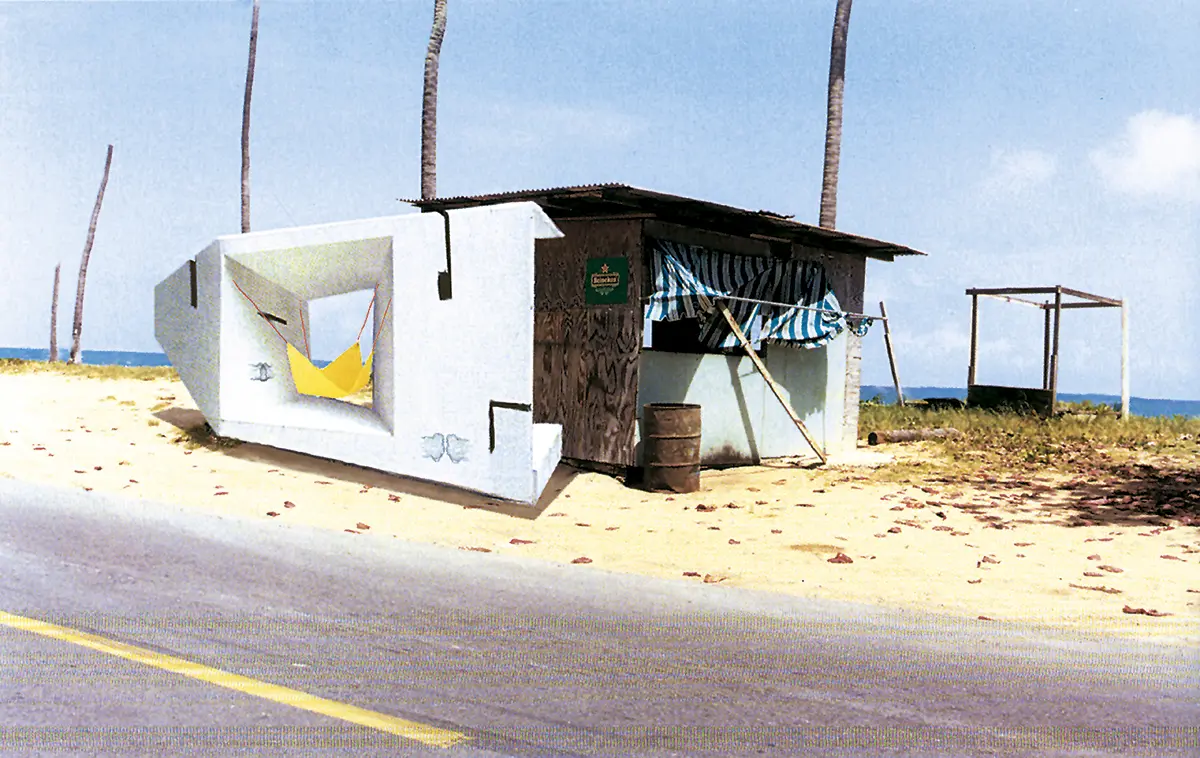
Javier Cambre. Habitat in Transit; Piñónes (In Situ), 2001. Wood, paint, graphite wall drawings, hammock, and wood shack. Variable dimensions.
Thematically there seems a new balance, in so far as it is possible to summarize such a diverse group. Much of the concerns, within and outside new media, are with liminal spaces and moments: literally, thresholds of passage created through confused or barely discernible relationships to the world. Ironically, this can take the form of topologies and the mapping of systems but is used to reveal complexities rather than to establish the world as measurable and discrete. Interestingly, the immaterialities of these thresholds are often directed back into the world: places and spaces where memory, perception, and cognition occur, but now less authoritatively, with an intermingling of presence and absence accepted and explored as the nature of reality.
Film and video naturally lend themselves to such explorations. But the life-world concerns of the immaterial moments are shared by much of the more traditionally materialist art that turns away from art-world conceptualism and back into real- or life-world situations. Abstraction in the Biennial means a process that frequently turns out of and back into worldly concerns. Even such abstract arts as sound aim at a materialist presence. Technology and the sciences frequently set the paradigms here and provide new sources as well as resources for art as for the rest of our world.
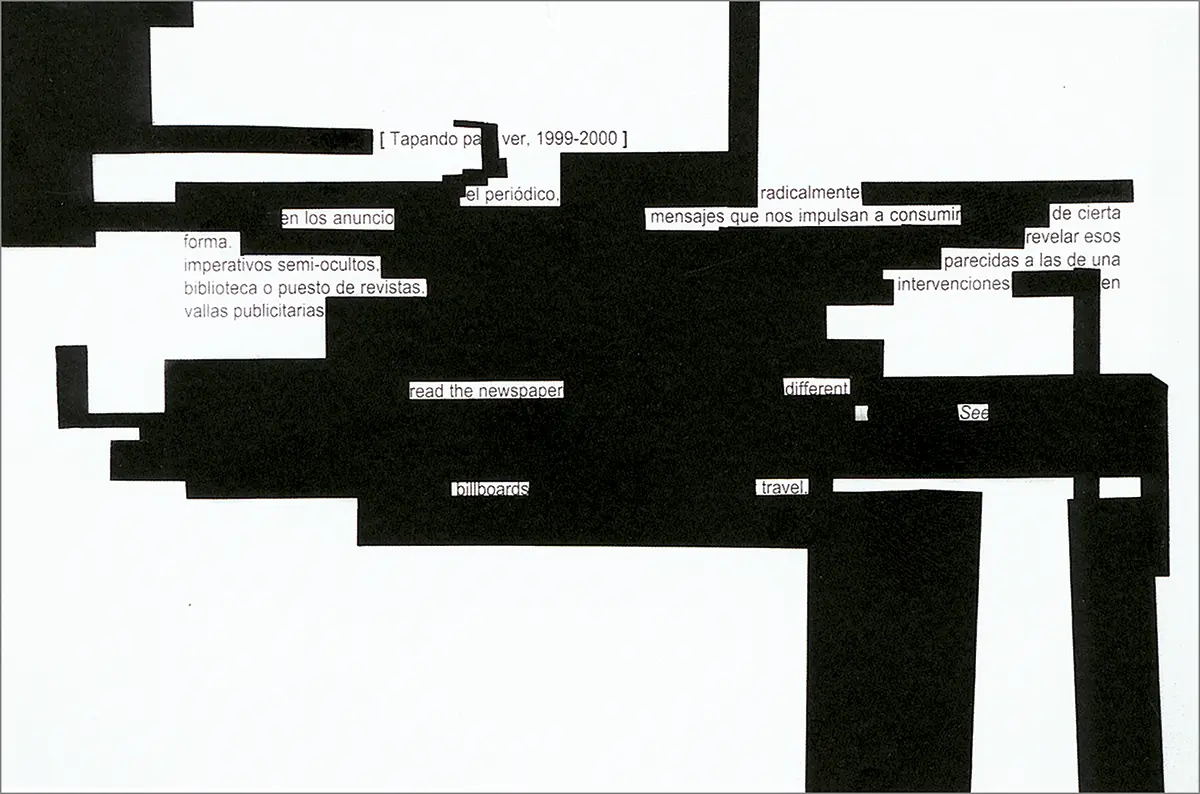
Chemi Rosado Seijo. Covering to See (Curator's essay intervened at the Museo de Arte de Puerto Rico), 2000. Detail. Contact paper on wall.
Film & Video
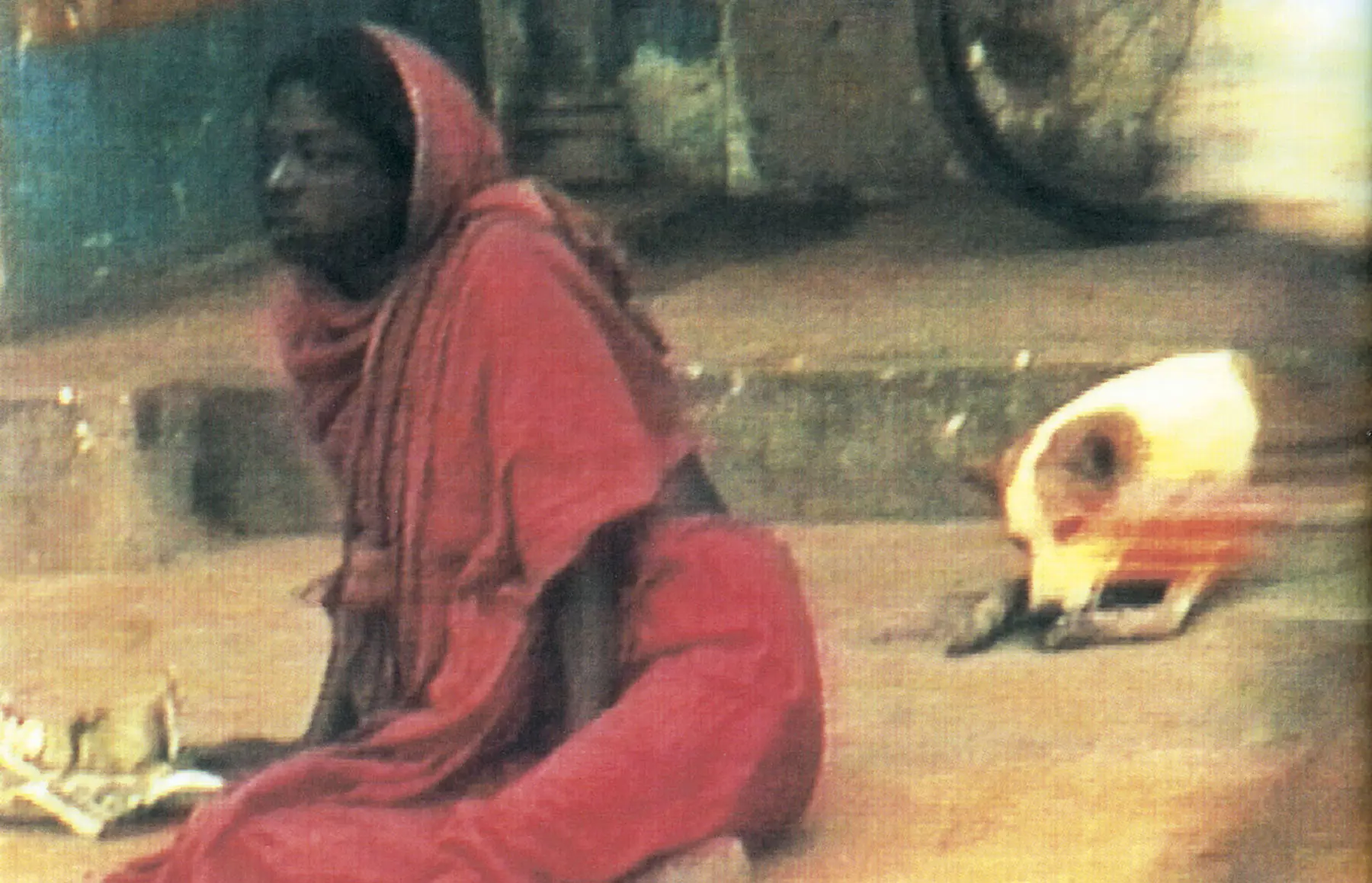
Surprisingly, the longer film and video pieces rather than the shorter ones seem most significant. Many of the brief pieces made rather singular and obvious if not cute, points. In contrast, Irit Batsry's 80-minute These Are Not My Images (Neither There Nor Here) was worth the full viewing and went on to win the Biennial's Bucksbaum Award of $100,000. Shot in color video and digitally edited, it is a multi-perspective, discontinuous narrative by a Western female filmmaker and two Indian males, each of whom is disconnected from the land and experience of India as expressed in apparently random voice-overs that speak of return and revision. Batsry establishes a haunting elusiveness, a space of thresholds neither there nor here, through saturated color, focus shifts and dissolves, and allowing Stuart Jones' soundtrack to linger after the disappearance of the image.
Her issues of the sense of absence within the presence and of an unfulfillable desire for materiality that slips away from us even though she/we resist through the materialism available in her media: saturated colors, motion, and a hyper-sensuality were major and poignant leitmotifs of many of the artists. There is uncertainty afoot in the Western culture—even pre-9/11—and many of the artists responded to it. As in much art of the late nineties and early new century, our objective embodied experiences of reality are reinforced through the physicality of technological media while the same media also embodies our subjective and mediated sense of reality. Neither dominates and this opens a slightly schizophrenic place that includes space and time as lights, colors, and, information. Such themes are found in the films and videos of Phil Solomon, Fred Worden, Silt, Stom Sogo, Bruce McClure, Luis Recoder, Andrew Noren, and Diane Kitchen, among others.
It is impossible to see all the works because they are spread across weekend showings grouped into 14 different programs requiring seven different days, and this is a problem the museum needs to solve. Two of the best seen by this viewer opened similar spaces through construction of far more direct narratives. Miranda July's video Nest of Tens, and Christian Jankowski's DVD projection The Holy Artwork, immersed the viewer in storylines that were combinations of fiction and fact both disquieting (July) and extremely humorous (Jankowski).
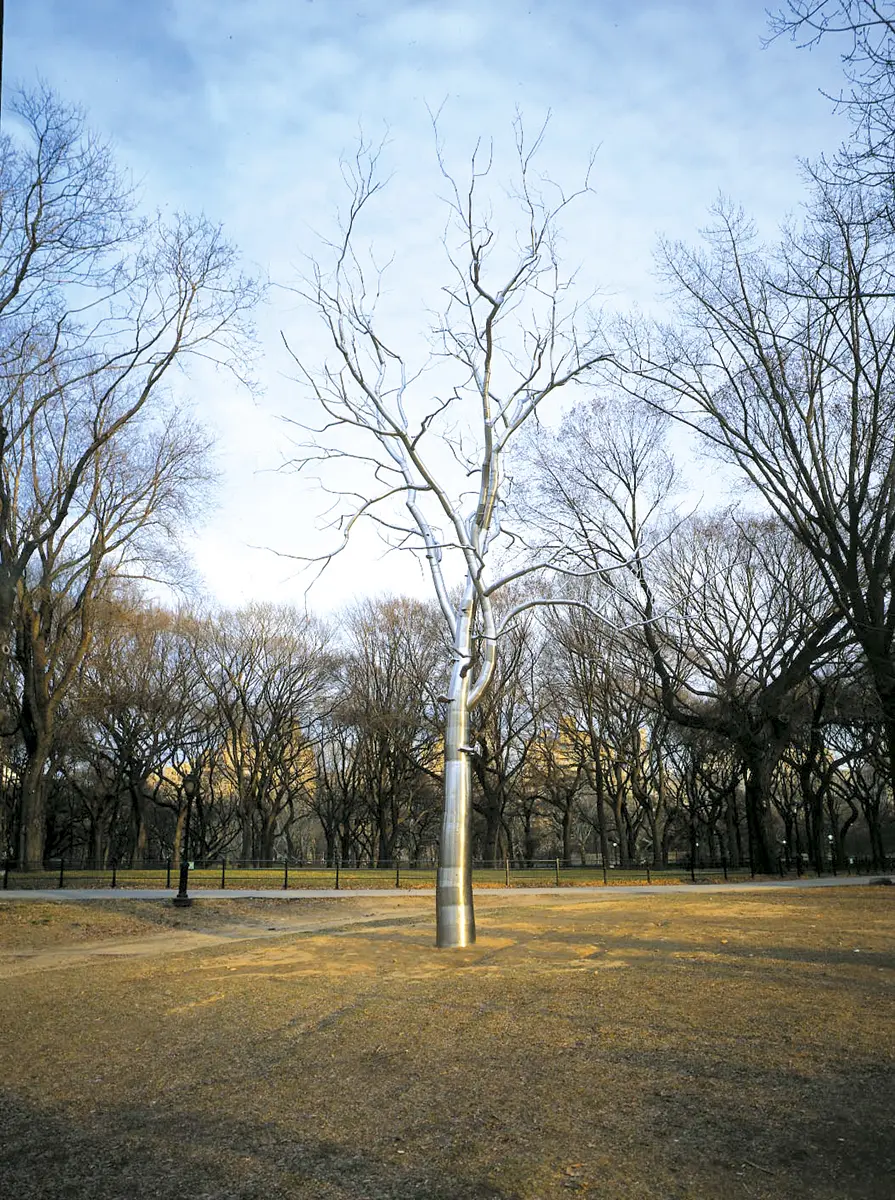
Roxy Paine. Bluff, 2002. Stainless steel. 47 x 43 in. (119,4 x 109,2 cm.). Courtesy: Public Art Fund; James Cohan Gallery, New York.
Latin Artists
Javier Cambre, born in San Juan with studies in Medellín and Chicago, now living in Queens, split apart a kiosk from the beachfront area outside San Juan (Piñones), added a modernist white wooden structure that echoes the Marcel Bruer windows of the Whitney Museum—where it sits in the exhibition—and left half of it in Puerto Rico. Inside the modernist portion is a space that emulates his boyhood bedroom, complete with a hammock. The split between homes and self is fused with the politics of capitalism as luxury hotels destroy the kiosks and force out the working class these roadside vendors once served.
Chemi Rosado Seijo, a resident of Puerto Rico, uses the metaphors most common to popular culture: disposability, fragmentation, and the remix, or in his terms, Tapando para ver (Covering to see), in his video and radio rebroadcasts. He creates not art objects but interventions that connect and disconnect him (and us) from life. Here, large, flat, crude wooden crates which symbolize both the transience of shipping and a newsstand display, contain newspaper pages collected through his travels, with large sections covered by black charcoal. We see only what he allows. Filters of censors, filters of life. Impressive is his El Cerro Project in Puerto Rico, represented by a photograph, where he has worked with the residents to repaint their houses, the entire barrio in green paint to blend into the hillside.
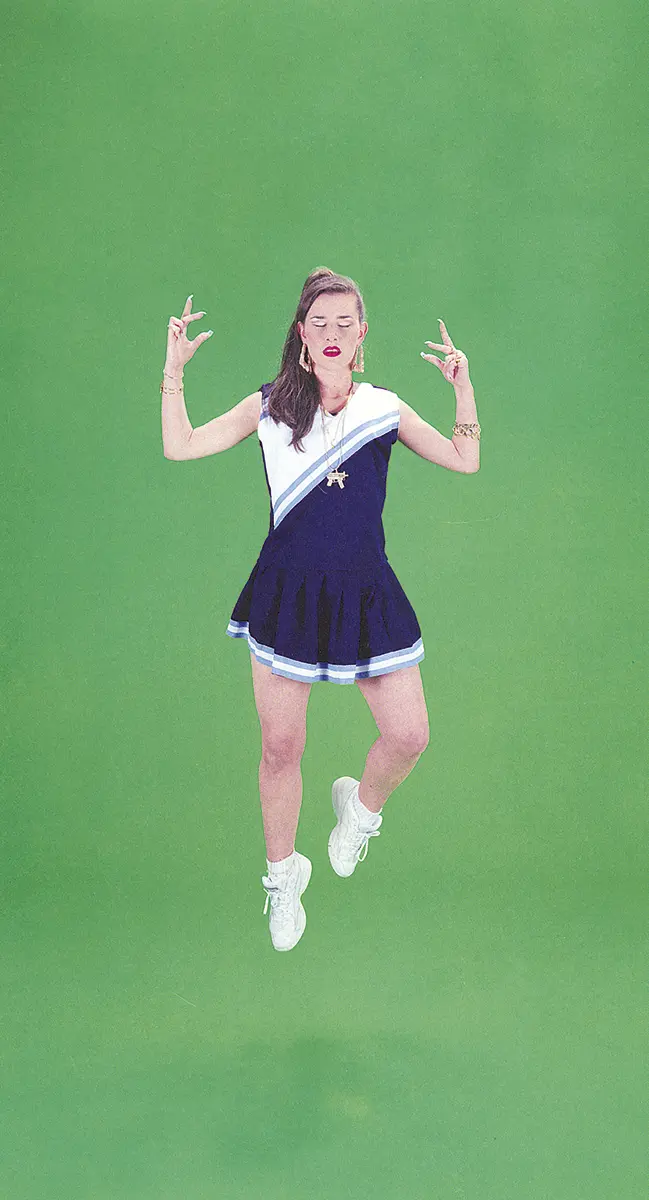
Luis Gispert. Untitled (Single Floating Cheerleader), 2001. Fujiflex print mounted on aluminum. 72 x 40 in. (182,9 x 101,6 cm.). Courtesy: Massimo Audiello, New York.
The photographs and installations of Luis Gispert, born in Jersey and living in Brooklyn, accept that hip-hop is contemporary Baroque. His Untitled (Single Floating Cheerleader) rises like a Baroque Madonna, replete with overpainted lips, long blue fingernails, and heavy gold jewelry (one piece replicates a favored automatic street weapon). Her eyes are closed and her arms raised as she cheers/ascends, her hands form either religious mudras or throw the viewer a street/hip-hop sign. Is it any wonder that popular culture, essentially seamless and without contradictions, exerts such a strong pull when it can so easily embody our daily seamless contradictions?
John Leaños from California, also fuses several forms of fact and fiction in complex ways. His installation Remembering Castration: Bloody Metaphors in Aztlán, uses the small archeological museum as his model to mount vitrines, photographs, light boxes, and the informational labels of a non-existent archeologist who had discovered the lost land and ritual beliefs of Aztlán (the once real, now mythic land stretching from Mexico through the United States, and accepted as the ancestral home of many Chicanos). His fiction which contains facts reminds us that history is filled with empowered distortions. The contemporary memory of Aztlán fuses with its forgetting to assemble a fictitious mythology but one that also reasserts cultural fact.
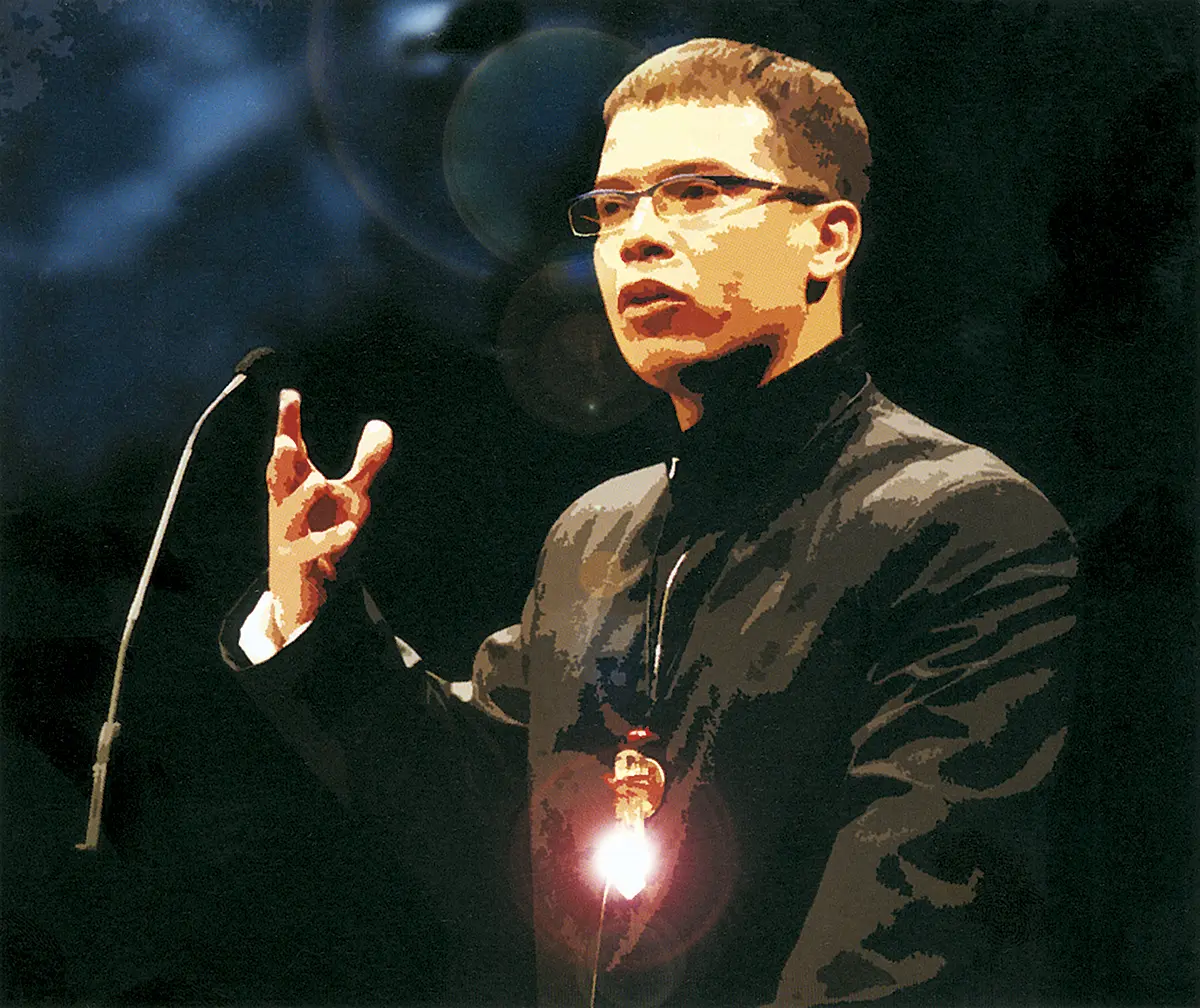
José Álvarez. Knowledge Session, Number IV (Tonal), 2001. Performance.
This complex understanding of the ways in which our senses of reality are constructed through multiple conversions of facts and fiction is also at the heart of the installation of José Álvarez, a New Yorker, who infuses old myths with artistic fame. His longstanding public performances as 'Carlos', an ancient spirit he channels, were not presented. But the media coverage of those performances, and one is not certain whether it is real or forged, loops across six television monitors, making media THE channel of empowerment. The video projection peep-show in the back wall shows Carlos wandering the halluci nogenic mushrooms made famous by the real-time anthropologist Carlos Casteñada and his Yaqui bruho, Don Juan. We are now lost and found in the myriad connections between vision and image, reality and representation, space and time, fame and power.
The old but unfinished intersection of art with popular culture and entertainment seems more fully understood by the many young artists here. It means they are beginning to understand and use their own culture more critically.
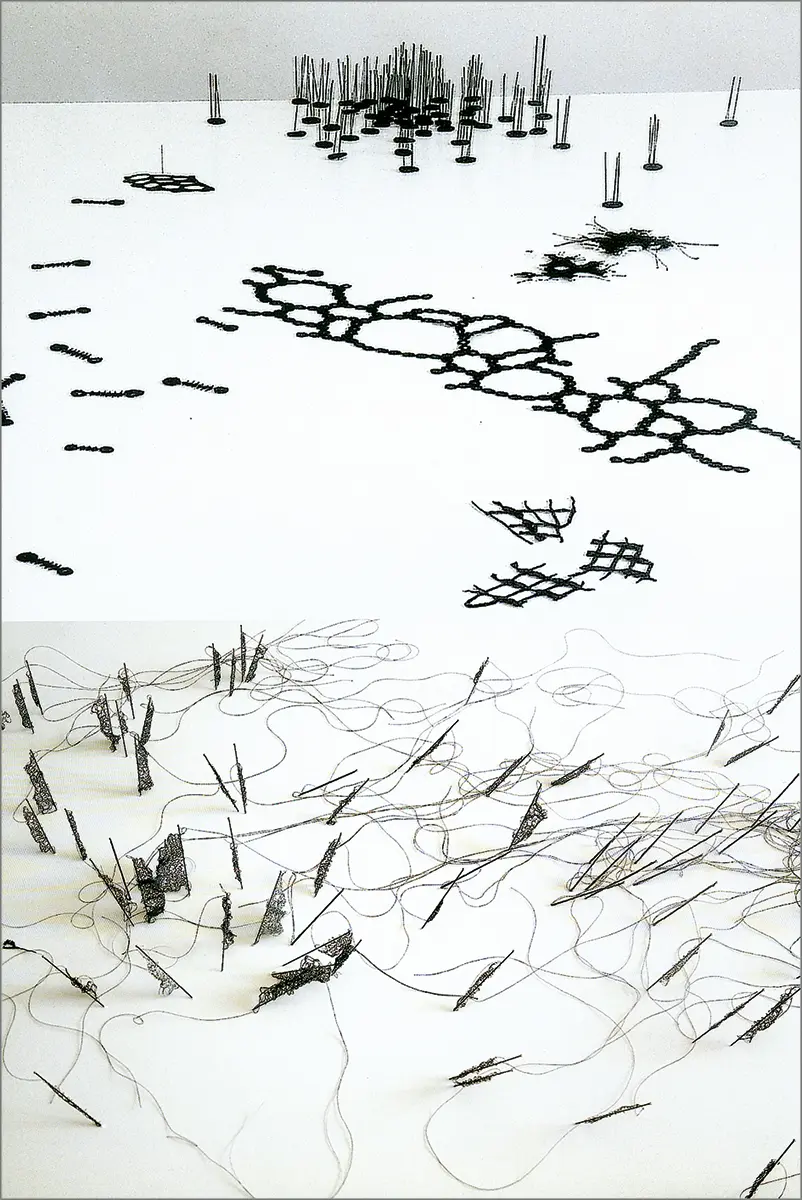
Anne Wilson. Topologies (3-5.02), 2002. Lace, thread, cloth, pins and painted wood support. Variable dimensions. Courtesy: Revolution Gallery, Detroit.
Other Themes & Issues
Many works are interested in strucures and systems: the myriad ways in which relationships are formed and perceived. When the structures are of power and influence they are often hidden. The website by Josh On & Fu ture Farmers, They Rule, maps the interlocking boards of, many U.S. companies. But the ability of art to evoke rather than state was best in Anne Wilson's Topologies (3-5.02). Delicate and obsessive webs and networks of black lace and thread spread and separated over a 20-foot table have the ability to simultaneously evoke the multiple webs and systems that surround and define us, from nature to cities to cyberlinks. Typical of much Biennial work, likely influenced by the internet, there are no hierarchies or privileging of one form over another.
The emergence of cooperative groups was also noticeable, as was the pervasive influence of music. In addition to the musicians who performed and recorded for the Biennial, many artists used music as a conceptual paradigm, often from their own experiences as musicians. Much of the web art remains in love with its own systems, codes, and complexities rather than in constructing issues of human use. An exception to that is Margot Lovejoy's website, Turns (www.myturningpoint.com), which gives a graphic interface and visualization to the collection and sharing of personal stories of turning points to which the viewer may contribute. This is an effective fusion of database and narrative that utilizes the richness and non-linear possibilities inherent in the new media. One speculates that it is Lovejoy's years of work in multi-media and digital installation and her willingness to work with a cooperative team (Hal Eagar, John Legere, Marek Walczak) that enrich her vision of cyberspace.
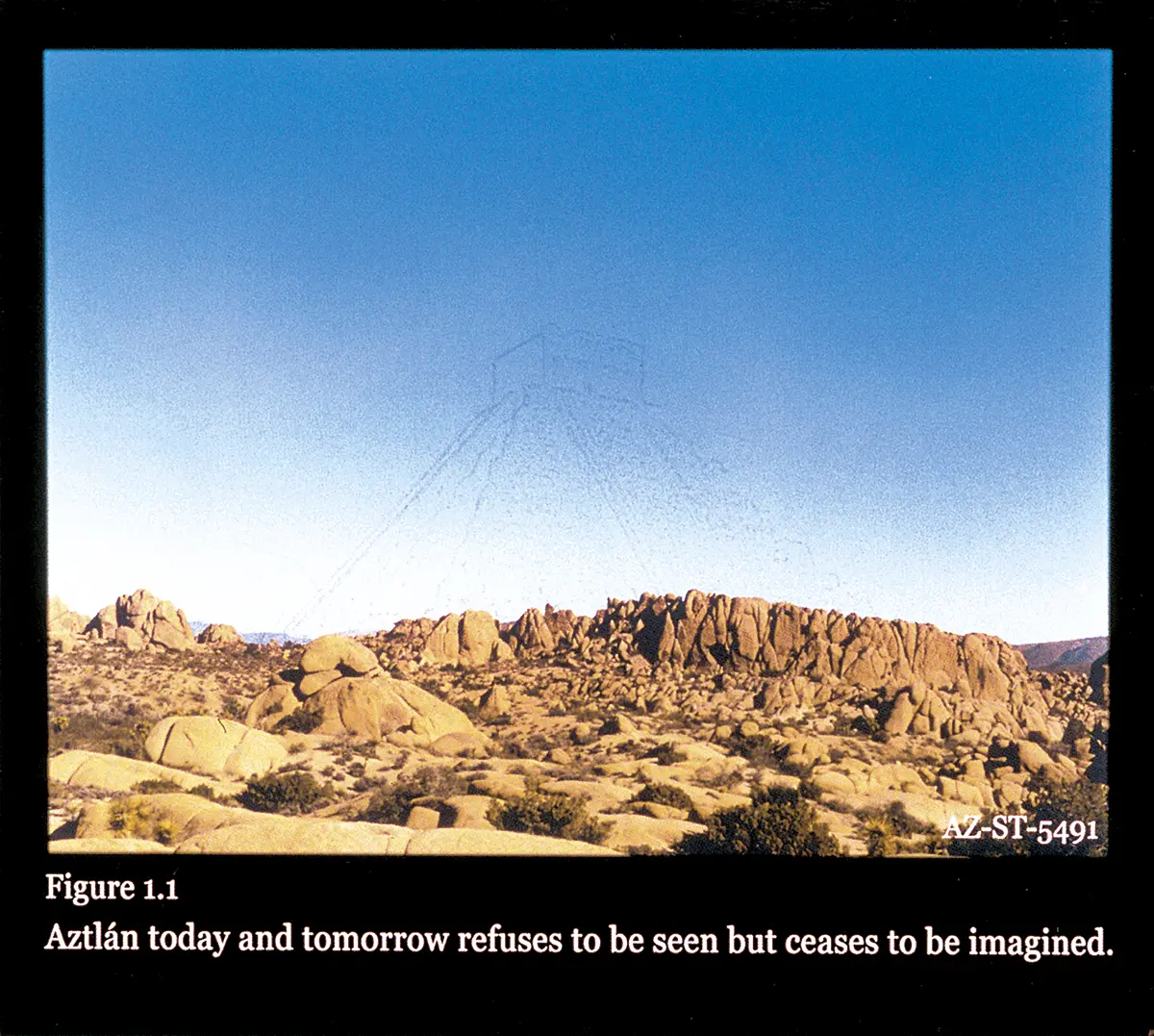
John Leaños. Remembering Castration: Bloody Metaphors in Aztlan, 2000. Detail of the installation at the San Francisco State University Art Gallery. Photograph in a lightbox. Variable dimensions.
Concluding Remarks
One hopes the Biennial retains its breadth and more global understanding of American art, despite the dangers. The issue of architecture is rich in possibilities not yet explored here. No doubt film and video make the exhibition a major force but viewing needs to be more frequent. The offsite sculpture and inclusion of sound, though a bit disappointing in their accomplishments, remain viable, and the Friday night performances are sorely needed. The catalog needs two versions: a brief early version and a more fully illustrated and developed edition produced after the works have been installed. The Whitney has not answered the burning question of this time period—the relation between art and entertainment—but only because the art world has not yet decided. And it may be in its own best self-interest to continue to finesse the topic.
Were the organizers tendentious? Yes. They sacrificed the richness of painting on the altar of new media. What the Whitney has done is provide a rich forum for our explorations on the state of the arts. But a word of warning to the Whitney administration for taking advantage of 9/11 in their catalog essays to yoke it to the freedom of creativity and coincidentally to the importance of the Biennial and its new breadth. Be very careful; more nuanced. The last time we did this we were part of the CIA agenda for Cold War rhetoric. Today Silicon Valley video game developers are working for the CIA and think it's a pretty neat idea, all those toys for creativity.
RICHARD LESLIE
Independent art historian, critic, and curator in New York. He specializes in contemporary art, visual and digital culture, and theory. He has published several books and was Managing Editor of the journal Art Criticism.