This tenuous thread of life that separates us (1997-1999) was the title of a show that José Miguel Rojas, painter, and poet, recently presented at the Valanti Gallery in San José, Costa Rica. A figurative artist, Rojas becomes, during each stage of his creative process, an artisan, a researcher, or an alchemist searching for ways to express in visual terms the ghosts which torment him. Concerns of a human, political, and social kind, as well as love, both requited and unrequited, are transformed into images that painfully cover the surface of his canvases, visual metaphors gestating in an introspective and ontological process.
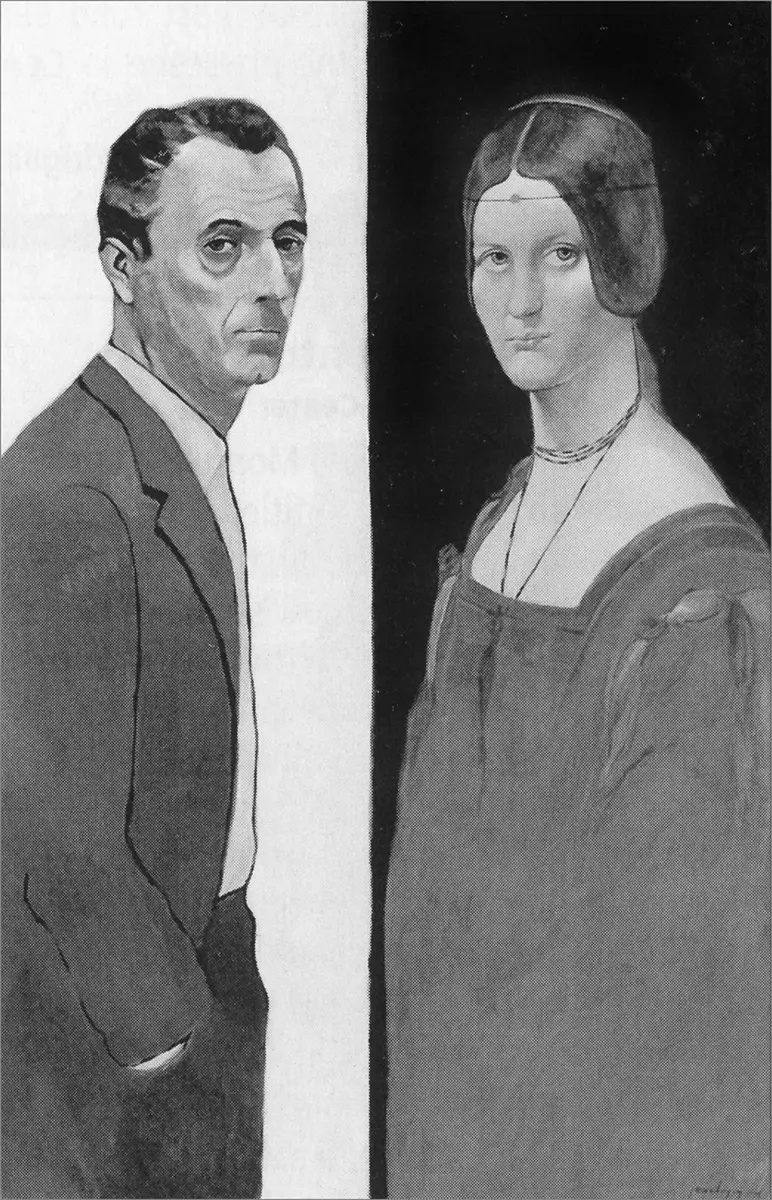
At the beginning of the 1980s, Rojas explored thematic and textural dimensions which brought him close to informalist painting. This was the springboard for his first one-man show, entitled The Unburied, neo-figurative works that pointed ahead to the path which the artist would pursue. There is a clear atmosphere of protest, or at least social nonconformity, in Rojas' painting. The series titled The Transgressors (1986), The Motocyclists (1985-1989), and The Amusements (1988) revealed aspects of his interest in assemblage and collage, which became a socio-political theme in the series titled Power to Images. Rojas has pursued these solid paths, paved with the experience he gained in Germany and other European countries, with the fierceness of someone who knows what he is achieving in his art.
Man and his fears, concerns, and unease with his private and public life, would seem to be the central theme of the work of this young Costa Rican artist. Why look beyond the figures which make up Latin American reality? The themes are there, and Rojas makes use of them as he searches for the most appropriate techniques for each of his series. Poetry, writing, and painting combine in his desire for visual expression, where the metaphors reflect the feelings, fears, and hopes of a being who finds himself most of the time lost in the darkness of the night. From the mid-1990s, Rojas has focused on the expression of feelings through the figures of men and women, as in the series Amatorio (1995-1997)and his new one-man show, where the iconography attempts to explore "fears, frustrations, weaknesses, and passions through the drama of couples or the simple solitude of individual human beings." When we look at the pictures, they clearly embody understanding your feelings. Passion? Disappointment? 'a, Frustration? The entire series can be seen as a psychological study of the human being. Rojas does not paint portraits, but rather the iconography of the human being in contemporary society: a solitary being par excellence. The artist's mastery of his technical resources explains the impeccable nature of the painting, where the images are revelations of solitude set in some indefinite time, but where the spaces are perfectly measurable. The artist seems to believe in the possibility of exploring the unknown through his intuition and knowledge of the world, the vibrations of the soul in moments of encounter and separation. The figures appear almost always in couples, but they do not come together or even seem to know their individual selves. The virtual absence of color, coupled with the strongly expressionist nature of the brush strokes and line work (and in particular, the use of charcoal), are the main characteristics of this painting, which is almost drawn, by one of the most solid personalities of the art scene in Central America.
BÉLGICA RODRÍGUEZ