Obituario19 de mayo de 2008
Raúl Lozza
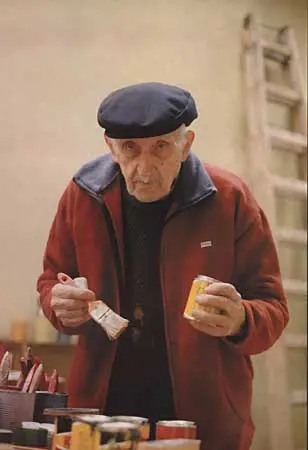
Learning of the passing of Raúl Lozza was received with an enormous sense of loss. He was a master of Argentine and Latin-American Art in more than one way, became a protagonist in the Argentine avant-garde from the decade of the Forties, and was a pioneer of concrete art. He also became a permanent reference for young artists who felt themselves represented by his thinking and saw in his work an authentic source of visual research. It is because of this that Lozza is a ¿historic¿ artist, as well as a ¿young¿ artist born in 1911, a spiritual colleague of younger generations of artists. Beyond the specific value of his work, Lozza offered an exemplary life that was guided only by his vocation. He was indifferent to the glamour that came with success and the facile recognition stimulated by the market. In his Testamento Insólito (Unusual Testament), he said: ¿Fifteen hours of activity, 9 hours of sleep; a total of 24 hours dreaming. In other words, I dedicate these 24 hours every day to pleasure¿. That is the way this artist would speak at the age of 92. A humanist to the core, Lozza fought for social justice; he was jailed and was prosecuted for his ideas on freedom. He was not solely a revolutionary in the art world, but also in the political and social spheres. He desired to place the viewer in direct contact with things and leave the fiction behind. He pointed his finger at the deceit to which people are dispatched when they only learn about the world through the mass media. With scientific gravity, Lozza created a color theory that was not illusionist. Each form possessed a corresponding color, according to the artist¿s notion of ¿qualimetry¿, and each form-color was required to fall at an equal distance in relation to the plane, both in reality and visually, according to the notion of ¿co-planarity¿. Lozza adopted the irregular frame, rejected the traditional resorting to window-framing, and attempted to avoid pictorial background by placing the forms directly on the wall. Although for practical purposes these were finally adhered to a wooden support, this should be interpreted not as background, but as a fragment of the wall; in this fashion, one sees it for what ¿it¿ actually ¿is¿. In 1947, Lozza distanced himself from his colleagues at the Asociación de Arte Concreto Invención (Concrete-Invention Art Association) to create a new artistic current known as Perceptivism. With this, he elevated to the highest possible level of coherence the proposals of the concrete artists. It is important to note that this association founded by Lozza was immediately acknowledged by the international art world. Max Bill said that after the group of concrete artists he directed in Zurich, the Argentine group was the most important. Lozza had the satisfaction of seeing the completion of a museum project in Alberti, his place of birth, located west of the Buenos Aires province. Inaugurated in 2003, the Raúl Lozza Museum of Contemporary Art displays works by this artist from all periods of his artistic trajectory. Among the most important recognitions this artist received while still alive were the Palanza Award, the Platinum Konex, the Leonardo Prize given by the National Museum of Fine Arts in Buenos Aires, and, more recently, the Premio Cultura 2007, awarded by the National Secretariat of Culture.