Nota de Arte11 de febrero de 2011
Base Paint Tents
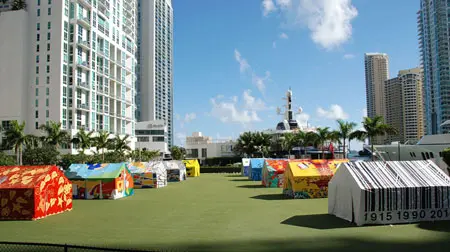
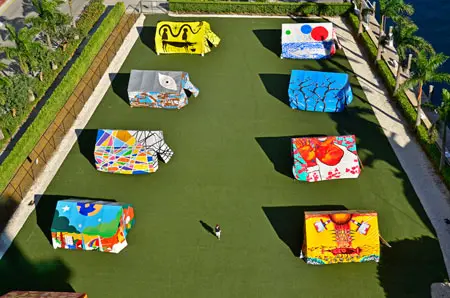
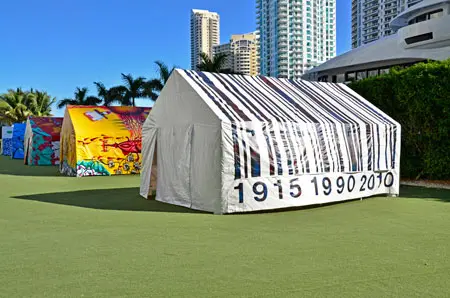
Base Paint Tents is a colossal artistic project that focuses on social emergencies. Based in Miami, the project is aimed at sensitizing and involving the public on the desperate need for help of the Haitian people. This past January 12 marked the first anniversary of the devastating earthquake that claimed the lives of 150,000 people and left more than 3,000 children orphaned. Today the Haitians continue to struggle for survival amid extreme living conditions. In November of last year hurricane Thomas landed in Haiti, adding to the destruction of a nation that, as of more recently, has been further weakened by a cholera outbreak that continues to have devastating effect. Base Paint Tents consists of ten huge tents designed and painted by contemporary Latin American artists who drew inspiration from the Haitian cultural ideology for creating hopeful universes. Presented in December of last year at the grounds of the EPIC Green estate on Biscayne Boulevard, it used the context of the Art Basel Miami Beach fair to sound the alarm of the need to rebuild and support our Caribbean neighbor. Later on the exhibition was presented at the Florida International University (FIU) exactly on the anniversary of the earthquake. Directed by Antuán Rodríguez, the project's central idea is that the education of children must become the driving force in the reconstruction of the country. Antuán invited ten international artists to develop a specific thematic that answered to one aspect of Haitian culture. These artists are Pedro Barbeito, José Bedia, Eduard Duval-Carrié, José García-Cordero, Nicolás Leiva, Leonel Matheu, Rubén Millares and Antonia Wright, Gean Moreno, Antuán Rodríguez and Elba Luis Lugo, and Damián Sarno. Some of the artists approached the theme of alphabetization, like Rubén Millares and Antonia Wright, who drew inspiration from creole poems to shed light on one of Haiti's most pressing issues: the high percentage of illiteracy. For his part, José Bedía drew inspiration from Haiti's popular beliefs to create his piece. Painted exclusively in yellows and blacks, his tent speaks about effort, sacrifice, discipline, and patience. On the tent's ceiling, Dambalah-one of the most important deities in Haiti-invokes the rain as one of the propitiatory signs of regeneration. The ceilings are one of the crucial elements of an exhibition that will be eventually placed at a designated area, just 1.24 miles away from the Port-au-Prince airport. They will become a perennial cry for help to all the flights that leave and enter the country. Once inside the tent, the feeling of being under a protective cover is vital. The intense tropical light lets the exterior painted surface enter through the translucent walls, creating an encouraging and protective atmosphere. This element was essential for the creation of Jose García-Cordero's tent, which included a blue canopy of heaven filled with tree branches that, like arms, extend their embrace to us. A replica or mockup of each tent is available for sale, the proceeds of which will be used to purchase furniture, materials, and school supplies with the objective of making each classroom operational. Base Paint Tents is an emergency call made from art. It represents one of those essential missions in which artistic expression abandons the saturated white cube and reconciles with life.
Gallery