ExhibitionJanuary 21, 2022
We Are History. Race, Colonialism & Climate Change
On view until February 6, 2022, Somerset House presents the exhibition We Are History, a perspective on humanity's impact on the planet by tracing the complex interrelationships between the current climate crisis and the legacies of colonialism.
The exhibition highlights 11 works by artists with personal connections to countries in the Caribbean, South America, and Africa, foregrounding the perspectives of their communities as the source of resonant ideas and images related to social and environmental justice.
"We Are History," curated by Ekow Eshun, interrogates the environmental issues facing the global South by looking to the past and drawing important insight into the cultural, practices, and knowledge systems of indigenous peoples. He captures nature as a place of beauty and fragility through photographs, prints, textiles, installations, and videos.
Climate change is a theme that is often linked to the beginning of the Industrial Revolution in the West, so "We Are History" invites visitors to look further back in time. To explore significant periods of change, such as the 18th-century colonial era, which saw plantation agriculture and the forced mass migration of people through slavery reshaping lives and landscapes on a global scale.
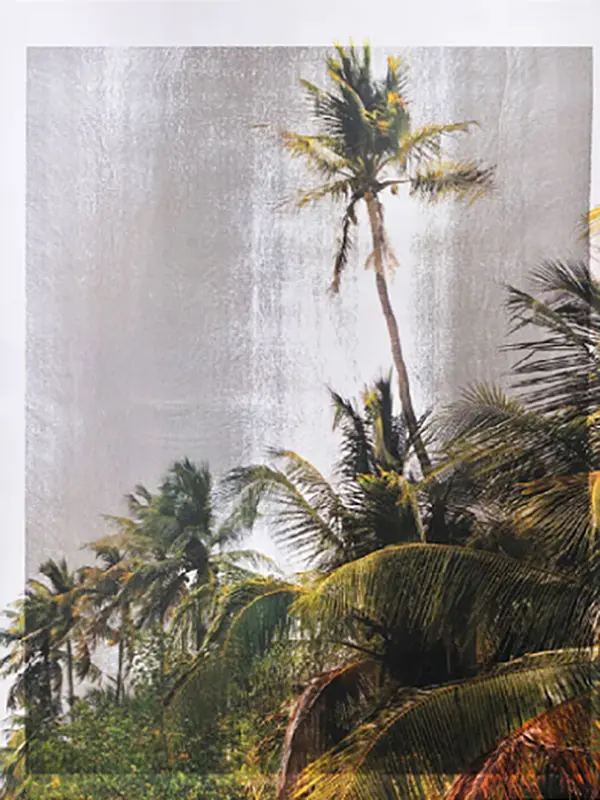
The exhibition begins with the work of Allora & Calzadilla, who cataloged sites in Puerto Rico where palm trees were used as biological markers by the U.S. military during its sixty-year occupation of the island to identify locations where hazardous waste had been disposed of. These sites, now paradoxically managed as Conservation Zones, were photographed by the artists, and intervened through silkscreen printing.
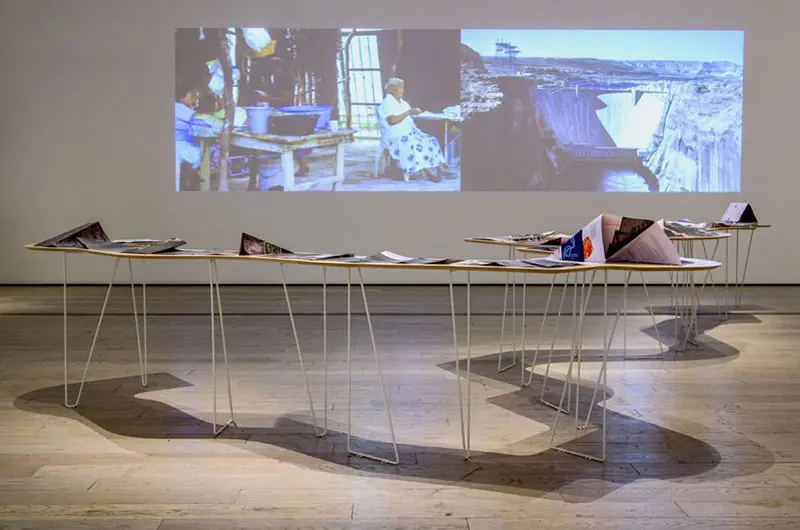
Carolina Caycedo looks to Colombia, Mexico, and Brazil to document the effects of the dams on the surrounding communities and landscapes. Features archival images, maps, poems, satellite photos, and researched texts, displayed in a meandering accordion-style artist's book. Her book "Serpent River" traces the power dynamics associated with the corporatization and annihilation of water resources and the activism of displaced communities.
French-Algerian photographer and video artist Zineb Sedira presents two large-scale photographs, "The Lovers" (2009) and "Sugar Routes I" (2013), that document the movement of sugar for mass consumption across the Atlantic from the southern hemisphere, reflecting on the history of human migration across oceans.
Colombian artists Mazenett & Quiroga explore the relationships between living organisms and how the "resources" in their mineral and biological ecosystems are appropriated and expanded across cultures, becoming an integral part of globalized economies and our daily lives. Drawing on a fascination with the jaguar, present as a physical and spiritual animal in most Native American cultures, the artists explored the animal's habitat in the Colombian Amazon and the Lacandon jungle of Mexico, where mineral mining threatens the environment.
Featuring artists Alberta Whittle, Allora & Calzadilla, Carolina Caycedo, Louis Henderson, Malala Andrialavidrazana, Mazenett Quiroga, Otobong Nkanga, Zineb Sedira, and Shiraz Bayjoo.
The exhibition highlights 11 works by artists with personal connections to countries in the Caribbean, South America, and Africa, foregrounding the perspectives of their communities as the source of resonant ideas and images related to social and environmental justice.
"We Are History," curated by Ekow Eshun, interrogates the environmental issues facing the global South by looking to the past and drawing important insight into the cultural, practices, and knowledge systems of indigenous peoples. He captures nature as a place of beauty and fragility through photographs, prints, textiles, installations, and videos.
Climate change is a theme that is often linked to the beginning of the Industrial Revolution in the West, so "We Are History" invites visitors to look further back in time. To explore significant periods of change, such as the 18th-century colonial era, which saw plantation agriculture and the forced mass migration of people through slavery reshaping lives and landscapes on a global scale.
The exhibition begins with the work of Allora & Calzadilla, who cataloged sites in Puerto Rico where palm trees were used as biological markers by the U.S. military during its sixty-year occupation of the island to identify locations where hazardous waste had been disposed of. These sites, now paradoxically managed as Conservation Zones, were photographed by the artists, and intervened through silkscreen printing.
Carolina Caycedo looks to Colombia, Mexico, and Brazil to document the effects of the dams on the surrounding communities and landscapes. Features archival images, maps, poems, satellite photos, and researched texts, displayed in a meandering accordion-style artist's book. Her book "Serpent River" traces the power dynamics associated with the corporatization and annihilation of water resources and the activism of displaced communities.
French-Algerian photographer and video artist Zineb Sedira presents two large-scale photographs, "The Lovers" (2009) and "Sugar Routes I" (2013), that document the movement of sugar for mass consumption across the Atlantic from the southern hemisphere, reflecting on the history of human migration across oceans.
Colombian artists Mazenett & Quiroga explore the relationships between living organisms and how the "resources" in their mineral and biological ecosystems are appropriated and expanded across cultures, becoming an integral part of globalized economies and our daily lives. Drawing on a fascination with the jaguar, present as a physical and spiritual animal in most Native American cultures, the artists explored the animal's habitat in the Colombian Amazon and the Lacandon jungle of Mexico, where mineral mining threatens the environment.
Featuring artists Alberta Whittle, Allora & Calzadilla, Carolina Caycedo, Louis Henderson, Malala Andrialavidrazana, Mazenett Quiroga, Otobong Nkanga, Zineb Sedira, and Shiraz Bayjoo.
Gallery