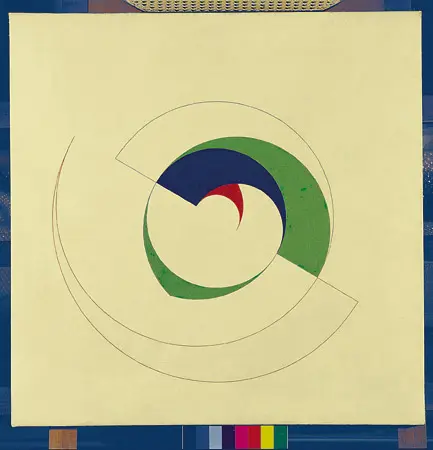
Vontade Construtiva na Coleção Fadel, MAR – Rio de Janeiro
Throughout the Twentieth Century, non-figurative art reached such a wide scope in Brazil that it became a thread of Ariadne to be unraveled by critics. The exhibition titled Vontade Construtiva na Coleção Fadel, shed new light on this topic, revealing aspects of an artistic language that found its Latin American pioneers in Brazil and Argentina.
The show, curated by Palo Herkenhoff and Roberto Conduru, featured nearly 250 works from the collection amassed by Rio attorney Sergio Fadel. The idea was to highlight the direct connection that existed, and continues to exist, between modern and postmodern movements as a solid foundation for the country's culture.
It is possible to locate the stat of this artistic movement in names that were still wholly connected to the academic tradition, such as Belmiro de Almeida, who painted Maternidade em circulos in 1908. In this work, the scene of a mother holding a baby to her bosom is represented by overlapping circles of different sizes, with the points of overlap used for the chromatic and spatial organization of the canvas. This is unique moment in the artist's career, which critics at the time defined as a flirtation with Futurism.
Nevertheless, despite being seen only as a one-off flirtation, this painting by De Almeida (who was also a master caricaturist) already signaled the way to an aesthetic language that was to expand over the entire world, with Brazil as a vigorous incubator, as demonstrated by the earliest Modernist experiments along the lines set by Tarsila do Amaral, who, in her antopofagia phase would display the whole strength of visual synthesis.
While the European avant-garde was laying the ground for abstract art in explicit movements, such as Russian Constructivism, already in the early Twentieth Century, the trend gained momentum in brazil especially after WWII, with the adoption of a geometric abstraction already transformed into a universal artistic language. The sow presented variants of the constructive idea through individual quests and group moves, through the 1960s, 1970s and 1980s, decades when the exploration incorporated socio-political themes, conceptualism, and a revision of Modernism.
It is worth noting the peculiarities that define this kind of art in Brazil, beginning with the debates between Ruptura, the São Paulo-based group more rationalistic in its approach, and Frente, the Rio group that emphasized the need for a more humanistic art. The activity of the latter group's members, all the way to those that ultimately committed to Concrete Art, was marked by an artistic freedom that reconciled abstract-art principles with other references, both contemporary and past. These differences determined a break between practitioners of concrete art in the country and culminated in the launching of Neo-concretism. The manifestos, the works, and the public debate that characterized the end of the decade transcended the movement's boundaries and connected with other critiques of constructivism, the practices of the local art world, and Brazil's general cultural environment, especially the ideas of rationality and progress.
The word "will" ("vontade") in the exhibition's title also resonates with the adoption of a more individualistic perspective, a desire that, despite the universalist context, suggest a subjective emphasis. This is to say, how to understand and evaluate artists whose poetic force goes beyond collective or regional trends, and who interpreted Constructivism freely: Alfredo Volpi, Milton Dacosta. Pancetti, Lygia Clark, Tarsila do Amaral, Hélio Oiticia.
For instance, reductionism was always a risk in any analysis of the painter Alfredo Volpi (1896-1988). The exhibition reveals that the uniqueness of his art require...