Constructive Will in the Fadel Collection
This exhibition, open through July 7th, is inspired in a well known statement by Helio Oiticica, according to whom Brazilian art can be defined by its "constructive will". Te show brings together nearly 230 works by Brazilian visual artists who participated in the Concrete and Neo-Concrete movements and developed their oeuvre in the 1950s and 60s, as well as artistic expressions that emerged between 1960 and 1980, when experimentalism incorporated sociopolitical notions, ideas form conceptualism, and a revision of modernity. The objective is to demonstrate the direct relationship between these movements and Brazil, as well as the transversal nature of constructive art since the Baroque period in Eighteenth Century Brazil, which is the main topic of the show.
Curated by Paulo Herkenhoff and Roberto Conduru, the selection of works includes names such as Volpi, Tarsila do Amaral, Anita Malfatti, Hélio Oiticica, Lygia Pape, Lygia Clark, Cicero Dias, Aleijadinho, Willys de Castro, among others.
The exhibition begins with the presentation of a series of works representing the Afro-Brazilian legacy of Candomblé, and continues with Lygia Clark's "Bichos" and some miniatures by Aleijadinho. The diversity of the Fadel collection is reflected in this selection of works, which puts forward the idea that the "constructive will" has been present since Baroque times. Through forms, shadows, and mathematics, this exhibition wants to express the diversity of this ideas by means of an investigation of specific group movements.
At the same time, the exhibition reflects the contributions of the Fadel family as one of Brazil most important collections, with more than 1,700 works, bringing now to the public only a portion of its holdings.
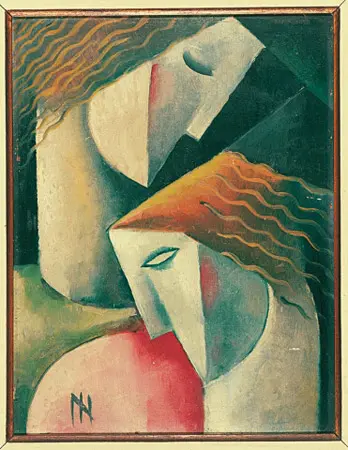
"Constructive Will" emphasizes the constructive participation of modernistas from the 1920s and 30s, with works such as Ismael Nery's Duas Figuras (1928), Tarsila do Amaral's A Boneca (1928) and Nu Cubista (1923), Di Cavalcanti's Roda de Samba (1929), and portraits of Mario and Oswald de Andrade by Anita Malfatti.
Starting in the 1940s and 1940s, the show includes examples of concrete and neo-concrete art, with representatives of the São Paulo-based Ruptura group, like Waldemar Cordeiro, Lothar Charoux, and Anatol Wlaislaw, and of the Rio group Frente, like Ivan Serpa, Lygia Pape, Lygia Clark (Bicho, 1960), Hélio Oiticica (Relevo especial, 1959) and Aluísio Carvao (Branco e Preto , 1959).
The program posited by the show's curators concludes with what is known as the second constructive generation, 1960-1980. During this period, the works selected are influenced by social, economic, and political development in Latin America. The work of Sergio Camargo, Ubi Brava, Ascanio MMM, Anna Maria Maiolino, Antonio Dias, and Waltercio Caldas stand out.
For more information, visit the MAR museum's web page at http://www.museudeartedorio.org.br