ExhibitionMay 21, 2025
Veemente - Gabriel de la Mora
The Museu Oscar Niemeyer (MON) is showcasing the exhibition "Veemente" by Mexican artist Gabriel de la Mora, under the curation of Marcello Dantas. Featuring 70 works—including installations, mixed media canvases, and sculptures—most of which were created between 2000 and 2025, this collection highlights not only the artist's aesthetic journey and evolution but also the unique variety of materials he employs. These works push the boundaries of traditional supports and pigments, showcasing de la Mora's innovative approach to art.
"Gabriel de la Mora's art provokes a fundamental reflection on our time and invites us to reframe the ordinary, to look more closely at what we have discarded or forgotten," says the Secretary of State for Culture, Luciana Casagrande Pereira. "It's an exhibition that dialogues with contemporary themes and reinforces MON's commitment to bringing the public powerful experiences connected to global art discussions."
MON's director, Juliana Vosnika, emphasizes that the artist invites us to reconsider our gaze and perception through his thought-provoking paintings, installations, and sculptures crafted from unconventional, discarded materials. "Nothing in his intense and extensive work is obvious. Everything results from an insight into human nature, its feelings and sensations," she says.
In the process of creation, the artist transforms found objects into raw material for unique works of art, evoking the concept of ready-made. "There is always a message, addressing sustainability, the passage of time, and the cycle of life, translated into works full of beauty and movement," says Juliana.
Curator Marcello Dantas describes Gabriel de la Mora's work as a deep exploration of materials, focusing on both the physical and conceptual boundaries involved in the processes of collecting and reconstructing. "At first glance, his works may seem abstract, sculptural or even minimalist. However, a closer look reveals that nothing is as it seems," says Dantas.
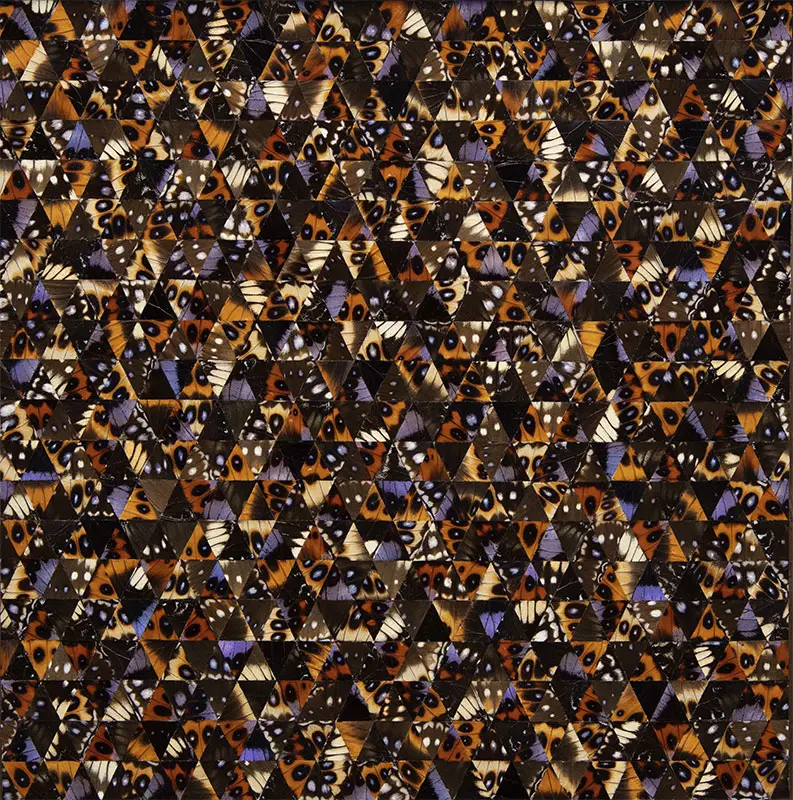
"His works are made up of unexpected elements: strands of hair, fragments of mirrors, eggshells, shoe soles, butterfly wings, and other traces of everyday life," says the curator. "His technique denotes an almost obsessive process that transforms the raw material into new shapes, patterns, and textures. The continuous repetition of the artisanal gesture—sometimes restorative, sometimes destructive—reveals a method that challenges the viewer's visual and sensory experience," he says.
"Gabriel de la Mora's art provokes a fundamental reflection on our time and invites us to reframe the ordinary, to look more closely at what we have discarded or forgotten," says the Secretary of State for Culture, Luciana Casagrande Pereira. "It's an exhibition that dialogues with contemporary themes and reinforces MON's commitment to bringing the public powerful experiences connected to global art discussions."
MON's director, Juliana Vosnika, emphasizes that the artist invites us to reconsider our gaze and perception through his thought-provoking paintings, installations, and sculptures crafted from unconventional, discarded materials. "Nothing in his intense and extensive work is obvious. Everything results from an insight into human nature, its feelings and sensations," she says.
In the process of creation, the artist transforms found objects into raw material for unique works of art, evoking the concept of ready-made. "There is always a message, addressing sustainability, the passage of time, and the cycle of life, translated into works full of beauty and movement," says Juliana.
Curator Marcello Dantas describes Gabriel de la Mora's work as a deep exploration of materials, focusing on both the physical and conceptual boundaries involved in the processes of collecting and reconstructing. "At first glance, his works may seem abstract, sculptural or even minimalist. However, a closer look reveals that nothing is as it seems," says Dantas.
"His works are made up of unexpected elements: strands of hair, fragments of mirrors, eggshells, shoe soles, butterfly wings, and other traces of everyday life," says the curator. "His technique denotes an almost obsessive process that transforms the raw material into new shapes, patterns, and textures. The continuous repetition of the artisanal gesture—sometimes restorative, sometimes destructive—reveals a method that challenges the viewer's visual and sensory experience," he says.