Book ReviewsJune 30, 2025· By Humberto Valdivieso
Un minuto con las artes. Micros culturales. Volume I
Books, like life, are made of time. We sense this when moving through syntaxes where words acquire an order; when experiencing the slow or frenetic rhythm of reading, or the length of stories within stories; when sensing the writer’s laborious days, or the duration of texts in their readers’ souls. Un minuto con las artes (A Minute with the Arts) brings together all these properties and experiences. This volume is also a rhizome where the radio, social networks and the publishing world coexist, entangled.
The authors are Susana Benko, art critic and researcher; Rafael Castillo Zapata, writer and professor; Álvaro Mata, professor and editor; and Humberto Ortiz, philosopher and professor. They offer us a journey through the visual, performing, musical, literary and architectural arts. A journey “against oblivion,” as writer and editor Antonio López Ortega states in the Prologue. Following the intense brevity of a one-minute radio transmission, these authors walk the corridors of universal and national cultures. Appealing to research, memory and fine taste, they lecture on Marcel Duchamp, Elías Crespín, Honoré de Balzac, Erik Satie, the New Circus of Caracas, the Church of San Vitale in Ravenna, the Cemetery of the Children of God, poetic inspiration, The Kiss by Constantin Brâncuși and beauty in Leonardo, among many other topics. But beware: these brief lectures have nothing to do with quick fixes or syntheses. They are what Deleuze and Guattari called haecceities. What does this mean? Well, that the book is made up of texts that possess degrees of intensity: more or less radio, more or less literature, more or less networks, more or less history. Hence their beauty and seductively hybrid style.
When entering the pages of this cultural artifact, we traverse multiple dimensions and get the feeling that we are learning different ways of relating to a theme, a story, and anecdotes that are strangely linked to our life experiences. Who cares how old and geographically distant they are. Everything leads us to other worlds without the need to leave our own. This is due to the pertinent relationship between brevity and universality; between mass media’s formats and art. Here we encounter the cultural and experiential environments characteristic of the mythology of the electric age that led Marshall McLuhan to assert that “the medium is the message.” And also, to Federico García Lorca’s poetics, halfway between dreams and the conscious life: “I want to sleep for a while, / a while, a minute, a century; / but let everyone know that I have not died.”
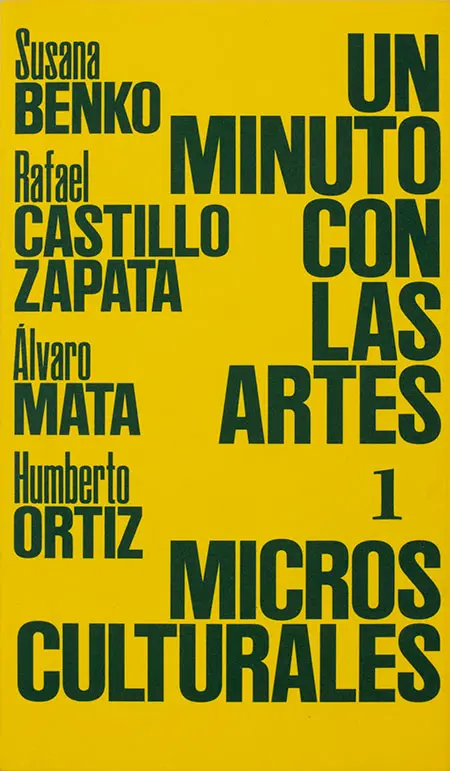
It is also essential to highlight the book’s extraordinary design, conceived by VACA (Gabriela Fontanillas and Álvaro Sotillo), with the assistance of Eddy Reinoso. Its format, logo, typography and color variations remind us of time’s presence. It’s got a pamphlet-like feel to it, with a nod to an emergency manual. It is portable and precise. Its size, clarity, and readiness are connected to the energy of the city, the speed of the media, and the voices of all the stories woven into words.
What has been said so far allows us to affirm that this book is defined by its refinement. Something increasingly strange in our century’s voracious culture. It has an intrepid exquisiteness that does not ask for distance or pretend to speak to small circles of connoisseurs. On the contrary, its authors are motivated by their enthusiasm for a culture that is open to the world and connected to people’s daily lives. The success of Un minuto con las artes lies in a subtle combination of the brevity of radio and digital media, with great writing, research, and intelligence.
The 120 texts gathered in this beautiful first volume are also the promise of what is to come in the next editions: more culture, more design and more exciting stories. In time, we will have a collection that will undoubtedly become one of the most precious fetishes in our libraries.
Humberto Valdivieso
Researcher, art critic and professor at the Universidad Católica Andrés Bello, in Caracas.
The authors are Susana Benko, art critic and researcher; Rafael Castillo Zapata, writer and professor; Álvaro Mata, professor and editor; and Humberto Ortiz, philosopher and professor. They offer us a journey through the visual, performing, musical, literary and architectural arts. A journey “against oblivion,” as writer and editor Antonio López Ortega states in the Prologue. Following the intense brevity of a one-minute radio transmission, these authors walk the corridors of universal and national cultures. Appealing to research, memory and fine taste, they lecture on Marcel Duchamp, Elías Crespín, Honoré de Balzac, Erik Satie, the New Circus of Caracas, the Church of San Vitale in Ravenna, the Cemetery of the Children of God, poetic inspiration, The Kiss by Constantin Brâncuși and beauty in Leonardo, among many other topics. But beware: these brief lectures have nothing to do with quick fixes or syntheses. They are what Deleuze and Guattari called haecceities. What does this mean? Well, that the book is made up of texts that possess degrees of intensity: more or less radio, more or less literature, more or less networks, more or less history. Hence their beauty and seductively hybrid style.
When entering the pages of this cultural artifact, we traverse multiple dimensions and get the feeling that we are learning different ways of relating to a theme, a story, and anecdotes that are strangely linked to our life experiences. Who cares how old and geographically distant they are. Everything leads us to other worlds without the need to leave our own. This is due to the pertinent relationship between brevity and universality; between mass media’s formats and art. Here we encounter the cultural and experiential environments characteristic of the mythology of the electric age that led Marshall McLuhan to assert that “the medium is the message.” And also, to Federico García Lorca’s poetics, halfway between dreams and the conscious life: “I want to sleep for a while, / a while, a minute, a century; / but let everyone know that I have not died.”
It is also essential to highlight the book’s extraordinary design, conceived by VACA (Gabriela Fontanillas and Álvaro Sotillo), with the assistance of Eddy Reinoso. Its format, logo, typography and color variations remind us of time’s presence. It’s got a pamphlet-like feel to it, with a nod to an emergency manual. It is portable and precise. Its size, clarity, and readiness are connected to the energy of the city, the speed of the media, and the voices of all the stories woven into words.
What has been said so far allows us to affirm that this book is defined by its refinement. Something increasingly strange in our century’s voracious culture. It has an intrepid exquisiteness that does not ask for distance or pretend to speak to small circles of connoisseurs. On the contrary, its authors are motivated by their enthusiasm for a culture that is open to the world and connected to people’s daily lives. The success of Un minuto con las artes lies in a subtle combination of the brevity of radio and digital media, with great writing, research, and intelligence.
The 120 texts gathered in this beautiful first volume are also the promise of what is to come in the next editions: more culture, more design and more exciting stories. In time, we will have a collection that will undoubtedly become one of the most precious fetishes in our libraries.
Humberto Valdivieso
Researcher, art critic and professor at the Universidad Católica Andrés Bello, in Caracas.