AwardsSeptember 20, 2019
Beca Túnel de Escape 2019
During the month of August, the gallery of the Santa Catalina castle, located in Cartagena’s historic center, exhibited the winning projects of the Túnel de Escape Grant 2019. This grant has been in the portfolio of the Ministry of Culture’s National Stimulus Program since 2015.
The winners, Mario Opazo and Jhon Fredy Alzate, were chosen by a jury comprised of María Posse Emiliani (Túnel de Escape recipient in 2018), Rafael Ortiz, and Humberto Junca Casas.
The purpose of the competition is to select two proposals that refer, narrate, and prompt analogous reflections framed by the Caribbean region’s realities, history, and idiosyncrasy. For this edition, the grant was supported by the Escuela Taller Cartagena de Indias (Etcar), the managing entity for historical fortifications in the capital of the Department of Bolívar.
The evaluating committee considered the projects’ adjustment to the requirements established in the call for entries: that they be conceived as site-specific works for the Santa Catalina castle; that they be connected to the site and the Caribbean region, or acknowledge their history; that they foster an exploration of the Aljibe area, the Casamata and the Santa Catalina castle’s escape tunnel (Túnel de Escape in Spanish).
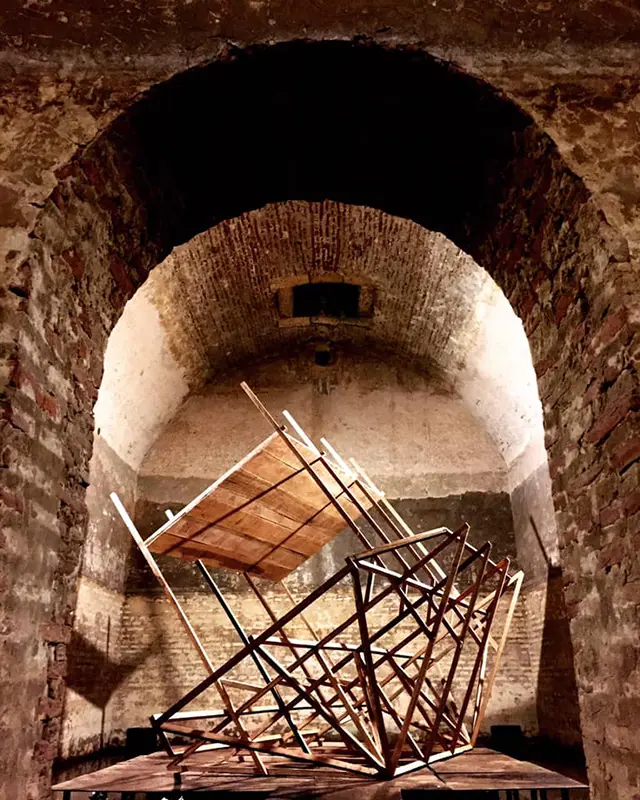
Mario Opazo’s project, Naufragio (de la serie canto de sirenas) [Shipwreck (From the Siren Song Series), proposes a visual-sound installation that includes features characteristic of the local indigenous settlements at the time of the Spaniard’s arrival on the continent, such as the bohío, as well as a reinterpretation of the skull-and-crossbones pirate flag.
For juror Rafael Ortiz, it possesses “an indubitably symbolic and poetic character, allusive to the journey of those forcibly brought to the America’s as enslaved people. It is coherent, clear, and pertinent in its reversion of elements in order to reformulate meanings and perceptions.”
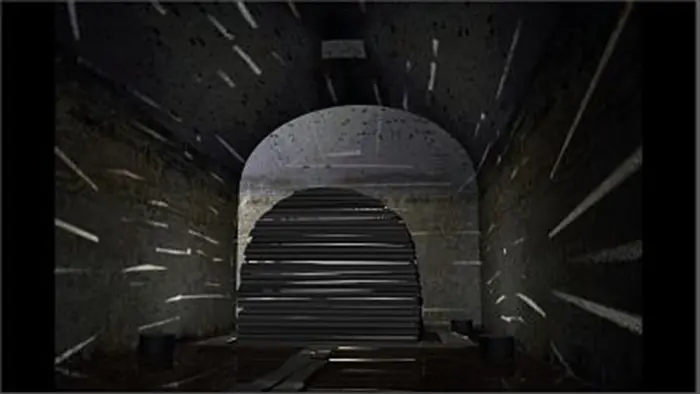
Fredy Alzate’s project, Arco de marea (Arch of the Tide) is an installation with wood, light, and sound as its protagonists. About it, the artist explains that “the perception of the place is altered with the motion and projection of light filtering through slots. Another ingredient for the viewer’s experience will be a sound dimension that connects with a distant urban landscape: the murmur of the city, with cadences and intensities that refer metaphorically to the sound of the tide as it ebbs and flows.”
The artists received stimulus funds in the amount of 30 million pesos each, for the pre-production, production, and installation of the exhibits.
The winners, Mario Opazo and Jhon Fredy Alzate, were chosen by a jury comprised of María Posse Emiliani (Túnel de Escape recipient in 2018), Rafael Ortiz, and Humberto Junca Casas.
The purpose of the competition is to select two proposals that refer, narrate, and prompt analogous reflections framed by the Caribbean region’s realities, history, and idiosyncrasy. For this edition, the grant was supported by the Escuela Taller Cartagena de Indias (Etcar), the managing entity for historical fortifications in the capital of the Department of Bolívar.
The evaluating committee considered the projects’ adjustment to the requirements established in the call for entries: that they be conceived as site-specific works for the Santa Catalina castle; that they be connected to the site and the Caribbean region, or acknowledge their history; that they foster an exploration of the Aljibe area, the Casamata and the Santa Catalina castle’s escape tunnel (Túnel de Escape in Spanish).
Mario Opazo’s project, Naufragio (de la serie canto de sirenas) [Shipwreck (From the Siren Song Series), proposes a visual-sound installation that includes features characteristic of the local indigenous settlements at the time of the Spaniard’s arrival on the continent, such as the bohío, as well as a reinterpretation of the skull-and-crossbones pirate flag.
For juror Rafael Ortiz, it possesses “an indubitably symbolic and poetic character, allusive to the journey of those forcibly brought to the America’s as enslaved people. It is coherent, clear, and pertinent in its reversion of elements in order to reformulate meanings and perceptions.”
Fredy Alzate’s project, Arco de marea (Arch of the Tide) is an installation with wood, light, and sound as its protagonists. About it, the artist explains that “the perception of the place is altered with the motion and projection of light filtering through slots. Another ingredient for the viewer’s experience will be a sound dimension that connects with a distant urban landscape: the murmur of the city, with cadences and intensities that refer metaphorically to the sound of the tide as it ebbs and flows.”
The artists received stimulus funds in the amount of 30 million pesos each, for the pre-production, production, and installation of the exhibits.
Gallery