ExhibitionFebruary 25, 2011
National Design Triennial: Why Design Now?
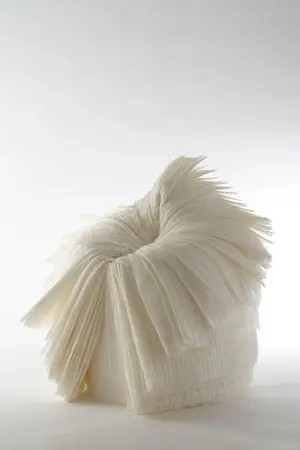
The Cooper-Hewitt, National Design Museum organizes exhibitions that center on design. The creation of the National Design Triennial confirms such focus. Although still called a National event, the fourth edition of the Triennial is actually global in scope. It was curated by Ellen Lupton, Cara McCarty, Matilda McQuaid, and Cynthia Smith. This edition offers a wide-ranging view of the reach and interaction of contemporary design in connection to human living and the environment. The event is divided into eight themes: community, communication, energy, materials, mobility, prosperity, health, and simplicity. Each section of the exhibition showcases examples of leaders of contemporary thought who rely on design as a tool to solve problems. Organized according to areas, the objects were accompanied by didactic labels and offered great examples of everyday interactive applications that encouraged visitors to participate. It included videos, and digital technology, available at no charge, to be used while in the exhibition space. Public voting allowed learning about the degrees of interest and understanding generated by the 134 projects from 44 participating countries. Age and social groups were taken into account for scientific development toward improving life, health, and simplification¿an incubator for neonutrition, for instance, was designed by teams from the U.S.A and Nepal. In "materials" the recycled pleated paper in the small individual "cabbage" chair, as well as applications for the agro and clothing industries, reveal the significant number of creative examples presented in the show. Likewise, the segment for energy conservation there are lamps, "energy" indicators for oceanic waves, and solar rechargeable flashlights, are just three of the nineteen proposals presented on that theme. The Triennial was made possible by the joint efforts of: GE, Agnes Bourne, Mondriaan Foundation, the consulates of Norway, Denmark, France, Switzerland, Finland, Holland, Israel, and the New York State Council on the Arts (NYSCA), the Esme Usdan Fund, Exhibition Endowment Fund, and Dr. Leonard Polonsky and Dr. Georgette Bennett