EventOctober 16, 2014
Yokohama Triennale 2014
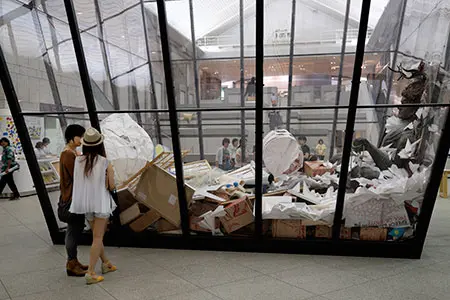
The enormous elicits the recollection of obvious things. But their obviousness does not mean that they have been overcome. Under the motto Triennale in the City, the Yokohama Triennale 2014 simultaneously covers all available spaces and exhibiting circumstances. Nonetheless, only two spaces are granted official status: the Yokohama Museum of Art and the Shinko Pier. The rest occurs at the periphery of the curatorial thread and lacks the historiographical paraphernalia of the white cube and its neat alchemical legitimacy. Artist Yasumasa Morimura takes the helm as the artistic director of the event and centers the exhibition around the theme of oblivion, an apparently diaphanous approach that nonetheless surreptitiously protects the triennial from being judged in terms of lack of consistency, articulation or substance. Usually obsessed with inserting his face in the realm of shared memories, Morimura reveals much more than his likings and personal contacts in the curatorship titled Art Fahrenheit 451: Sailing into the Sea of Oblivion, a proposal consisting of a double introduction and 11 chapters. The curatorial proposal opens with an apologetic gesture, a tribute to failed posterity that occupies the central nave of the museum and is as excessive and participatory as the triennial would like to see itself: a restaging of 'Art Bin' by YBA Michael Landy . It is a see-through dumpster for undesired art that, like death, equalizes all those involved. But only the epigenesis of actual death is banned, as the only works forbidden from participation are those that can rot or that contain "dangerous materials." A counter argument can be already observed just a few meters from Landy's work in "Offering", a series by artist Emiko Kasahara that reproduces several receptacles for religious donations from a wide array of cultures, placing them along interstitial spaces in both the pier and the museum. Each silent orifice surprises us where we least expect it, adorned with "do not touch" and titled with a female name that renders it explicitly genital and mysteriously political. It is not clear whether they are antidotes or merely new products of prevailing post-feminist forms, depoliticized in their self-promotional frenzy. The selection that occupies the space between the two scales is sharp and personal. It showcases an artist frontally creating art from art, respectfully weaving a capriccio that exempts itself from the logic of history. Inhabiting a hive made up of roughly outlined spaces, old sperm by Andy Warhol rests on two small white canvases that are about the same size of the one Karmelo Bermejo makes solely out of paint in his sculpture "Blank". González-Torres and Mendieta are present with the purpose of pointing to a rather intangible ecumenism, given that Gregor Schneider works hard in situ to remind us of the status quo. Photographer and curator, Morimura presents us with a resignifying of the journalistic: both invested through its inclusion in the exhibition (Ikko Narahara) and made unquestionable for its use of the vocabulary of art to make committed journalism (Taryn Simon). Despite being an event designed for its visitors—mostly from Japan and neighboring countries—the Yokohama Triennial is a purposely ambiguous and inconsistent exhibition, aiming for the visitor to willingly drift inside it rather than debate it.