Book ReviewsFebruary 3, 2023· By Jorge Sanguino
The Metropolis in Latin America, 1830-1930
Capital Cities and the Construction of National Identity
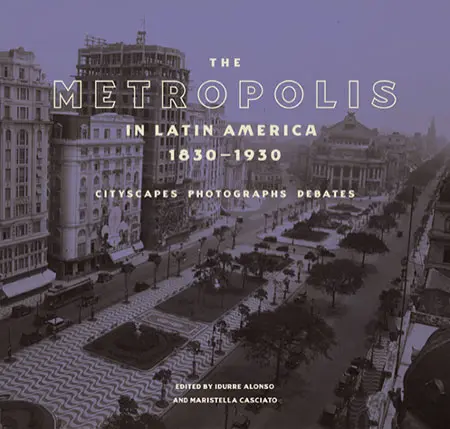
The Metropolis in Latin America, 1830-1930 - Cityscapes, Photographs, Debates, edited by Idurre Alonso and Maristella Casciato and published by the Getty Institute, is an educational and reference volume that complements the exhibition of the same title presented at the Institute and at New York City’s Americas Society between March and June, 2018 as part of the Pacific Standard Time Initiative (see ArtNexus 155, June-August, 2018).
In the almost 300 pages of this generously illustrated tome, the editors and several essay authors (see bibliographic note below) investigate the construction, urban development, and social effects of six Latin American capitals over a 100-year period: Buenos Aires, Havana, Lima, Mexico City, Rio de Janeiro, and Santiago de Chile. There are annotations concerning other cities, such as Caracas, Bogotá, and Veracruz, but these must be understood as references to the simultaneity of processes that took place in Latin America during that time.
In both the book and the exhibition, the concept of the metropolis is interpreted through its etymological meaning of “mother city”. With this, the authors intend to conceptualize the key role played by Latin American cities in the construction of national identities in the Nineteenth and Twentieth Centuries.
The essayists continuously point the reader towards the visual information included in the book. An ample selection of photographs, lithographs, watercolors, maps, and more, gathered from the Getty Institute’s own collection, serves as illustration of the historical conditions for the growth of Latin American cities, and also provides visual arguments in support of the authors’ historiographical hypotheses.
Therein resides the importance of these visual materials, freed from the nostalgic or romantic view of the cities in question that we often fall into in the face of old-time photographs; these materials play, instead, an epistemic role. They are clues to disentangle the traumatic processes of the post-independence disintegration of old colonial regimes, expressed in war and social upheaval, and their relationship with the establishment of Latin American metropolis in open competition with other, minor cities and provinces.
On more than one occasion, the authors are able to successfully thread historical events with the development of cities, affirming the thesis that the desire to break with the colonial past expressed itself in architecture and urban planning, synthesized in such dialectics as the transformation of the colonial city into the republican one, or analyzing the opposition between civilization and barbarism. In that way, independently yet harmoniously, the texts build a historiographical investigation around the following situations: the influence and adoption of European planning models, under the aegis of Baron Haussmann; the distribution of economic capacities for the construction of urban infrastructure, such as transportation and sanitation networks; the relationship between nature and the city, in particular the way in which public parks and botanical gardens transformed urban landscapes in Latin America; and, finally, the social and economic effects of the metropolis’ development. For example, migration from the countryside as well as European immigration to Latin American cities, while the cities established themselves as ports (or developed ports as extensions of the capital, as with Veracruz or Valparaíso) where export goods such as coffee gave rise to new modes of industry and labor.
Each author develops their own position with regards to the various situations and establishes, in turn, the limits of the visual archive at hand. The logic that dominates the visual documents, as demonstrated by Idurre Alonso’s essay, is the visibilization of bourgeois life in avenues and boulevards, political and urban plans for renewal, and each city’s aspiration to be called a “Paris of the Americas”; that same visual archive hides urban blight and poverty, as well as indigenous and afro-descendant peoples, workers, etc. On several occasions, the texts provide the number of buildings that had to be demolished in order for a new avenue to be built, and explain the consequences of such decisions: expropriation and the expulsion of poorer city dwellers towards the periphery of the city.
The essays also are able to explain how in the early Twentieth Century, just as indigenous peoples were rendered invisible, the indigenous past was appropriated by architectural languages, and identify these languages as strategies that scaffold the rise of political identities. At the same time, the specialists and technocrats who promoted the advent of the modern city also favored transatlantic exchanges, such as those that resulted from visits and sojourns by renowned urban planners like Forestier and Le Corbusier, among others.
In the case of the indigenous past, the authors shed light of the role played by the centennial celebrations of national independence in the 1910s, and the national pavilions designed for the Universal Expositions in Paris (1878 and 1889), San Diego (1915), and Seville (1929), conceived as a return of pre-Hispanic models. A group of local intellectuals, artists, and writers advocated for a return to local architectural traditions, with the purpose of promoting an identity that could find success through its insertion in the urban fabric.
Undoubtedly, the vitality of this book rests on the fresh, uncomplicated style in which the essays are written, supported by a laudable translation effort, which allows for a pleasurable reading and excursions into a rich visual archive, where more than one reader will find surprises about the cities they inhabit or know.
The metropolis in Latin America, 1830-1930. cityscapes, photographs, debates. Idurre Alonso and Maristella Casciato (eds.), Los Angeles. Getty Research Institute. 2021. Essays by Germán Rodrigo Mejía Pavony, Jorge F. Rivas Pérez, Arturo Almandoz, Sonia Berjman, David M. J. Wood, Maria Cristina da Silva Leme, Cristóbal Jácome-Moreno, Rodrigo Gutiérrez Viñuales.
The Metropolis in Latin America, 1830-1930 - Cityscapes, Photographs, Debates, edited by Idurre Alonso and Maristella Casciato and published by the Getty Institute, is an educational and reference volume that complements the exhibition of the same title presented at the Institute and at New York City’s Americas Society between March and June, 2018 as part of the Pacific Standard Time Initiative (see ArtNexus 155, June-August, 2018).
In the almost 300 pages of this generously illustrated tome, the editors and several essay authors (see bibliographic note below) investigate the construction, urban development, and social effects of six Latin American capitals over a 100-year period: Buenos Aires, Havana, Lima, Mexico City, Rio de Janeiro, and Santiago de Chile. There are annotations concerning other cities, such as Caracas, Bogotá, and Veracruz, but these must be understood as references to the simultaneity of processes that took place in Latin America during that time.
In both the book and the exhibition, the concept of the metropolis is interpreted through its etymological meaning of “mother city”. With this, the authors intend to conceptualize the key role played by Latin American cities in the construction of national identities in the Nineteenth and Twentieth Centuries.
The essayists continuously point the reader towards the visual information included in the book. An ample selection of photographs, lithographs, watercolors, maps, and more, gathered from the Getty Institute’s own collection, serves as illustration of the historical conditions for the growth of Latin American cities, and also provides visual arguments in support of the authors’ historiographical hypotheses.
Therein resides the importance of these visual materials, freed from the nostalgic or romantic view of the cities in question that we often fall into in the face of old-time photographs; these materials play, instead, an epistemic role. They are clues to disentangle the traumatic processes of the post-independence disintegration of old colonial regimes, expressed in war and social upheaval, and their relationship with the establishment of Latin American metropolis in open competition with other, minor cities and provinces.
On more than one occasion, the authors are able to successfully thread historical events with the development of cities, affirming the thesis that the desire to break with the colonial past expressed itself in architecture and urban planning, synthesized in such dialectics as the transformation of the colonial city into the republican one, or analyzing the opposition between civilization and barbarism. In that way, independently yet harmoniously, the texts build a historiographical investigation around the following situations: the influence and adoption of European planning models, under the aegis of Baron Haussmann; the distribution of economic capacities for the construction of urban infrastructure, such as transportation and sanitation networks; the relationship between nature and the city, in particular the way in which public parks and botanical gardens transformed urban landscapes in Latin America; and, finally, the social and economic effects of the metropolis’ development. For example, migration from the countryside as well as European immigration to Latin American cities, while the cities established themselves as ports (or developed ports as extensions of the capital, as with Veracruz or Valparaíso) where export goods such as coffee gave rise to new modes of industry and labor.
Each author develops their own position with regards to the various situations and establishes, in turn, the limits of the visual archive at hand. The logic that dominates the visual documents, as demonstrated by Idurre Alonso’s essay, is the visibilization of bourgeois life in avenues and boulevards, political and urban plans for renewal, and each city’s aspiration to be called a “Paris of the Americas”; that same visual archive hides urban blight and poverty, as well as indigenous and afro-descendant peoples, workers, etc. On several occasions, the texts provide the number of buildings that had to be demolished in order for a new avenue to be built, and explain the consequences of such decisions: expropriation and the expulsion of poorer city dwellers towards the periphery of the city.
The essays also are able to explain how in the early Twentieth Century, just as indigenous peoples were rendered invisible, the indigenous past was appropriated by architectural languages, and identify these languages as strategies that scaffold the rise of political identities. At the same time, the specialists and technocrats who promoted the advent of the modern city also favored transatlantic exchanges, such as those that resulted from visits and sojourns by renowned urban planners like Forestier and Le Corbusier, among others.
In the case of the indigenous past, the authors shed light of the role played by the centennial celebrations of national independence in the 1910s, and the national pavilions designed for the Universal Expositions in Paris (1878 and 1889), San Diego (1915), and Seville (1929), conceived as a return of pre-Hispanic models. A group of local intellectuals, artists, and writers advocated for a return to local architectural traditions, with the purpose of promoting an identity that could find success through its insertion in the urban fabric.
Undoubtedly, the vitality of this book rests on the fresh, uncomplicated style in which the essays are written, supported by a laudable translation effort, which allows for a pleasurable reading and excursions into a rich visual archive, where more than one reader will find surprises about the cities they inhabit or know.
The metropolis in Latin America, 1830-1930. cityscapes, photographs, debates. Idurre Alonso and Maristella Casciato (eds.), Los Angeles. Getty Research Institute. 2021. Essays by Germán Rodrigo Mejía Pavony, Jorge F. Rivas Pérez, Arturo Almandoz, Sonia Berjman, David M. J. Wood, Maria Cristina da Silva Leme, Cristóbal Jácome-Moreno, Rodrigo Gutiérrez Viñuales.