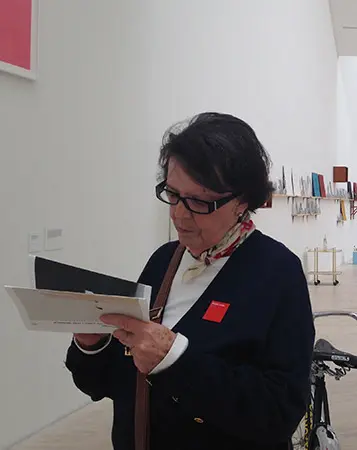
ObituaryApril 13, 2017
Teresa del Conde
The death of Teresa del Conde marks a significant loss in the cultural art scene of Mexico. Her great ability to cover academic and secular issues leaves a profound void in society. Trained as an Art Historian and Psychologist, Teresa del Conde integrated both disciplines into a well-balanced vision. She applied her education to the academic and institutional spheres as well as to art criticism. At the Universidad Nacional Autónoma de México (UNAM), she became a dependable member of the Institute of Aesthetic Research, both as researcher and professor, since 1975. As professor, she was often generous with her time and offered students advice on the development of their careers. Through her contributions she developed an image of exemplary commitment to the modern and contemporary visual arts fields in Mexico. Del Conde presented the research in several congresses and generated reflections among her colleagues, collectors and other people from the cultural sphere. She received important grants and recognitions. Beginning in 1981, and for over a five year period, she directed the Visual Arts Coordination section of the Instituto Nacional de Bellas Artes and, from 1990 to 2001, directed the Museo de Arte Moderno in Mexico City. While her facet as curator did not occupy the majority of her time, she did contribute to the discipline through angular points of view. Through the written word, she used her expertise to author books that became important contributions and also co-authored twice as many more in collaborations with other colleagues and writers (about forty). Likewise, numerous catalogs emerged from her pen. But the impact of her printed contributions does not end there. Teresa del Conde was one of the few experts that gave value to three different vectors: the publication of books, catalogs, and art criticism. The university environment as well as art away from the classrooms—in museums, galleries, and institutions—were impacted by her sharp gaze, her careful selecting, her ability to convey historical contemporary impressions, and her decision to address institutional truths and criticism whenever necessary. In a disciplined manner, every week, and for almost three decades, Teresa del Conde practiced art criticism in the Mexican periodical La Jornada and in other media—in the periodicals Vuelta, Uno Más Uno, as well as in national and international television. She also framed, expanded, and coined terminology for contemporary art history. She contributed two fundamental terms: Rupture and Neo-Mexicanism. Her authorship of the former is not certain, but that is no longer important. About the term Neo-Mexicanism, because of the controversy that it has caused as terminology and conceptualization, she said "sometimes I regret having published it." The shaping and practice of Art History pull the gaze towards the past, but every time a different past is formed that must be recorded as one reflects on it, but without losing the accelerated rhythm in which one lives. This concept has been strangled during this period of transmodernity. The "today" burns, the recent past is ashes at best or not even acknowledged at worst. This situation also was an intense theme of conversation filled with sadness and lamentations. With the exception of one individual that is still with us, the death of Teresa del Conde closes the chapter of a generation that continuously practiced art criticism. Writings on art—whether controversial or laudatory—involve the analysis of the society of the period covered and profound thinking about the individual and the collective.