Art NotesOctober 30, 2014
Temacapulín. Proyecto de una inundación.
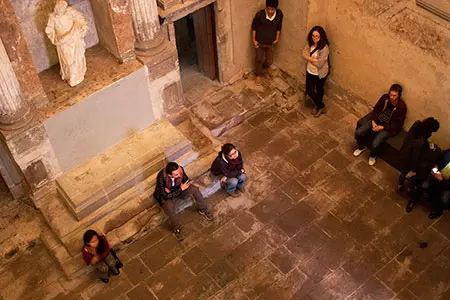
Ex Teresa Arte Actual, an alternative art space in Mexico City's historic downtown, hosted the work of the young sound artist Diego Martínez, who presented a project for the recovery of recent memory in a small village of Altos de Jalisco: Temacapulín, a town slated to become part of the El Zapotillo dam. The artist researched, through documents, the history of the dam project, including political and scientific-technical information, as well as the resistance movement organized by the villagers. These materials, donated by the artist to Ex Teresa's documentation center, were on display in the exhibition space, as was an installation of 7.1 audio channels reproducing a series of soundscapes from the town. The dam construction project involves the flooding of Temacapulín, which will disappear. Martínez's proposal has deep political undertones, shedding light on the absurdity of transforming the natural landscape and the vanishing of an entire village. Along with collaborators like Nelly Carrillo, Alejandro Gallo, and Israel Martínez, in 2013 the artist also recorded the town's sounds in order to generate an acoustic memory of the place before its disappearance. On the basis of these recordings, Martínez built intervened soundscapes. The exhibition at Ex Teresa also featured material collected by the artist around the resistance movement, presenting a series of recording of testimonials and meetings held by the locals. These documents are a central element (and a wise move) in the exhibition, as they allow us to understand the complex circumstances of the town of Temacapulín in a broader perspective. The sound work proposed by Martínez thus transcends the aesthetic domain and comes close to being journalistic and anthropological in nature. The inclusion of audiovisual materials, including the videos and documentation collected by the artist, facilitates the experience, as it anchors the audio-art proposal and connects it to data reflecting the depth of the research behind it. Martínez's work revisits a social movement that resists the pressures of a "progress" that refuses to take into account the human costs of its expansion. It brings to mind Goethe's Faust, where the sacrifice of human lives is a minor price to pay for advancement and progress. In that sense, Martínez's research-anchored proposal underscores and highlights the human consequences of this process and how absurd it can be to modify the landscape and obliterate a populated settlement in order to "move forward" with progress.