A Lygia Clark Retrospective
São Paulo's Itaú Cultural center presents a retrospective of works by Lygia Clark, the Brazilian painter and sculpture seen by some critics as foreshadowing the modern era of digital information.
The show, open to the public September 1st through November 11th, occupies three of the Itaú Center's galleries and is arranged aerially, as the work requires. A number of people were involved with the organization of the show: the curatorship is by Felipe Scovino and Paulo Sergio Duarte—following an architectural project by Pedro Mendes da Rocha—with the participation of Itaú Cultural center, the collaboration of the Associação Cultural o Mundo de Lygia Clark, and the support of Alessandra Clark, the artist's granddaughter.
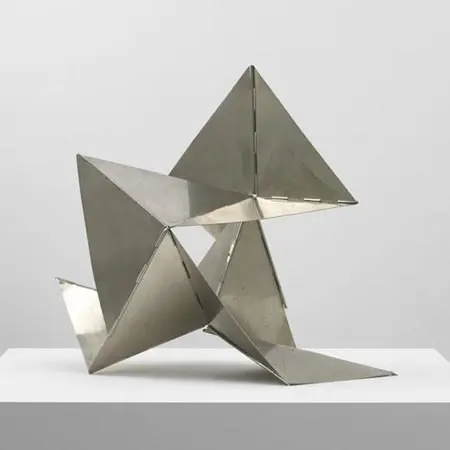
Among the works featured in the exhibition are some of Clark's best-known paintings, sculptures, installations, and sensorial objects: Ocupaçao, Bichos, Casa do Poeta, A Casa É o Corpo, Máscaras Sensoriais. In parallel, there will be seminars and film cycles with the projection of documentaries such as O mundo de Lygia Clark.
Lygia Clark's universe, presented through 145 of her works and four films by different authors, is characterized by her permanent interest in creating an art at the service of human freedom, the expression of her inner life and her emotions, and her concern with the relationship between art and society.
Born in Belo Horizonte, Minas Gerais, in 1920, Lygia Clark became an artist in 1947, as a student of landscape architect Roberto Burle Marx. Between 1950 and 1952 she studied in Paris with Fernand Léger and Isaac Dobrinsky. Returning to Rio in 1953, she joined Hélio Oiticica, Lygia Pape, and Abraham Palatnik, among others, in the establishment of the Grupo Frente artistic movement. Because of her konochrome painting, her neo-concrete sculptures, and her installations, she is considered one of the main figures in the Neo-Concrete Group founded in 1959.
Neo-Concrete artists wanted to create a modern, global kind of art opposed to the provincial style then popular in Brazil. An intuitive, yet subjective and expressive art. As a founder of the movement, Clark believed that art has to be organic, and that, in consequence, the audience had to be allowed to interact with the work. This concept was always present in her work, especially in later years, when she used art as a sensorial experiment for group therapy and made her works living experiences of healing.
In 1960 Clark won the Guggenheim International Prize in New York, one of her many recognitions. Between 1970 and 1975 she lived and worked in Paris, teaching at the Sorbonne. In 1976, Clark returned to Rio de Janeiro, where she died in 1988.
Clark's work has been shown in museums, biennials, and galleries around the world since 1959, including at the São Paulo Biennial, the Venice Biennale, Documenta Kassel (Germany), the Museum of Contemporary Art (Los Angeles), the Guggenheim Museum (New York), Barbican (London), and Centre Pompidou (Paris).
Gallery