ExhibitionNovember 14, 2018
Jesús de Armas Retrospective at the Museo Nacional de Bellas Artes
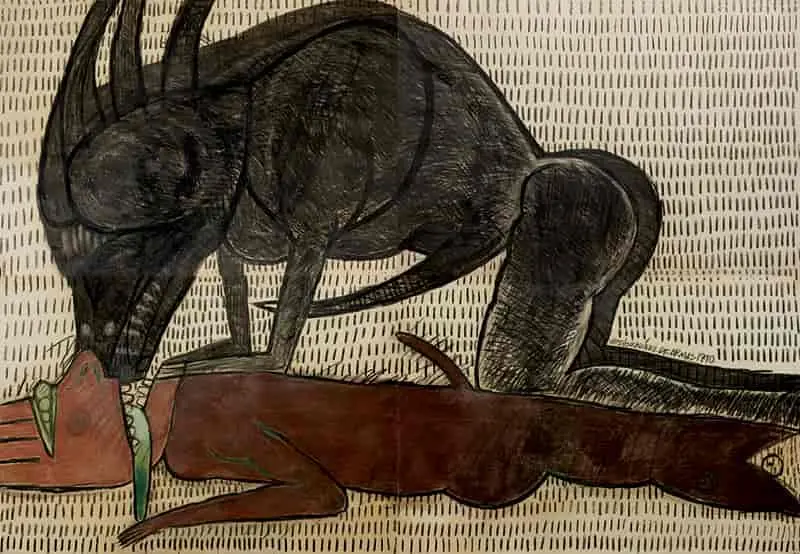
Under the title of "Jesús de Armas: Drama and Utopia," the Museo Nacional de Bellas Artes, in Havana, presented an exhibition that vindicates the importance of Jesús de Armas's work in Cuban Art. Caricatures, comics, animated cartoons, notes, drawings and paintings are among the forty-eight works included in the exhibition displayed in the transitory room on the second floor of the building dedicated to Cuban art. With them Laura Araño, the curator of the exhibition, shaped the first retrospective of this artist in the island. Ignored for a long time, Jesús de Armas's discourse was immersed in the exploration of aboriginal cultures; a research centered on the insular pre-Columbian universe that greatly influenced his creations and gained in intensity and graphic strength from 1975 onwards, until becoming deeply rooted in a vigorous expressionism. Present in most of his work it is a narrative directly connected to his archeological training, his specialization in Cuban rock art, and his interest in history. Unique in their revisionist approach to culture, these aspects make him a referent of an insular aesthetic current in which art and anthropology converge. The exhibition "Jesús de Armas: Drama and Utopia" proposes a comprehensive look at all the various facets of his work. It stands out for its vanguardist association with the graphic humor of the second half of the 1950s, a period in which his production foreshadowed the value of the line (economical, revealing, and sufficient) as an essential resource for his poetic. It is a distinctive sign in De Armas's production that gradually became more personal and refined as it evolved towards a neo-expressionistic aesthetic. During this process, charcoal (an element taken from his aboriginal heritage) became an ideal medium with which to render on canvases and cardboard—as shown in the exhibition—his inquiries and reflections on culture, the Amerindian theme, the clash during the colonization of the Americas (a subject that also addresses power, the use of force, depredation, and cruelty); all aspects that, alongside his hybridizations, lyricism, and gestural bestiary, shaped the symbolic production by this artist. Populated by pieces from the museum's collection—augmented for the occasion with new acquisitions—film archives from the Instituto Cubano de Arte e Industria Cinematográficos (ICAIC), some works from private collections, and the documentary titled De Armas el último taíno (De Armas, the Last of the Taíno, 2001), the exhibition "Jesús de Armas: Drama and Utopia" reclaims the stature of this multifaceted artist. The show achieves this through a communion between his vanguardist caricatures, experimental short films—created while director of ICAIC's Department of Animations, a precursor of the animated video art created in Cuba—cartoons containing aboriginal myths or satirical approaches to colonization, and his powerful pictorial practice from the 1980s and 1990s with their universally appealing anthologies rendered with charcoal.