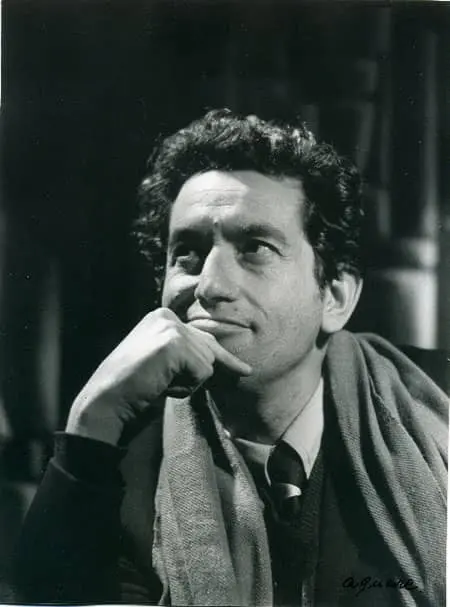
ObituaryMay 19, 2016
Rafael Squirru
Rafael Squirru, a one-of-a-kind character, was a decisive figure in the formation of Latin America's artistic and cultural field. Although he graduated as a lawyer from the University of Edinburgh in 1948, he never practiced that profession. His life was devoted to consolidating a sustainable, profound philosophy of art. In 1956, Squirru founded the Museo de Arte Moderno de Buenos Aires without an actual site, nor a collection, and under the poetic alias of "phantom museum". Before settling in its Teatro San Martín location, the itinerant museum temporarily occupied galleries, exhibition spaces, the Botanical Gardens, a remodeled garage, and even the ship Yapeyú, which visited twenty-two cities. Such was their commitment to the project that Squirru and his collaborators donated their salaries in order to acquire the collection's first works. With rare enthusiasm and daring, they organized nodal exhibitions that contributed to the public ascent of many Latin American artists of the first rank. Kemble wrote to Squirru in 1981: "Well, I want you to know that I will never forget how much you have done to support unknown artists (I among them, of course), even when it meant general disapproval and the sarcasm of the supposed experts." During President Arturo Frondizi's administration, Squirru was named Director of Cultural Relations at the Ministry of Foreign Affairs (1960). It was thanks to his efforts that Alicia Penalba's sculptures traveled to the São Paulo Biennial and Antonio Berni's prints to the Venice Biennale, where they won first prize. As Cultural Affairs Director at the Organization of American States (OAS), located in Washington, D.C., he achieved impressive results in the promotion of Latin American culture in the global stage (1963-1970). The journal Americas, edited by Guillermo de Zéndegui, was one of the instruments used by Squirru to promote the work of unknown Latin American and US artists, even rediscovering the work of forgotten figures like Edward Hopper. Squirru also validated the work of writers like Cortázar, who thanked him in a 1964 letter for having recommended Rayuela as "required reading". Squirru understood culture and its promotion as a sustained exercise in admiration and celebration, with complete independence of an artist's ideology. One event that speaks of his impartiality was his recommendation to include in the State University of New York's Anthology of Latin American Poetry the work of Cuban writers Guillén, Lezama Lima, and Fernández Retamar. This gained him the admiration of anti-Castro exiles and also of those Cubans who saw the OAS as an arm of American imperialism. Returning to Argentina, Squirru focused on forging the complex network of connections and linkages that give shape to the cultural field. An exceptional orator, he lectured in his country and abroad; like a nomad of culture, he traveled to different provinces in a truck specially conditioned to carry a traveling exhibition. There are famous anecdotes about his nighttime lectures in public squares, which some people attended in their pajamas. Squirru was a contributing writer for the La Nación newspaper for more than twenty years; his articles, which appeared regularly through 1994, were compiled and published in five books. He wrote innumerable introductions for art exhibitions as well as several books of poetry and prose. He published essays and translated Shakespeare. The essential corpus of Squirru's work includes more than fifty publications. In 1985 he launched the "Conversations with Artists" cycle at the Argentine Council of Foreign Relations, interviewing artists of the greatest relevance live on stage. A successful person, Emerson sa...