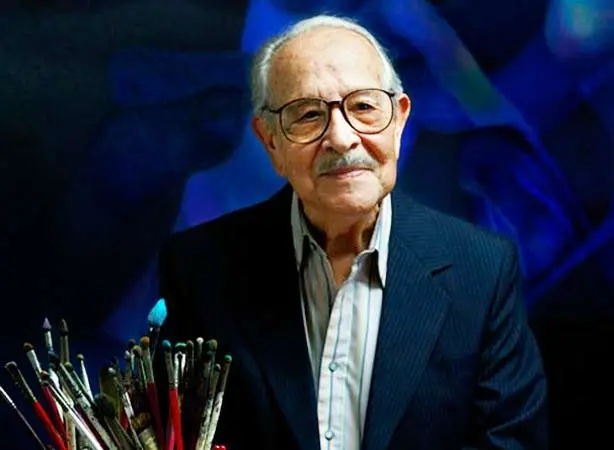
Rafael Soriano
Painter Rafael Soriano died in the city of Miami at the age of 94. Considered one of the forerunners of Cuban abstract art, Soriano began to paint and dabbled in abstractionism during the 1940s, eventually becoming one of the leading exponents of Concrete Art in Cuba and Latin-America.
The son of a barber and brother to six siblings, Soriano was born in Matanzas on November 23 of 1920. He began to pain at an early age in the southern coastal town of Cidra, Matanzas. His first formal studies in art were under Alberto Tarascó, a Spanish national who resided in Matanzas. Later on, in 1943, Soriano graduated from the Academia de San Pedro in Havana where he majored in painting and sculpture.
Along with Manuel Rodulfo Tardo, José Felipe Núñez, Juan Esnard and Roberto Diago, Soriano founded the Escuela Provincial de Bellas Artes. There he taught and directed the school from 1943 to 1962, a period in which he was excluded from official circles—for creating art not based on ideology—and that led to his decision to seek asylum in the US. There he taught design and composition in the Cuban Program of the University of Miami.
During the 1970s, Soriano's work favored a metaphysically motivated abstract imaginary. Unlike the earlier period, the works from this second phase of his artistic career reflected ambiguous representation and the color and light renderings with which he achieved unique visual effects that reveal a special intuition for expressing the dissolution of borders between the solidity of reality, the mysteries of nothingness and the subconscious.
In 2011, the Lowe Art Museum of the University of Miami paid tribute to Soriano by organizing a large retrospective of his work that presented 75 works, including paintings, drawings and ceramics.
By the end of the 1960s, while he also taught Design and Composition in the Cuban Program of the University of Miami, his artistic work acquired a new energy. He presented more than 50 personal exhibitions and participated in several group shows in galleries and museums across the US and Latin America.
In an interview with Diario de Cuba, curator Jesús Rosado affirmed that "With his death, Cuba has lost one of its most talented painters. He died without having been welcomed back to the island and without the recognition he is owned for an important artistic career; one which was initially marginalized for pursuing a purely aesthetic discourse that left no room for politics, and then, for several decades more, for his condition as an exile."