ExhibitionSeptember 2, 2014
Wall Project
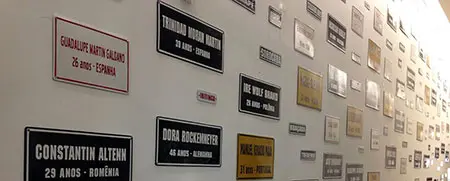
Until December 14, the Museu de Arte Moderna in São Paulo presents the second exhibition of the Wall Project installation program. On this occasion, the museum showcases the work of artist Carmela Gross, a proposal that combines immigrant data with the names of landforms from the Brazilian municipality of Tupi, in order to approach an element in the makeup of Brazilian society. The personal information found in the registration forms of several foreign immigrants who arrived in the state of São Paulo during the second half of the Nineteenth Century serve as content for the multimedia artist Carmela Gross to create Marapé, the work selected for the second exhibition of the Wall Project of MAM-SP, in which artists are invited to occupy with their work the corridor that expands from the museum's lobby entrance to the grand hall. For Marapé, Carmen Gross uses 531 metallic plaques of the sort used for street signs that in her installation are printed with the personal information of immigrants—names, last names, age, country of origin and date of arrival in São Paulo—and placed alongside other signs with the printed names of landforms from the Tupi region, which in turn illustrate the history and cultural and ethnic melting pot within the São Paulo population—as well as the language that is currently used in the region. Such proposal offered a window into the presence and influence of immigrants in Brazilian society. After thoroughly researching the public archives of the State of São Paulo—which contains over two million records of immigrants from several ethnic groups and nationalities—Gross selected 390 immigrant records. According to the artist: "The name of the immigrants became the starting point for the development of my project. It started with the last name Gross, my father's family, who arrived here in 1889. I also found other names as well dates, ships, cities of origin and of destination." And the artist adds: "The archives were introduced in a group of enameled metal plaques usually used for street signage but that, for the purposes of this exhibition, varied in size and colors and were distributed throughout the wall and on the stairs used to access the museum's exhibition hall." In Marapé, the artist explores family ties, affective memories and the reality of those immigrants; the confluence in the names of Carmela Gross, countries of origin and the ages of immigrants upon arriving to Brazil; in combination with the names of rivers, mountains, towns, cities and neighborhoods that represent the indigenous territories written in the Tupi language (such as Aricanduva, Tietê Itu, Anhangabaú). This anthology creates the platform that formed Brazil through the fusion of ethnic groups, nationalities and languages. According to Gross "the various names chosen are nothing but a small sample of that which this multiculturalism represents."