Book ReviewsOctober 14, 2020· By Natalia Gutiérrez
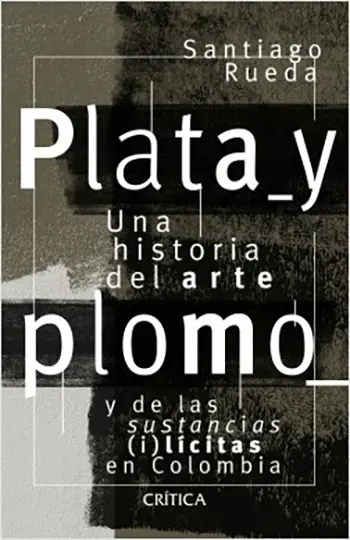
Plata y plomo. Una historia del arte y de las sustancias (i)lícitas en Colombia
Hoy me llaman marimbero por cambiar de situación y no piensan si primero fui gamín o pordiosero sin ninguna educación. Hoy porque tengo dinero hoy me persigue el gobierno hoy quieren saber quién soy.
(Today they call me marimbero because I changed my situation, they forget I was a street urchin, a beggar with no education. Because today I’ve got money, the government is after me; today they want to know who I am, or may be.)
Those lines from “El marimbero," a vallenato song by Romualdo Brito cited in Rueda’s Plata y plomo, give us an entry to talk about three aspects of the book I want to highlight. The first aspect is the thickness of the problem. As a reader, following along an agile style, I found myself immersed in a thick web of connections between drug trafficking in Colombia and the country’s landscape, politicians, arts, culture, the paradoxical notions of illicit or licit drugs—in sum, a web that we all intuit but this book brings into sharp focus. After reading Plata y plomo, we will never again think about the issue without taking this thickness into account. Thick, indeed, is the anthropologist Michael Taussig’s description, which Rueda also cites: “William Burroughs’ refrigerator, from Lawrence, Kansas, with a sign on its door, Just Say No, as an Indian teenager saunters past with a Nike sign on its chest saying Just Do It, and a smiling Nancy Reagan floats overhead as a Cheshire cat gazing thoughtfully at an automobile with the trunk open and two corpses stuffed inside it with their hands tied behind their backs and two neat bullet holes, one each through the right temple and one each through the crown of the head."
The second aspect of Plata y plomo is the type of discourse Rueda has chosen to speak about his subject: he makes all kinds of connections without Manichaeism and without accusatory or redeeming discourses, yet with a clear North, a commitment I will describe—these are my words, not Rueda’s—as to the eighty percent of Colombia’s population that the State and the ruling classes invisibilize. Historically, Colombia’s State, its dominant culture, and its urban population, enmeshed in the capitalist saturation of the Twenty-First Century, have ignored what occurs in most of the country’s territory; their municipalities, occupations, and faces come to light for them only when something unexpected happens, such as large sums of money, massacres, or armed conflict.
For instance, Colombia's recent history finds it surprising when the guerilla fighters turn out to be children or pregnant women, or when civilian children are found dead after an attack by the army, to cite two examples. On one web page, I found a comment by Romualdo Brito that reinforces what I'm trying to convey: Brito says that he never tries to describe himself as a treintero because he was born in Treinta Tomarrazón, a location in La Guajira that, according to him, does not show up on the maps. Rueda’s book is firmly committed to countering Colombia’s limbo of invisibilization and intends to write about it to expand a subject that remains insufficiently discussed.
The third aspect of Plata y plomo is, in my view, of great significance for Rueda’s future as an essayist. The first book he wrote about art and drug trafficking was Una línea de polvo, published in 2008; in it, Rueda posed a fundamental question that can be answered only if aesthetics and art theory break out of their enclosure and engage critically with society. "Besides being a genre in and of itself in journalism and literature, the narco subject has gained a solid foothold in film, as demonstrated by such recent productions as Rosario Tijeras, María llena eres de gracia, El Rey, Sumas y restas, and Colombian Dream, among others. Significantly, the art scene's reaction has been slow, and only in the current decade (the 2010s) do we find a coherent response to the phenomenon.” That earlier book was an attempt at such a response. Art was its angle to engage the narco problem.
In Una línea de polvo, then, art was the focus. In Plata y plomo, his second book on art and narco culture, Rueda emphasizes the events instead and also the vivid images produced by researchers and writers, which tells me he is preparing to take the leap towards an incisive interrogation of Colombian culture in broader terms, while, of course continuing to write about art. It has often been said that life is more complicated than art; for such complexity, Rueda is an essayist that Colombia needs.
(Today they call me marimbero because I changed my situation, they forget I was a street urchin, a beggar with no education. Because today I’ve got money, the government is after me; today they want to know who I am, or may be.)
Those lines from “El marimbero," a vallenato song by Romualdo Brito cited in Rueda’s Plata y plomo, give us an entry to talk about three aspects of the book I want to highlight. The first aspect is the thickness of the problem. As a reader, following along an agile style, I found myself immersed in a thick web of connections between drug trafficking in Colombia and the country’s landscape, politicians, arts, culture, the paradoxical notions of illicit or licit drugs—in sum, a web that we all intuit but this book brings into sharp focus. After reading Plata y plomo, we will never again think about the issue without taking this thickness into account. Thick, indeed, is the anthropologist Michael Taussig’s description, which Rueda also cites: “William Burroughs’ refrigerator, from Lawrence, Kansas, with a sign on its door, Just Say No, as an Indian teenager saunters past with a Nike sign on its chest saying Just Do It, and a smiling Nancy Reagan floats overhead as a Cheshire cat gazing thoughtfully at an automobile with the trunk open and two corpses stuffed inside it with their hands tied behind their backs and two neat bullet holes, one each through the right temple and one each through the crown of the head."
The second aspect of Plata y plomo is the type of discourse Rueda has chosen to speak about his subject: he makes all kinds of connections without Manichaeism and without accusatory or redeeming discourses, yet with a clear North, a commitment I will describe—these are my words, not Rueda’s—as to the eighty percent of Colombia’s population that the State and the ruling classes invisibilize. Historically, Colombia’s State, its dominant culture, and its urban population, enmeshed in the capitalist saturation of the Twenty-First Century, have ignored what occurs in most of the country’s territory; their municipalities, occupations, and faces come to light for them only when something unexpected happens, such as large sums of money, massacres, or armed conflict.
For instance, Colombia's recent history finds it surprising when the guerilla fighters turn out to be children or pregnant women, or when civilian children are found dead after an attack by the army, to cite two examples. On one web page, I found a comment by Romualdo Brito that reinforces what I'm trying to convey: Brito says that he never tries to describe himself as a treintero because he was born in Treinta Tomarrazón, a location in La Guajira that, according to him, does not show up on the maps. Rueda’s book is firmly committed to countering Colombia’s limbo of invisibilization and intends to write about it to expand a subject that remains insufficiently discussed.
The third aspect of Plata y plomo is, in my view, of great significance for Rueda’s future as an essayist. The first book he wrote about art and drug trafficking was Una línea de polvo, published in 2008; in it, Rueda posed a fundamental question that can be answered only if aesthetics and art theory break out of their enclosure and engage critically with society. "Besides being a genre in and of itself in journalism and literature, the narco subject has gained a solid foothold in film, as demonstrated by such recent productions as Rosario Tijeras, María llena eres de gracia, El Rey, Sumas y restas, and Colombian Dream, among others. Significantly, the art scene's reaction has been slow, and only in the current decade (the 2010s) do we find a coherent response to the phenomenon.” That earlier book was an attempt at such a response. Art was its angle to engage the narco problem.
In Una línea de polvo, then, art was the focus. In Plata y plomo, his second book on art and narco culture, Rueda emphasizes the events instead and also the vivid images produced by researchers and writers, which tells me he is preparing to take the leap towards an incisive interrogation of Colombian culture in broader terms, while, of course continuing to write about art. It has often been said that life is more complicated than art; for such complexity, Rueda is an essayist that Colombia needs.