ExhibitionAugust 11, 2020· By Elisa Rodriguez Campo
Rethink Everything - Rolf Art Gallery
Rethink Everything is the name of the first online exhibition launched by the Rolf Art gallery. It is a research project curated by Andrea Giunta before the pandemic, which takes on a new dimension during confinement, inviting us to reconsider its postulates opportunely.
Impeccable design and visual identity and a consistent website, together with an efficient communication apparatus from social networks and online conversations, make it possible to share it in these moments of contingency, while much of the planet is at home.
From its launch on May 21st until July 31st, the project Rethink Everything unveiled six chapters or "digital corridors" housed in Rolf Art’s Viewing Room.
These chapters are: "Policies of the Body," "Forms That Administer the Body," "Affections," "Memories That Are Present," "Urban Signs," and "Bodies and Nature."
As a turning point, we find feminism, which makes it possible to highlight themes that are specific to its claims that emerge during the long confinement such as inequality, re-significance of the domestic sphere, isolation, the link with nature, as well as transcendence in the uses of memory and body.
Based on this thread, the works of selected artists from Latin America and the Caribbean offer a multiplicity of approaches, political, social, and cultural demands. These are pieces that still—made in other contexts—come into force and are revisited so that today we can “Rethink Everything.”
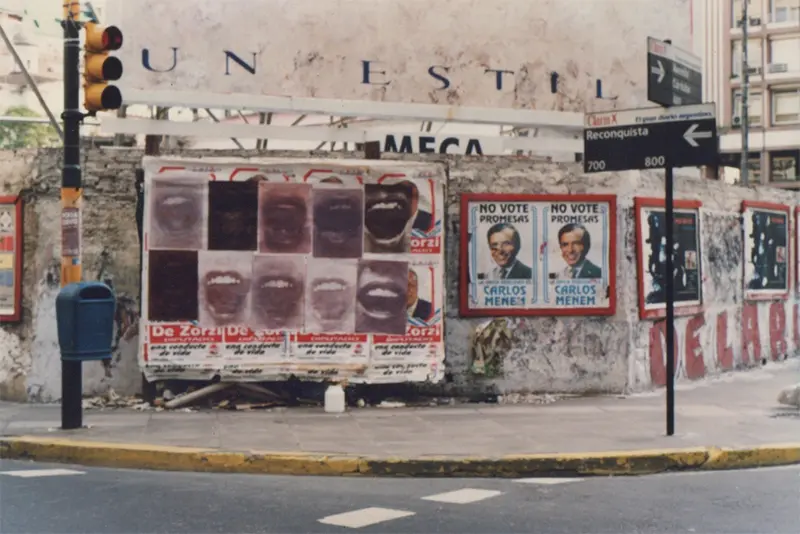
Chapter I "Policies of the Body" announces the urgent need for belonging to the body in the context of the “public sphere.” It groups together the repertoire of urban interferences by Graciela Sacco: an extensive record of the series Bocanadas (Puffs, 1993) heliographic works presented on different walls in Rosario, Buenos Aires. Giant open empty mouths cry out with a deaf cry their disagreement during Menem's time. We also find the audiovisual record of Graciela Sacco, who was invited to Paris in 2013 to reinstall her Bocanadas, this time on a wall outside the Fondation Cartier pour l 'Art Contemporain within the framework of the exhibition America Latina (1960- 2013). It is also reviewed that, after Sacco died in 2017, a commitment to feminist practices in art is acquired, which leads to the birth of the feminist collective Nosotras proponemos (We propose), which seeks to give visibility to feminism's agendas using the poster. The first chapter also incorporates an extensive record of Liliana Maresca's photo-performance Imagen pública-altas esferas (Public Image-High Spheres, 1993). In it, she strips her body and soul in an exercise of political denunciation, creating huge banners that enlarge the irritating faces of politicians, Argentines, and North Americans, taken from the newspaper Page 12. Allegories of crime and corruption, these characters are the uncomfortable support on which the artist stands naked. Marcos López takes the photos that immortalize this first action by Maresca. The second part of the action, recorded photographically by Adrián Rocha Novoa, consisted of temporarily placing the banners in the middle of the Costanera Sur Ecological Reserve. This place served irregularly as a landfill. Today, when we revisit this registry's location, we can see how nature responded, adapting to the rubble, and wrapping new forms of fauna and flora among them.
Isn't this incredible adaptability a lesson that nature has given us during the quarantine? Much cleaner air and water make us reflect on how we impact a powerful and resilient environment. Our mirror.
This section also addresses the experimental record of the theme “violence” from the performance of María Teresa Hincapié and José A. Restrepo Intempestivas (Untimely, 1992), alluding to tensions within the home, which unfortunately have increased during confinement. In this section, Silvia Rivas' 2001 Full of Hope series (2001-2003), in which past and future seem to compress the existence of the performer who acts as the only pillar from the strength that emanates from her present body, is re-contextualized. Rethinking this video today gives me the impression of seeing Silvia Rivas locked-up, registered, and uncomfortable inside a video surveillance camera. Thus, we feel supervised, controlled. Fighting.
The idea of a feminine resistance based on the apparent fragility of the body is also found in the performance practices of María José Arjona, who, in her photo-performance La belleza del animal de cuatro patas (The beauty of the four-legged animal, 2008) displays tensions between her body, a chair, and the surrounding space. Meanwhile, Joiri Miraya presents her video Satisfecha (Satisfied, 2012), leading us to rethink and digest from another perspective the exotic and stereotyped body of a Caribbean woman.
Chapter II "Forms That Administer the body" poetically expresses how bodies manage to detach themselves from second skin, from a layer that has somehow constrained them, becoming an object of reflection. Liliana Maresca is cited again with her photo-performance (1983) captured by Marcos López.
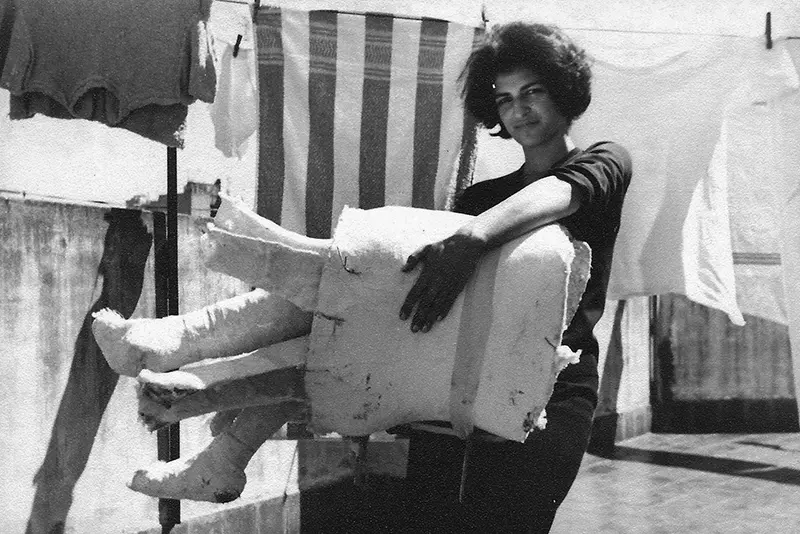
It is worth noting the early work of Dalila Puzzovio, who is portrayed amid her forceful Cáscaras (Peels, 1963) from which she inquires, among so many things, about the notions of a break, absence, or dignification of pain. Cáscaras arises from the captivating symbolism of the discarded plaster casts that he runs into in a hospital. These “peels” denote the “dramatic” and, in a certain way, open the reflection on what is “liberating.”
At this point, Puzzovio’s “peels” constitute the most graphic example that I take advantage of to rethink: Why is it imminent to "Rethink Everything?"
It is pertinent to recognize how we assume the “political body” in Latin America and how artistic practices in the Continent acquire their tessitura. The relevance of “the art of the concept," “the art that happens,” “the art of action,” and “the art that is proposed by the media," acquired in Latin America since the second half of the 20th century, is undeniable.
How can we approach a consensus that defines our artistic practices if such a definition exists?
“Latin American conceptualisms” insist on shedding different peels or armors, as a metaphor—conscious or not—of the need to mitigate the colonial brand. They tune into the process of “dematerialization” to which art is unequivocally directed since the second half of the last century.
The impetus of Latin American artistic practices is harnessed as a workforce, creation, and production, as a way of self-determination, art as a way of existing and facing situations of political and social injustice.
It is interesting to observe how, since the beginning of the 60s, certain advanced artistic practices insist on detaching from the object. They overflow it with the emancipatory gesture of the body, reaching that virtuous moment impregnated with powerful gestures and claims that we appreciate in recording performances and happenings gathered in this virtual exhibition.
Television screens, radio broadcasts, the press, and the media, may be the new technological channels through which the artistic expressions will emancipate themselves for the sake of a more “diffusible,” accessible, democratic (?) art.
It tends to show the presence of the media in everyday life. We will see the artists interact with televisions in their performances (a wink typical of the 90s) as in Intempestivas by Hincapié and Restrepo, included in the exhibition.
Let us also remember the early happenings devised for media dissemination (developed by Marta Minujín in the 1960s). We will be able to verify the proposal in a non-objectual way of “consuming art.”
Artistic practices today—more than ever—travel from a highway encrypted in binary codes. Art is devised, embodied, and dematerialized again to flow in cyberspace. Rethink Everything is capable of leading us through virtual corridors and giving us the satisfying feeling of thinking extensively about the immediate, about what baffles us today.
In the second chapter of this exhibition, we also have the opportunity to listen to Milagros de La Torre, arguing about the concept of absence from her spectral photographic series Colgadores (Hangers, 1992). We find in this section part of the series Otro-Lugar (Another-Place) by Ananké Asseff.
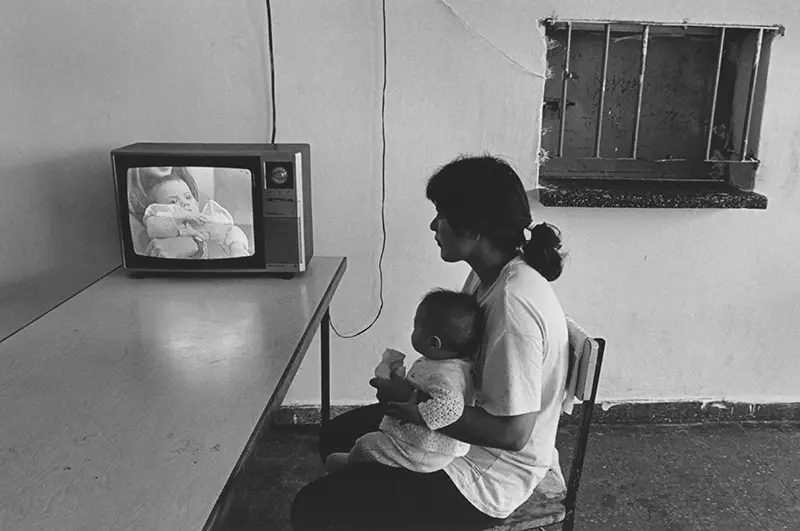
Chapter III, "Affections," refers to the bodies that go through the limbo of misunderstanding and recognition. It groups the photographic series of Mujeres presas (Imprisoned Women, 1991-1993) with which Adriana Lestido lives. Also, the video by Ananké Asseff, who, this time, embodies the fading of the individual in the dense urban fabric. Adolescentes (Adolescents) shows bodies in transit photographed by Juan Travnik. The boundaries of the binary are blurred. The ancestral complementary opposites are questioned in Vivian Galban’s Ying-yang (2011), while Nicola Constantino revisits the canonical reading of the female body that immortalizes the male historiography of art.
Chapter IV, "Memories That Are Present," constitutes the raison d'être of this exhibition, remembering or “passing through the heart” (etymologically). It gathers archives of the abject or the pleasant that are revisited to understand its repercussion today. Los Braceros (Laborers, 2018) portraits on wet collodion of captive Mapuches presented by Cristina Piffer are underlying wounds that reappear with the overwhelming persistence of racism in the 21st century. In Inventario (Inventory, 2018), this artist shows us the cruel dissection of the indigenous resistance bodies that were dissected and exhibited once in La Plata.
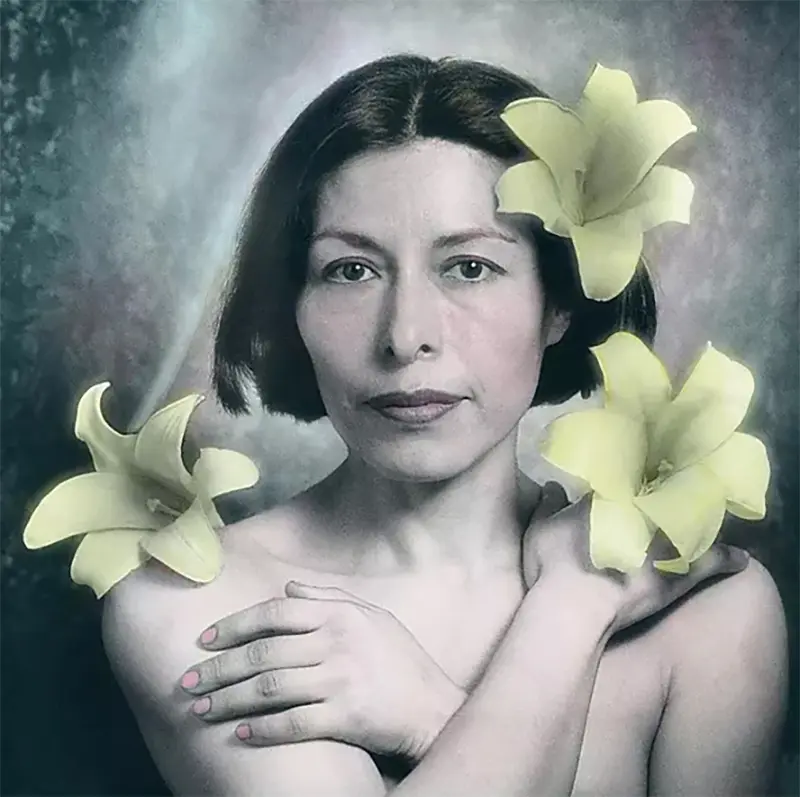
The video (Otros) Fundamentos ([Other] Fundamentals) by Brazilian artist Aline Motta narrates her trip to Nigeria, marked by the reflection of a mirror. It is about the insistence on recognizing herself three generations back. The “exoticizing” portrait of the artist Elba Bairon, taken and colored by Marcos López, is juxtaposed with the fruit-like frame of an absent mirror proposed by her.
Chapter V, "Urban Signs," opens the debate that arises in the (global) public arena in the face of the iconoclastic wave, in the heat of the nonconformity aroused by monuments erected to characters deserved by many. In this context, respect for urban iconography and the fall of so many symbols of power are in crisis.
The exhibition presents the photographic and audiovisual record of the installation Obelisco recostado (The Obelisk Lying Down) by Marta Minujín (1978), in São Paulo. We find the photographic record of Santiago Porter (2008) on the emblematic sculpture of Eva Perón, who was symbolically beheaded in 1955 (today preserved and exhibited as a witness). This piece, the header image of the section, opens a furiously current debate in which it seeks to reach a consensus on the anti-idols systematically shot down around the globe.
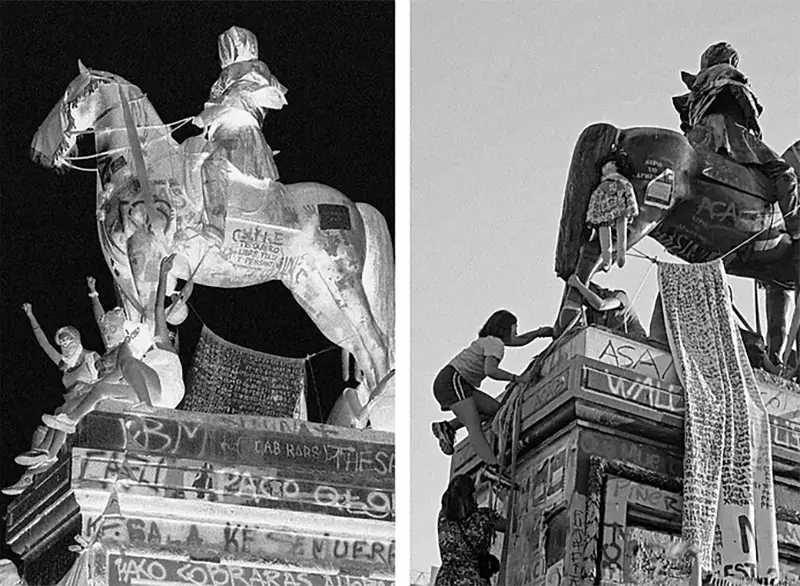
It also gathers the copious Inventario Iconoclasta de la Insurrección Chilena (Iconoclast Inventory of the Chilean Insurrection) by Celeste Rojas Mugica (2020) in web format.
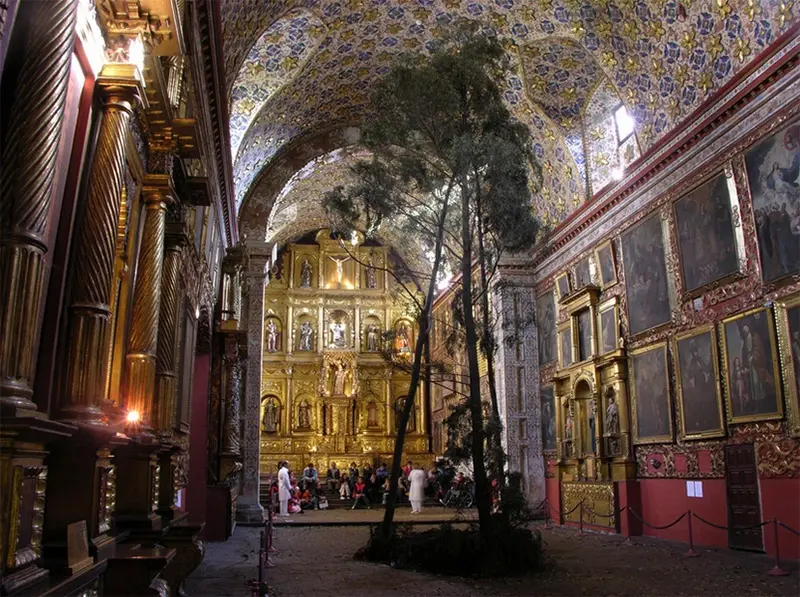
Finally, Chapter VI, "Bodies and Nature," gives an account of the frequent organic and sublime relationships in feminist discourses, which invites us to resume the use we have made of natural resources. María Teresa Hincapié shows the photographic record ¿Quién engendra las gotas de rocío? (Who Generates Dew Drops? 2005) implanting three huge trees inside a church in Colombia. Jackie Parisier presents Coloide (Colloid, 2020), delicate human blends with the landscape. With Chanchobola (1998), Constantino underlines the disproportionate dominance that human exercises over the rest of living beings. Finally, we can see the only photograph that Florence Levy could keep, after being arrested and accused of espionage while searching a toxic artificial lake, once a natural landscape, in China. A QR code on the exhibition's website leads us to the video that shows this apprehension in 2016. It exposes how highly supervised societies punish dissents in a clear abuse of power.
Rethink Everything unravels and associates works that, even if emanated from another time, give off a new brilliance and constitute the key to understanding the present time in which it is necessary, as Giunta states, “a new distribution of affections and human relations."
We become aware of the delicate filaments that unite us to a whole. It is time to rethink our priorities and evaluate the unsustainable race in which we have been participating as a society.
It is hoped that, in the near future, the exhibition can physically materialize in the gallery space.
@elisarodriguezc
Web de la exposición en español: https://www.pensartododenuevo.com/
Web of the exhibition in English: https://en.pensartododenuevo.com
Impeccable design and visual identity and a consistent website, together with an efficient communication apparatus from social networks and online conversations, make it possible to share it in these moments of contingency, while much of the planet is at home.
From its launch on May 21st until July 31st, the project Rethink Everything unveiled six chapters or "digital corridors" housed in Rolf Art’s Viewing Room.
These chapters are: "Policies of the Body," "Forms That Administer the Body," "Affections," "Memories That Are Present," "Urban Signs," and "Bodies and Nature."
As a turning point, we find feminism, which makes it possible to highlight themes that are specific to its claims that emerge during the long confinement such as inequality, re-significance of the domestic sphere, isolation, the link with nature, as well as transcendence in the uses of memory and body.
Based on this thread, the works of selected artists from Latin America and the Caribbean offer a multiplicity of approaches, political, social, and cultural demands. These are pieces that still—made in other contexts—come into force and are revisited so that today we can “Rethink Everything.”
Chapter I "Policies of the Body" announces the urgent need for belonging to the body in the context of the “public sphere.” It groups together the repertoire of urban interferences by Graciela Sacco: an extensive record of the series Bocanadas (Puffs, 1993) heliographic works presented on different walls in Rosario, Buenos Aires. Giant open empty mouths cry out with a deaf cry their disagreement during Menem's time. We also find the audiovisual record of Graciela Sacco, who was invited to Paris in 2013 to reinstall her Bocanadas, this time on a wall outside the Fondation Cartier pour l 'Art Contemporain within the framework of the exhibition America Latina (1960- 2013). It is also reviewed that, after Sacco died in 2017, a commitment to feminist practices in art is acquired, which leads to the birth of the feminist collective Nosotras proponemos (We propose), which seeks to give visibility to feminism's agendas using the poster. The first chapter also incorporates an extensive record of Liliana Maresca's photo-performance Imagen pública-altas esferas (Public Image-High Spheres, 1993). In it, she strips her body and soul in an exercise of political denunciation, creating huge banners that enlarge the irritating faces of politicians, Argentines, and North Americans, taken from the newspaper Page 12. Allegories of crime and corruption, these characters are the uncomfortable support on which the artist stands naked. Marcos López takes the photos that immortalize this first action by Maresca. The second part of the action, recorded photographically by Adrián Rocha Novoa, consisted of temporarily placing the banners in the middle of the Costanera Sur Ecological Reserve. This place served irregularly as a landfill. Today, when we revisit this registry's location, we can see how nature responded, adapting to the rubble, and wrapping new forms of fauna and flora among them.
Isn't this incredible adaptability a lesson that nature has given us during the quarantine? Much cleaner air and water make us reflect on how we impact a powerful and resilient environment. Our mirror.
This section also addresses the experimental record of the theme “violence” from the performance of María Teresa Hincapié and José A. Restrepo Intempestivas (Untimely, 1992), alluding to tensions within the home, which unfortunately have increased during confinement. In this section, Silvia Rivas' 2001 Full of Hope series (2001-2003), in which past and future seem to compress the existence of the performer who acts as the only pillar from the strength that emanates from her present body, is re-contextualized. Rethinking this video today gives me the impression of seeing Silvia Rivas locked-up, registered, and uncomfortable inside a video surveillance camera. Thus, we feel supervised, controlled. Fighting.
The idea of a feminine resistance based on the apparent fragility of the body is also found in the performance practices of María José Arjona, who, in her photo-performance La belleza del animal de cuatro patas (The beauty of the four-legged animal, 2008) displays tensions between her body, a chair, and the surrounding space. Meanwhile, Joiri Miraya presents her video Satisfecha (Satisfied, 2012), leading us to rethink and digest from another perspective the exotic and stereotyped body of a Caribbean woman.
Chapter II "Forms That Administer the body" poetically expresses how bodies manage to detach themselves from second skin, from a layer that has somehow constrained them, becoming an object of reflection. Liliana Maresca is cited again with her photo-performance (1983) captured by Marcos López.
It is worth noting the early work of Dalila Puzzovio, who is portrayed amid her forceful Cáscaras (Peels, 1963) from which she inquires, among so many things, about the notions of a break, absence, or dignification of pain. Cáscaras arises from the captivating symbolism of the discarded plaster casts that he runs into in a hospital. These “peels” denote the “dramatic” and, in a certain way, open the reflection on what is “liberating.”
At this point, Puzzovio’s “peels” constitute the most graphic example that I take advantage of to rethink: Why is it imminent to "Rethink Everything?"
It is pertinent to recognize how we assume the “political body” in Latin America and how artistic practices in the Continent acquire their tessitura. The relevance of “the art of the concept," “the art that happens,” “the art of action,” and “the art that is proposed by the media," acquired in Latin America since the second half of the 20th century, is undeniable.
How can we approach a consensus that defines our artistic practices if such a definition exists?
“Latin American conceptualisms” insist on shedding different peels or armors, as a metaphor—conscious or not—of the need to mitigate the colonial brand. They tune into the process of “dematerialization” to which art is unequivocally directed since the second half of the last century.
The impetus of Latin American artistic practices is harnessed as a workforce, creation, and production, as a way of self-determination, art as a way of existing and facing situations of political and social injustice.
It is interesting to observe how, since the beginning of the 60s, certain advanced artistic practices insist on detaching from the object. They overflow it with the emancipatory gesture of the body, reaching that virtuous moment impregnated with powerful gestures and claims that we appreciate in recording performances and happenings gathered in this virtual exhibition.
Television screens, radio broadcasts, the press, and the media, may be the new technological channels through which the artistic expressions will emancipate themselves for the sake of a more “diffusible,” accessible, democratic (?) art.
It tends to show the presence of the media in everyday life. We will see the artists interact with televisions in their performances (a wink typical of the 90s) as in Intempestivas by Hincapié and Restrepo, included in the exhibition.
Let us also remember the early happenings devised for media dissemination (developed by Marta Minujín in the 1960s). We will be able to verify the proposal in a non-objectual way of “consuming art.”
Artistic practices today—more than ever—travel from a highway encrypted in binary codes. Art is devised, embodied, and dematerialized again to flow in cyberspace. Rethink Everything is capable of leading us through virtual corridors and giving us the satisfying feeling of thinking extensively about the immediate, about what baffles us today.
In the second chapter of this exhibition, we also have the opportunity to listen to Milagros de La Torre, arguing about the concept of absence from her spectral photographic series Colgadores (Hangers, 1992). We find in this section part of the series Otro-Lugar (Another-Place) by Ananké Asseff.
Chapter III, "Affections," refers to the bodies that go through the limbo of misunderstanding and recognition. It groups the photographic series of Mujeres presas (Imprisoned Women, 1991-1993) with which Adriana Lestido lives. Also, the video by Ananké Asseff, who, this time, embodies the fading of the individual in the dense urban fabric. Adolescentes (Adolescents) shows bodies in transit photographed by Juan Travnik. The boundaries of the binary are blurred. The ancestral complementary opposites are questioned in Vivian Galban’s Ying-yang (2011), while Nicola Constantino revisits the canonical reading of the female body that immortalizes the male historiography of art.
Chapter IV, "Memories That Are Present," constitutes the raison d'être of this exhibition, remembering or “passing through the heart” (etymologically). It gathers archives of the abject or the pleasant that are revisited to understand its repercussion today. Los Braceros (Laborers, 2018) portraits on wet collodion of captive Mapuches presented by Cristina Piffer are underlying wounds that reappear with the overwhelming persistence of racism in the 21st century. In Inventario (Inventory, 2018), this artist shows us the cruel dissection of the indigenous resistance bodies that were dissected and exhibited once in La Plata.
The video (Otros) Fundamentos ([Other] Fundamentals) by Brazilian artist Aline Motta narrates her trip to Nigeria, marked by the reflection of a mirror. It is about the insistence on recognizing herself three generations back. The “exoticizing” portrait of the artist Elba Bairon, taken and colored by Marcos López, is juxtaposed with the fruit-like frame of an absent mirror proposed by her.
Chapter V, "Urban Signs," opens the debate that arises in the (global) public arena in the face of the iconoclastic wave, in the heat of the nonconformity aroused by monuments erected to characters deserved by many. In this context, respect for urban iconography and the fall of so many symbols of power are in crisis.
The exhibition presents the photographic and audiovisual record of the installation Obelisco recostado (The Obelisk Lying Down) by Marta Minujín (1978), in São Paulo. We find the photographic record of Santiago Porter (2008) on the emblematic sculpture of Eva Perón, who was symbolically beheaded in 1955 (today preserved and exhibited as a witness). This piece, the header image of the section, opens a furiously current debate in which it seeks to reach a consensus on the anti-idols systematically shot down around the globe.
It also gathers the copious Inventario Iconoclasta de la Insurrección Chilena (Iconoclast Inventory of the Chilean Insurrection) by Celeste Rojas Mugica (2020) in web format.
Finally, Chapter VI, "Bodies and Nature," gives an account of the frequent organic and sublime relationships in feminist discourses, which invites us to resume the use we have made of natural resources. María Teresa Hincapié shows the photographic record ¿Quién engendra las gotas de rocío? (Who Generates Dew Drops? 2005) implanting three huge trees inside a church in Colombia. Jackie Parisier presents Coloide (Colloid, 2020), delicate human blends with the landscape. With Chanchobola (1998), Constantino underlines the disproportionate dominance that human exercises over the rest of living beings. Finally, we can see the only photograph that Florence Levy could keep, after being arrested and accused of espionage while searching a toxic artificial lake, once a natural landscape, in China. A QR code on the exhibition's website leads us to the video that shows this apprehension in 2016. It exposes how highly supervised societies punish dissents in a clear abuse of power.
Rethink Everything unravels and associates works that, even if emanated from another time, give off a new brilliance and constitute the key to understanding the present time in which it is necessary, as Giunta states, “a new distribution of affections and human relations."
We become aware of the delicate filaments that unite us to a whole. It is time to rethink our priorities and evaluate the unsustainable race in which we have been participating as a society.
It is hoped that, in the near future, the exhibition can physically materialize in the gallery space.
@elisarodriguezc
Web de la exposición en español: https://www.pensartododenuevo.com/
Web of the exhibition in English: https://en.pensartododenuevo.com
Gallery