ExhibitionMay 3, 2024
Patrick Hamilton: Atacama. MAC Parque Forestal
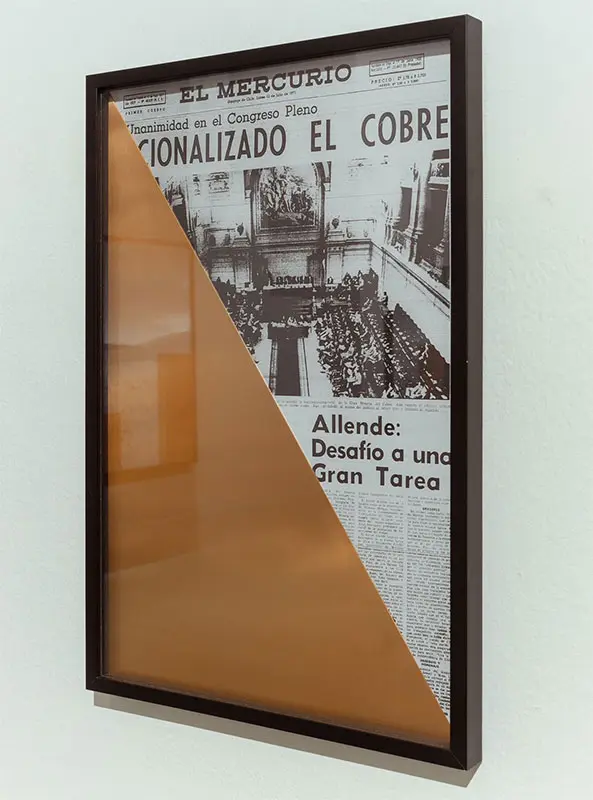
For more than two decades, the artist Patrick Hamilton (Leuven, 1974) has focused his artistic practice and research on the relationship between art, politics, and economy in the context of the last decades in Chile. “Atacama” offers images of the desert of the same name, intervened, in a minimalist key, with copper plate. These simple virtual interventions on the landscape, which superimpose the red metal on stones, sands, ravines, hills, and mounds, reference the multiple histories—past, present, and future—that the “driest desert in the world” holds.
“The Atacama is a fascinating territory for many reasons: it was under the Pacific Ocean millions of years ago. The Pacific Ocean was a place rich in salts and minerals millions of years ago, so everything is preserved. For example, the Chinchorro mummies, the oldest in the world, were found there. From the sea to the mountain range, it was a diverse space in ancestral cultures. It was Peruvian and Bolivian territory until the Pacific War. It has been a place of political massacres, a place of explorers of all stripes, a place from which it is possible to observe the universe. It is, certainly, the universe, and it is, by the way, the place with the largest copper reserves in the world,” explains visual artist Patrick Hamilton about the region of Chile that gives its name to his exhibition.
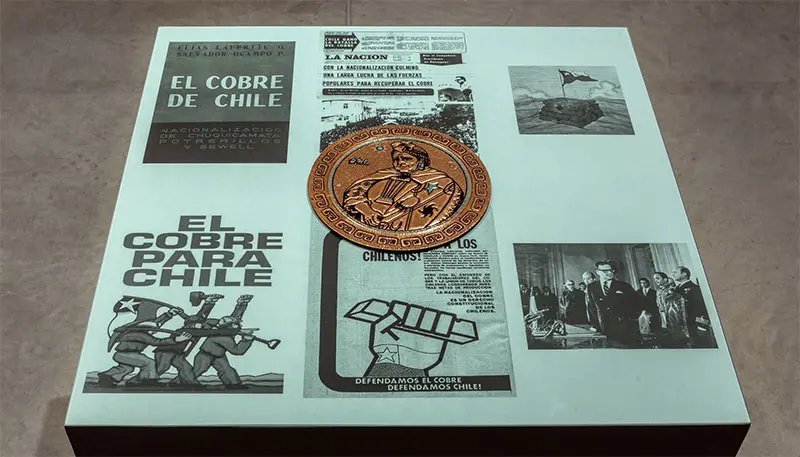
This is an enormous amount of information and milestones, which contrasts dramatically with the economy of resources that is in the proposal. A subtle mural with an ancestral Andean spirit gives context, situating a half dozen black-and-white photographs of the Atacama Desert, which were intervened with copper sheets extracted from the same place. It is a poetic approach, not a guided one. Patrick Hamilton trusts that we, the viewers, will relate copper to “Chile’s salary,” to the processes of nationalization and Chileanization, to extractivism.
“The Atacama is a fascinating territory for many reasons: it was under the Pacific Ocean millions of years ago. The Pacific Ocean was a place rich in salts and minerals millions of years ago, so everything is preserved. For example, the Chinchorro mummies, the oldest in the world, were found there. From the sea to the mountain range, it was a diverse space in ancestral cultures. It was Peruvian and Bolivian territory until the Pacific War. It has been a place of political massacres, a place of explorers of all stripes, a place from which it is possible to observe the universe. It is, certainly, the universe, and it is, by the way, the place with the largest copper reserves in the world,” explains visual artist Patrick Hamilton about the region of Chile that gives its name to his exhibition.
This is an enormous amount of information and milestones, which contrasts dramatically with the economy of resources that is in the proposal. A subtle mural with an ancestral Andean spirit gives context, situating a half dozen black-and-white photographs of the Atacama Desert, which were intervened with copper sheets extracted from the same place. It is a poetic approach, not a guided one. Patrick Hamilton trusts that we, the viewers, will relate copper to “Chile’s salary,” to the processes of nationalization and Chileanization, to extractivism.
Gallery