ObituaryMay 1, 2014
Oswaldo Vigas
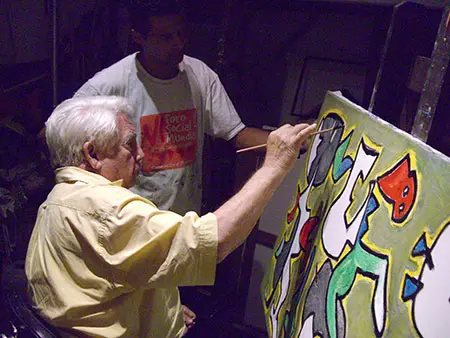
A colossus has died. I must say that this is the image I preserve of the great Oswaldo Vigas. He was 88 years old and those were indeed years spent living with enviable creative strength and will. Certainly his last years were spent dodging death, making pirouettes to evade disease, because even at critical and intense moments Oswaldo was invincible. He would come back from these intense experiences with renewed force to write poems or to draw sketches that foreshadowed his next series of damsels, witches or healers. He never stopped painting. Oswaldo was a colossus because throughout his life he turned adversity into the fuel that propelled his creativity. As a young man, he was able to make sound decisions. His first works date from the mid-1940s. Although he graduated from medical school he ultimately decided to be an artist. His opposition to the dictatorial regime of Marcos Pérez-Jiménez had immediate consequences in the artist's life, like having to abandon his medical studies in Mérida—although he eventually resumed them in Caracas. Still very young, he won the 1952 National Visual Arts Award with his work Gran Bruja (High Witch). At that time his work developed an identity that gained him the recognition that to this day helps define his place in the history of Venezuelan art: it is precisely when he conceived his Brujas (Witches) series when he also established a constant theme in his work. Women in Vigas's life are his allies, partners, lovers and loved figures. For him the female figure is a mythical presence and telluric image that speaks of the earth, "of the sense of belonging to this earth" and is what makes his paintings have that full feel of the Americas. In that year (1952), Vigas leaves for Paris where he enrolled in Art History courses at the University of the Sorbonne. In that city, he continues the path started in Venezuela and works in parallel on large projects such as the murals that he would shortly after enter to participate in the Synthesis of the Arts Project of Ciudad Universitaria—today a World Heritage Site—developed by architect Carlos Raúl Villanueva. He had such an independent spirit that the future of his work was consolidated from his individual explorations. And it was this spirit, perhaps rebellious and autonomous at once, which would make his work so relevant. During this period, Vigas's figuration reveals constructive characteristics that represent a departure from the expressiveness that characterized his work. While the figures are abstracted (without losing its mineral, vegetable and animal condition) they are also integrated into the given compositional structure. This period perhaps represents one of the lesser known moments in the evolution of his work and yet, it is of great importance. The Galería Ascaso recently presented an exhibition that centered on Vigas's constructivist period. Curated by Bélica Rodríguez, the exhibition has just been awarded best solo exhibition of 2013 by AICA-Venezuela. 1957 was a year of break ups. The political crisis in Venezuela worsened. Vigas assumes a radical position when participating in the drafting of the Manifesto of the Intellectuals against the dictatorship as he also radically changes his pictorial approach. The attachment to the land and the return to his origins are expressed through informal works—abstract in appearance—that are nevertheless representative of his "pictorial geography." These are "internal" landscapes in which matter and color are central elements. After a brief period characterized by a heavy use of signs, influenced by the practice of Zen Buddhism, his brushwork progressively turns more gestural and dynamic as his brushstroke increasingly becomes more violent and spontaneous. These brushstrokes are actually very consistent...