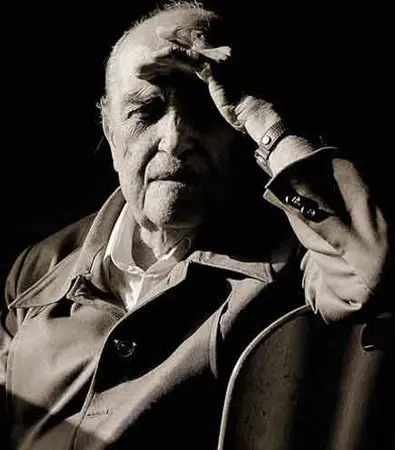
Oscar Niemeyer
"I only work on things that attract me, with the greatest freedom, convinced that architecture is, above all, invention."
The celebrated Brazilian architect Oscar Niemeyer, designer of Brasilia's iconic futuristic buildings as well as hundreds of structures that revolutionized Twentieth-Century architecture around the world, died in Rio de Janeiro on December 5th, at the age of 104.
Born in Rio in 1907, Niemeyer graduated as an architect from Brazil's Escola Nacional de Belas Artes and began his career working for the Lucio Costa Studio (it was with Costa that, years later, Niemeyer projected Brasilia). The era was dominated by Bauhaus and the modernist thinking of Le Corbusier. At the beginning, Niemeyer followed the Swiss master (with whom he shared works such as the UN headquarters in New York City), but he was able to blaze his own trail and open the way for a generation that broke with modernist abstraction, eliminating its straight lines and adding large scale, expressive liquid and tropical forms.
From the beginning of his career, Niemeyer demonstrated great creative speed. The Pampulha complex, a landmark in modern architecture that follows the curved outline of the island on which it was erected, was designed during a single night in 1940, in response to a request by Juscelino Kubitschek, at the time the Major of Belo Horizonte. This project won Niemeyer a lifelong admirer and friend, who 15 years later, as President of Brazil, commissioned him to design the most important buildings for the country's new capital, Brasilia, inaugurated in 1960.
Among those buildings was the white marble-covered Planalto palace, seat of the executive branch, or the city's Cathedral, with its underground entrance for the public to access the well-lit church and leave behind the shadows. Here, Niemeyer wanted to produce the feeling of arriving in "heaven" and to avoid the solutions featured by old style cathedrals that associated darkness with guilt and sin. Another iconic building is the National Congress, which metaphorizes Brazil's bicameral system.
The Chamber of Deputies has a convex cupola and the Senate a concave one, as if to emphasize that both houses need to work in tandem. Curved lines dominate almost all of Niemeyer's works, including the French Communist Party Headquarters in Paris, created after the 1964 coup d'état that exiled him from Brazil.
Born to a Catholic, bourgeois family, Niemeyer married Anita Bildo in 1928. They had one child, Anna Maria. Their union lasted 76 years, until Annita's death in 204. Anna Maria died last June, at 82. Niemeyer remarried at the age of 98, with his secretary Vera Lucia Cabrera.
Niemeyer was an atheist and a communist, having joined the Brazilian Communist party in 1945. He supported Fidel Castro and Hugo Chavez. After the military takeover in Brazil, his office was raided; he resigned his post at the University of Brasilia alongside 200 professors. Niemeyer traveled to France for an exhibition of his work at the Louvre. He remained in Europe, where his architecture is well received, and built the Algiers Mosque, the Labor Council Building in Bobigny, and the Mondadori Publishing House's headquarters in Italy; for these works he received the Pritzker Prize—Architecture's Nobel—in 1988. There are currently some twenty Niemeyer projects underway in several countries.
During the most recent Carnival in Rio, last February, Niemeyer visited the renovation works at the Sambódromo, which he built in 1984, for the 2016 Olympic Games (among other events, the marathon will have its finish line there).
Years ago, Niemeyer was asked how he would like to be remembered after his death. He wanted, he said, for his tombstone to read: Oscar Niemeyer. Brazilian. Archite...