Orlan in Colombia
Two different and simultaneous exhibitions of works by French artist Mireille Suzanne Francette Porte, better known as Orlan, will be open through June 8th. Both are curated by Ricardo Arcos Palma. The exhibitions are held at the Museo de Arte Moderno, in Bogotá, and at the Museo de Antioquia, in Medellin. This event is part of the 4th French-Colombian High Studies program, under the title El cuerpo en cuestión: Homenaje a ORLAN, sponsored and coordinated by the Master's Program in History and Theory of Art, Architecture, and the City of the Universidad Nacional de Colombia (Bogotá), the Art School-ASBAB of Universidad Distrital, the Institución Universitaria Bellas Artes y Ciencias of Bolívar, and the French-Colombian Alliance. The High Studies program had among its participants Raphael Cuir, president of AICA (the International Art Critics Association).
The event was preceded by a seminar organized by the Guerrero Academy of Art, with presentations by academics, philosophers, and artists both international and local who have worked on the topic of the body as an instrument and a surface for artistic practice, among them Consuelo Pabón, Carlos Sanabria, Christian Padilla, Fernando Pertuz, and Ignacio Casado Casco.
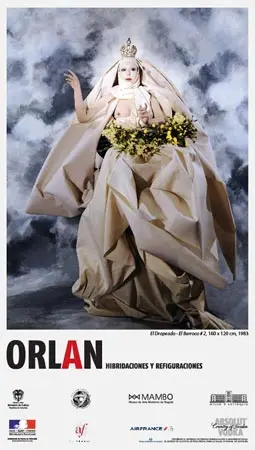
In the exhibition ORLAN/Hibridaciones y refiguraciones, at the Museo de Arte Moderno in Bogotá, the artist, taking as her point of departure Didi-Huberman's notions around the anachronistic that permeates the contemporary, uses digital photography and retouching software to generate hybrid versions of her own face combined with faces of individuals belonging to native American, pre-Columbian, and African groups. Included in this show are also images of St. ORLAN as well as some videos and images of her surgical interventions.
In Medellin, the public has an opportunity to see ORLAN / Arte carnal o cuerpo en obsoleto, which has the goal of showing a series of videos and photographs of her various surgeries-performances created in the 1980s and 1990s; a pioneering body of work that involved physicians in the process of performing an actual surgery in the production of a work of art. In this way, they also allude to the concept of the public and the private and its transformation on the basis of a gesture of transmission and mediatization.