InstallationOctober 18, 2021
Betsabée Romero's work covers Mexico's pavilion at Expo 2020 Dubai
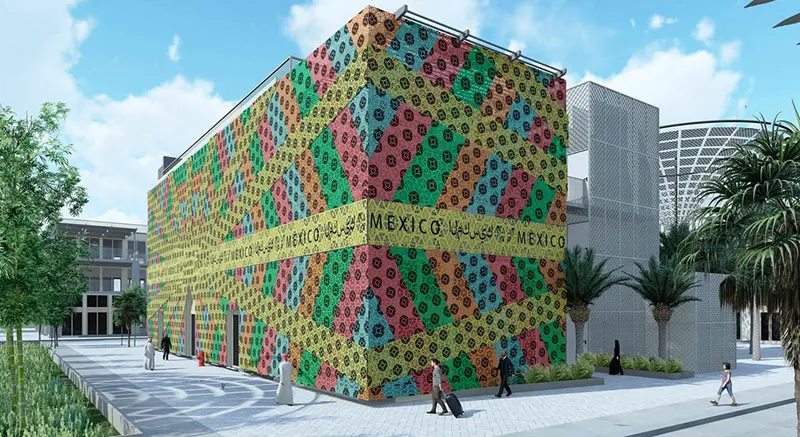
On October 4, the universal exhibition "Expo 2020 Dubai" opened its doors with the slogan "Weaving lives" and invited the artist Betsabée Romero to intervene in the space. The pavilion was covered with the work "Tejedoras de Lazos" (Weavers of Ties), crochet work made up of seven kilometers of interwoven threads to show the world the role of women in the construction and preservation of cultures.
About her designation, Betsabée Romero commented, "besides being a great honor as a contemporary artist, it seemed to be a great opportunity, not only because I was offered the façade of our country in that great international event, but because it was up to me to represent the women of my country and the world at this time when, incredibly and despite great fighters, gender violence continues to worsen."
"Tejedoras de Lazos" is a multicolored installation made by one hundred craftswomen from Etzatlán, Jalisco, and directed and intervened by Betsabée Romero, to represent the union, the ties, the talent, the perfect connection of nature, humans, and cosmos, with which Mexico wants to show itself within and beyond its borders. For the artist, it was important to collaborate with artisans since she has worked with them for more than 20 years and considers them to be an intangible material of her Mexico. She began searching for the material and the gesture to create a work with traditional roots but with a conceptual and contemporary creation. She researched different types of Mexican textiles, and in that search, she found this group of women who wrapped a village with their hands and won the Guinness Award.
About the work, the artist added: "Finding a community of women weavers willing to collaborate with me was a great journey, a great experience, and a great learning experience. Working with them and four other artisan workshops to reach such a distant country fills the whole work with generosity and color; it gives it a texture and warmth that only manual labor can achieve. These women intertwine with my project to bring a small sample of all that popular art, as part of cultures still alive, brings us, in accompaniment and comfort during difficult times and as rejoicing and emotion in each of the countless celebrations that calendarize our existence."
The artisans are from an old and small mining town, located in Los Altos de Jalisco, with the name of Etzatlan. Betsabé Romero says that it was there where it all began six years ago, with two women from one family —Paloma and Lorena Ron—, mother and daughter who, living their bereavements, infected all their relatives and little by little a community. Two losses that led them to remember by knitting and to discover that, by doing it together, they materialized their history in the act of knitting, a solitary capacity that grows as it becomes collective.
About her designation, Betsabée Romero commented, "besides being a great honor as a contemporary artist, it seemed to be a great opportunity, not only because I was offered the façade of our country in that great international event, but because it was up to me to represent the women of my country and the world at this time when, incredibly and despite great fighters, gender violence continues to worsen."
"Tejedoras de Lazos" is a multicolored installation made by one hundred craftswomen from Etzatlán, Jalisco, and directed and intervened by Betsabée Romero, to represent the union, the ties, the talent, the perfect connection of nature, humans, and cosmos, with which Mexico wants to show itself within and beyond its borders. For the artist, it was important to collaborate with artisans since she has worked with them for more than 20 years and considers them to be an intangible material of her Mexico. She began searching for the material and the gesture to create a work with traditional roots but with a conceptual and contemporary creation. She researched different types of Mexican textiles, and in that search, she found this group of women who wrapped a village with their hands and won the Guinness Award.
About the work, the artist added: "Finding a community of women weavers willing to collaborate with me was a great journey, a great experience, and a great learning experience. Working with them and four other artisan workshops to reach such a distant country fills the whole work with generosity and color; it gives it a texture and warmth that only manual labor can achieve. These women intertwine with my project to bring a small sample of all that popular art, as part of cultures still alive, brings us, in accompaniment and comfort during difficult times and as rejoicing and emotion in each of the countless celebrations that calendarize our existence."
The artisans are from an old and small mining town, located in Los Altos de Jalisco, with the name of Etzatlan. Betsabé Romero says that it was there where it all began six years ago, with two women from one family —Paloma and Lorena Ron—, mother and daughter who, living their bereavements, infected all their relatives and little by little a community. Two losses that led them to remember by knitting and to discover that, by doing it together, they materialized their history in the act of knitting, a solitary capacity that grows as it becomes collective.