Book ReviewsOctober 9, 2024· By Christine Frèrot
Monograph/José Gamarra
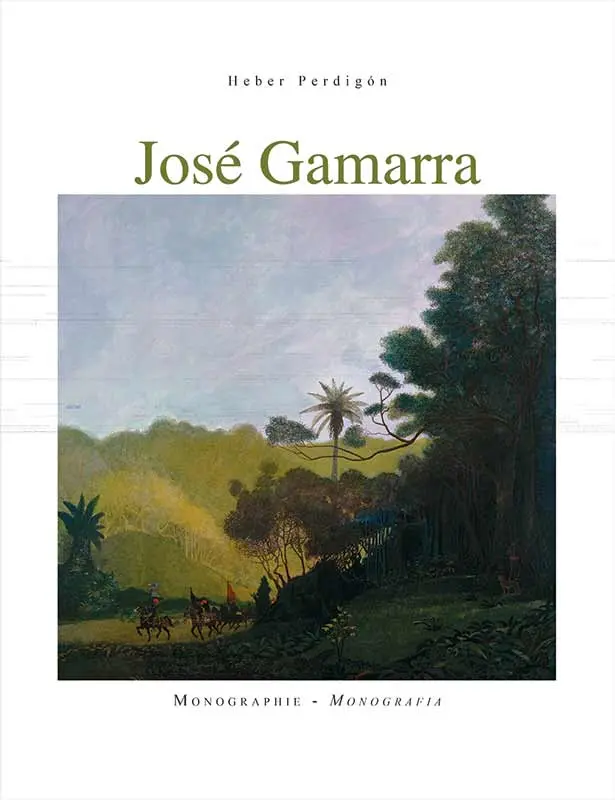
Prepared under the direction of Heber Perdigón (founder of the Paris-based Association de défense de l’œuvre de José Gamarra) and recently published in France, this monumental monographic volume on the Uruguayan painter José Gamarra (Montevideo, 1934) traces the artist’s trajectory from his beginnings in Uruguay until his arrival on French soil, after a Brazilian interlude. It threads together Gamarra’s life and work based on vast array of photographic documents, reproductions of his paintings, and a selection of essays by international critics, art historians, and writers. Gamarra has lived for almost sixty years in a town near Paris that was or is home to several Latin American artists, among them Antonio Seguí, Herman Braun-Vega and Pancho Quilici. The monograph is organized in “Periods”, followed by a chronology (“Childhood and Adolescence”, then “Transition”), but it also focuses on the introduction of a landscape that dominated Gamarra’s work from very early on: the jungle, an image/pretext where—he argued—many significant and/or bloody episodes in Latin American history were written. In one of the essays included in the monograph, Heber Perdigón underscores the formative impact that Gamarra’s stay in Brazil had upon the development of his oeuvre, both in terms of content and in terms of color. “After a period of abstract signs, with a low palette and dark hues,” Perdigón writes, “the exploration of color became the connecting thread in Gamarra’s painting. (…). The language that was to come, the language of the jungle, begins to announce itself in in this period, which we call Transition. Gamarra’s time in Brazil had an evident influence in his later work.” After an introduction by Eduardo Galeano, the volume collects texts by Édouard Glissant, Ángel Kalenberg, Edward Lucie-Smith and, of course, Gamarra himself. This sweeping panoramic closes with a catalog of exhibitions and works, and various appendices (museums, private and public collections, general bibliography.)
From his earliest figurative paintings, portraits and landscapes of the 1940s, permeated by the era’s currents of modernism, to his artworks/signs of the 1950s and 60s, more abstract yet still traversed by traces of figuration influenced by parietal art, graphic elements in the vein of Miró, or “calligraphies” à la Klee, and then to his “transition” in the late 1960s towards a more color-intensive and at times somber type of art, dominated by helicopters, palm trees, boats, wild animals, etc., Gamarra’s formulation of an entirely new iconography will culminate in “the jungle”. Starting in the early 1970s, the jungle, landscape/site of metaphor, came to symbolize the social and political dimension of Gamarra’s art, and this image/memory occupied several decades of his life. It is what Pierre Gaudibert accurately described as “Le viol du paradis” (the violation of Paradise), and Ángel Kalenberg, (1) “La loi de la jungle” (The law of the jungle), the latter evoking, in Gamarra’s return to the primal forest, “a return to Jean-Jacques Rousseau, to Leonardo, who conceived the world as an organic being, holistic as a unit.” For Gaudibert, (2) “Gamarra’s entire thematic symbolism is built around this double aggression towards nature and towards unseen men, which ends up fusing into one: the countersubversive commando thugs, small black gnomes, move forward and attack, while at the same time the machines dig and devastate in all directions.” In those forbidding, imposing, menacing jungles, where we encounter people (soldiers, Indians, etc.) as well as animals (serpents, leopards) and monuments or landscapes, the aesthetic writing of José Gamarra’s art found its definitive identity.
Notes
(1) Ángel Kalenberg, Exhibition, Luis Ángel Arango Library, Bogotá,1987.
(2) Pierre Gaudibert “Le viol du paradis ou la politique est partout” (The Violation of Paradise, or Politics is Everywhere”). L’œil de bœuf Gallery, Paris, 1976.
From his earliest figurative paintings, portraits and landscapes of the 1940s, permeated by the era’s currents of modernism, to his artworks/signs of the 1950s and 60s, more abstract yet still traversed by traces of figuration influenced by parietal art, graphic elements in the vein of Miró, or “calligraphies” à la Klee, and then to his “transition” in the late 1960s towards a more color-intensive and at times somber type of art, dominated by helicopters, palm trees, boats, wild animals, etc., Gamarra’s formulation of an entirely new iconography will culminate in “the jungle”. Starting in the early 1970s, the jungle, landscape/site of metaphor, came to symbolize the social and political dimension of Gamarra’s art, and this image/memory occupied several decades of his life. It is what Pierre Gaudibert accurately described as “Le viol du paradis” (the violation of Paradise), and Ángel Kalenberg, (1) “La loi de la jungle” (The law of the jungle), the latter evoking, in Gamarra’s return to the primal forest, “a return to Jean-Jacques Rousseau, to Leonardo, who conceived the world as an organic being, holistic as a unit.” For Gaudibert, (2) “Gamarra’s entire thematic symbolism is built around this double aggression towards nature and towards unseen men, which ends up fusing into one: the countersubversive commando thugs, small black gnomes, move forward and attack, while at the same time the machines dig and devastate in all directions.” In those forbidding, imposing, menacing jungles, where we encounter people (soldiers, Indians, etc.) as well as animals (serpents, leopards) and monuments or landscapes, the aesthetic writing of José Gamarra’s art found its definitive identity.
Notes
(1) Ángel Kalenberg, Exhibition, Luis Ángel Arango Library, Bogotá,1987.
(2) Pierre Gaudibert “Le viol du paradis ou la politique est partout” (The Violation of Paradise, or Politics is Everywhere”). L’œil de bœuf Gallery, Paris, 1976.