Milagros de la Torre
The Museo de Arte de Lima will present through July 1st the first anthology exhibition of works by Peruvian conceptual photographer Milagros de la Torre. The show has been organized by guest curator Edward J. Sullivan, Helen Gould —art history professor at the Institute of Fine Arts—, and the art history department of New York University. This compilation of works by de la Torre has been made possible by the support of Juan Carlos Verme and the cooperation of the US Embassy in Lima. As part of the Lima Photography Biennial, which started on March 19th and ill extend through July 22nd, Indicios: Milagros de la Torre is a collaboration between MALI and the New York-based Americas Society. On display at Americas Society through Aril 14th is a parallel exhibit, titled Observed: Milagros de la Torre, which has been made possible by the support of PromPerú, Eduardo Hochschild, the Mundus Novus collection, Javier Zavala, and Alexandra Bryce.
Through 12 series and some 50 photographs, Indicios reviews the artist's extensive career, from her early explorations of the medium, such as photographic painting —which drastically alters tone in a photograph— to her most recent production. The latter leans towards socio-political issues that shake Latin American today, such as violence, memory, identity, and suffering —for instance, with works dealing with Peru and Mexico, nations that have suffered high degrees of censorship. Among them are works of an investigative nature, from occasions when the artist has witnessed crimes and/or surveillance methods.
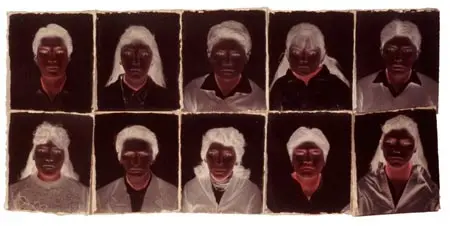
Resulting from de la Torre's intensive research in the Justice Palace archives, combined with Nineteenth-Century photographic techniques, the series Los pasos perdidos (1996) shows the hallways of the palace that connect to prisoner's cells. The artist abstracts photographed objects from their time and space, and presents an interpretation of physical testimonies (objects) used a support to the evidence in crimes under judgment. The series Censura (2001) resulted from an investigation of Spanish Inquisition manuscripts from the Seventeenth and Eighteenth centuries, portions of which have been blacked out. These abstract photographs attempt to capture the movement of pencils as they manipulated the documents. Anther example of de la Torres's wide-ranging body of work is her series Bajo el sol negro, comprised of portraits of people in Cuzco, altered by the de-pigmentation of their skins with mercurochrome. Finally, and never before seen in public, this exhibition includes the series Todo se queda en la familia, which explores concepts about the family. The family portraits are printed on vintage paper, and the artist uses an out-of-sync flash that causes the photographs to appear as a shadow that develops from a light gray hue to a dark black, leaving the connections between family members somewhat vague. In Indicios we can fully appreciate the complexity of de la Torre's work: synthesis of formal experimentation and conceptual declarations of a socio-political order.
A bilingual illustrated catalog will be available in April, with essays by Edward J. Sullivan and Miguel A. López, and an interview with Milagros de la Torre by Anne Wilkes Tucker. The catalog has been produced by the Americas Society and is distributed by ARTBOOK / D.A.P.
Gallery