Art NotesJune 17, 2011
Miamicito
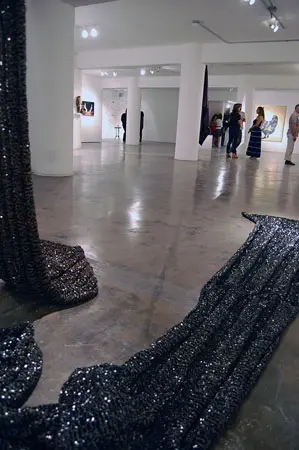
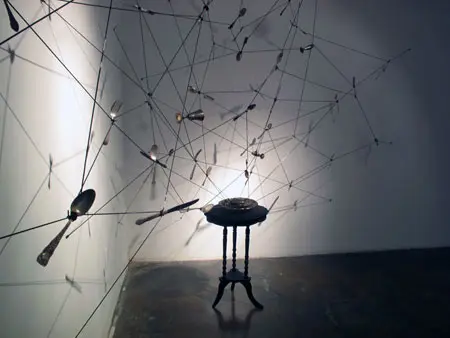
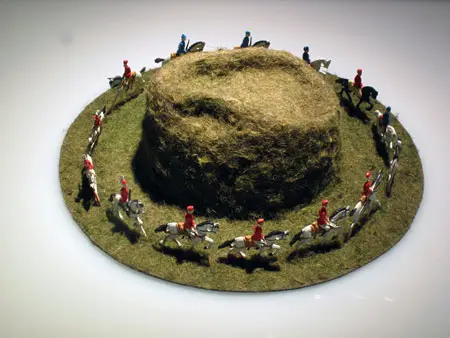
Miamicito, an outstanding sampler of works by contemporary Bolivian artists, was recently on view at Dot Fiftyone Gallery, located in Miami's Wynwood District. The show's suggestive title finds its inspiration in the Bolivian capital's flea market, and alludes to the city of Miami as a shopping spot for many Latin Americans, where virtually everything can be found for purchase. Raquel Schwartz, director of Santa Cruz, Bolivia's Kiosko Gallery and curator of Miamicito, explains that the title was chosen in order to underscore the show's eclecticism, which "intends to allude to the syncretic heterogeneity, the mutable spirit of the times that sways between the aspiration for a hybrid global identity and the irreducible need to assert our own sites of enunciation." Thus, Miamicito proposes a dynamic reading of the artworks included, a reading characterized by a plurality of voices and formal solutions. One highlight among the works on display is Dictator's Last Supper (La última cena del dictador, 2010), an installation by Eduardo Rivera Salvatierra. It comprises a delicate, oblong side table covered in fringes and volutes, resting on which¿like an offering or reliquary-we find a pristine Sacred Heart from where the most sophisticated silverwork seems to explode out. Cups, silverware, and salt shakers suspended in space via dark threads, capriciously stopping time like an intricate spider web and prompting us to reflect. This controversial artwork captivates us with its mastery of space, its attentive play with light, its intricate grid of black threads, and the flashing reflections from the freshly-polished silver. Raquel Schwartz's Woven Channels (Canales entretejidos) stands out for its synthetic capacity, effectiveness, and plasticity. We are presented with a 21-meter long, 5-meter wide weaving, painstakingly created using 300 used cassette tapes. The recourse of weaving and the audiotapes prompt a two-level reflection about time. A first level of reflection is connected to the notion of the peremptorily accelerated tempo that undergirds our existence, imposed by a contemporary society where everything, from ancient techniques such as weaving to modern technological advances such as audio recording, quickly becomes obsolete. In opposition to such frenzy, Schwartz proposes a second level: duration. That magnificent period of time that is necessary for the creation of a weaving or, more simply, for listening. From a visual standpoint, Woven Channels plays with components from its own surroundings such as gravity and light. Indebted to the informalist notion of art inaugurated by Robert Morris, the shawl that hangs from the ceiling is never the same, its shape shifting with each presentation, while the metallic oxidation in the magnetic tape generates changes in hue as light touches it and as viewers move around the work. Well executed in its synesthesia, Woven Channels is a penetrating reflection about our overabundance of information and our lack of real time to process it-a monument to the palimpsest, the Babel Tower of information that characterizes contemporary society. Claudia Jaskowickz's trilogy is bone-chilling. Her videographic installation shows three historical periods of Bolivian history, marked by the common signs of death and myth, reinterpreted here through fictionalized images that represent events and inscribe themselves as historical memory. In Drawn and quartered (Arrestado y descuartizado, 207), Jaskowickz recreates the public execution of the indigenous leader Tupac Katari, sentenced to death by quartering by the Spanish colonizers and executed, tied to four horses, in the plaza of the town of Peñas in 1781. Jaskowickz¿s video displays in ralenti the tragic instant when the naked body resists the pull. The horses have been replaced by motorcycles and the scene has been transported to La Paz. The camera's panoramic sweep from left to right effectively emphasizes the tension and t...
Gallery