PublicationMay 20, 2010
Memorias del Encuentro Regional de Arte
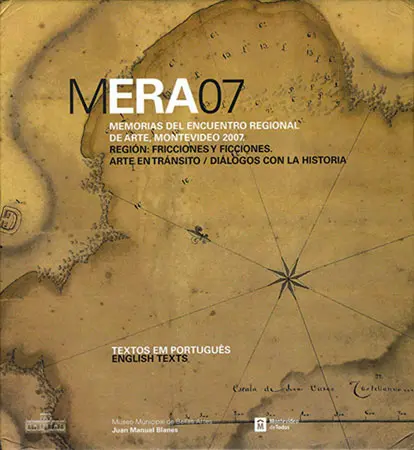
Gabriel Peluffo-Linari, Director of the Museum, served as official curator of a project that centered on analyzing "the concept of region within the context of a globalization that affects all orders of human interaction," based on the aesthetic and historic frictions between the creation of political regions and the current crisis of the nation states. This problem was contemplated through artistic practice and multidisciplinary examination made possible by conferences and debates by theoreticians in the fields of art, anthropology, and politics. The exhibitions and discussions incited a dialogue between images that corresponded to a particular region and pre-modern policy, such as Images Under Siege 1830-1870, presented by guest curator Roberto Amigo, and contemporary poetics such as those proposed in the exhibition Squaring the Cone/Border Jam, by guest curator Gerardo Mosquera. The conclusion was the publication of MERA07 Memorias del Encuentro Regional de Arte, Montevideo, 2007. It consisted of four volumes and a DVD. "Región: Fricciones y Ficciones", offers a general presentation of the project. Peluffo, Amigo, and Mosquera explain the perspective of the analysis by each of the curators. While the essays presented under the title Cultural Geopolitics; The Ubiquitous Borders, by Hugo Achúgar, Alberto Methol-Ferré, and Justo Pastor-Mellado analyze why the concepts of region and border cannot be observed through a univocal historical construction. They deconstruct these notions by precisely exhibiting the frictions and fictions that are generated in historic, cultural, and artistic research. They explain their intention of reformulating assumptions that have often been consecrated a priori. "Diálogos con la Historia" is the title of the second book, were readers can "intersect" the texts written by three anthropologists and three art historians who describe the ways in which each of them analyzes the construction of images and cultural models at the regional level. Under the title Anthropology and Strategies of the Difference, Marcia Sprandel, Teresa Porzencanski, and Mario Consens delve in aspects such as the diversity of possible identity constructions, the inquiry into the way in which operations of geographical conditionings work, the questioning of the traditional Eurocentric perspective for explaining occurrences at the periphery. "The Role of Images in Regional History" four art historians, Paulo Herkenhoff, Laura Malosetti, Roberto Amigo, and Gabriel Peluffo, explore the role of images and visual discourses across different moments in the local history of the Nineteenth Century and write about the imaginary that was constructed and the premises that supported these. They also analyze the contribution of periodical publications with respect to the dissemination of images and discourses, the proliferation of allegories that convey complex relationships with politics, and the role that art began to acquire in the political arena, at a time when the former was perceived as a promoter of civilization and pacification. "Escenas Subregionales", the title of volume three, contains writings by Constanza Moreira and Carlos Caetano, who under the main title Sub-Regional Debate from the Perspective of Political History, discuss the concept of boundaries from both cultural and geographical perspectives as they explore how these influence the construction of imageries. They propose that the concept of "border" is a problematic notion, as they apply the term's meaning to political, historical, and cultural fields. "Other Translocal Contemporary Art Scenarios", Ana Tiscornia, Gustavo Buntinx, Virginia Pérez-Ratton, and Tício Escobar focus the discussion around the practice of art, the particularities of the spaces "museums, biennials, etc." that contain it, as they analyze the complexity of the process of constructing cultural venues that must deal with multiple influences. They also address the problem of t...