ExhibitionDecember 18, 2015
Matta, este lado del mundo
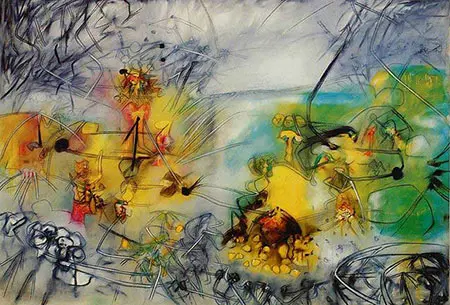
The exhibition Matta, este lado del mundo is on view through January 22, 2016, at the Matta Cultural Center of the Chilean Embassy in Buenos Aires. It is curated by María José Fontecilla, Chile's cultural attaché in Argentina, and Inés Ortega-Márquez, who in 2011 was in charge of the large exhibition celebrating the 100th anniversary of Matta's birth (1911-2002) at the La Moneda Palace Cultural Center. Matta, este lado del mundo opened on December 10th with the presence of President Michelle Bachelet, and it is one of the artist's most significant exhibitions ever held in Argentina, or indeed in Latin America. Intended to explore Matta's connection to Latin America, the exhibition features 40 works—including paintings, drawings, prints, and sculptures—on loan from Chilean and Argentinean collections. Among the works on exhibit in Matta, este lado del mundo are early drawings from the artist's period as a member of the Surrealist group, as well as key paintings such as El día es un atentado ("The Day is an Attack", 1942), El nacimiento de América ("The Birth of America", 1952), and Eros enfant (1985), which display Matta's metaphysical preoccupations, his transit from automatism to abstract expressionism, and the allegorical power of his figurative art. There are also series like El gran Burundú-Burundá ha muerto ("The Great Burundú-Burundá is Dead", 1975), where the artist engages the subject of human rights violations in Latin America, and Verbo América ("America Verb", 1985), about the work of some of the region's essential poets, like César Vallejo, Rubén Darío, and Gabriela Mistral. According to María José Fontecilla, the main goal of the exhibition is "to recover Matta in this side of the world. To bring him back. To speak of him from the place he never stopped inhabiting, despite his many years between Europe and the United States and the large influence he exerted there, since he always retained his connection to Latin America." A second goal, she adds, is to institutionalize Matta: "to show how institutions, foundations, and museums on both sides of the Atlantic, as well as private collectors, have positioned him in our territory as one of the continent's greatest artists." The exhibition features works from Chilean collections such as the Museo de Bellas Artes, the MAC, the Museo Salvador Allende, and the MAVI, and from Argentinean collections like the Museo de Arte Latinoamericano de Buenos Aires (Malba) and the Ministry of Foreign Affairs. Adding to these are works loaned by private collectors like Isabel Aninat, Juan Salinas, and Ana María Stagno, as well as curator María José Fontecilla.