Marta María Pérez Bravo
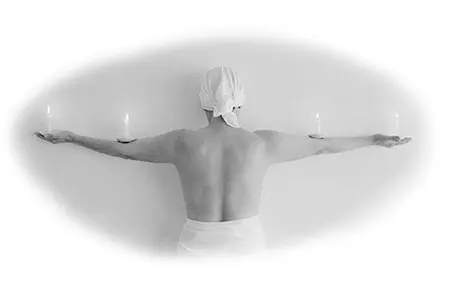
La Maison d'Amerique Latine in Paris is presenting, from September 18th through December 20th, 2013, as part of the Quai Branly event "Photoquai 4th World Images Biennial", the first solo exhibition by Cuban photographer Marta María Pérez Bravo, curated by Christine Frérot. The exhibition is built around a series of photographs shot in different periods, in which the artist develops a thematic approach that puts into play her own body, fragments of it or her face, never completely unveiled, in contexts of violence or tenderness. Her videos extend and enrich the viewer's gaze. They are simply moments of meditation about chance and fate that reinforce the dual play where we permanently confront darkness and light, to escape the doubts that inevitably accompany the passage of time.
Nearly fifty black and white, medium-format photographs (1998-2011), several videos (2010-2013), and a video-installation designed especially for the site, are presented for the first time in France. Centered on the representation of the body, between eroticism and sacrifice, identity and mask, apparitions and revelations, this exhibition invites viewers to follow the "mysterious path" of a trajectory that interrogates the relationship between an individual and the world.
Born in Havana in 1959, Marta María Pérez Bravo lives and works in Mexico since 1995. After studying painting—San Fernando Academy and Instituto Superior de Arte de la Habana, 1975-1984—, she chose photography and used it at first as a medium to document her interventions and performances on the landscape. Her attraction for Cuba's rural world, where religious beliefs and popular superstitions remain alive, added to her personal experience of motherhood, helped her establish a singular relationship with her own body, used as support and mediation, "altarpiece" or "receptacle", in the construction of a personal body of work. This work is not properly autobiographical, since in its dramaturgy the use of the artist (fragmented) body is above all the expression of a mediation between herself and her relationship with the world through a series of rituals inspired in a variety of religious practices—from Cuban santería to spiritualism—and of objects both everyday and of sacred import. The chosen object is presented in a minimalistic way, the body becomes decontextualized, and a kind of enigmatic apparition emerges to float in space, leaving ample space to the white surface.
Marta María Pérez Bravo's conceptual projects is connected to a current in Latin American photography where the presence of the artist's cultural background is a dominant element of the creative imagination. Several Cuban artists of her generation, such as Ana Mendieta (1948-1985) or José Bedia (1959), as well as photographer René Peña (1957), display the same attachment to syncretic Afro-Cuban religions, and one cannot forget the deeply ritualized cultural universes explored by painter Wilfredo Lam (1902-1982). These artists, embedded in widely varying degrees in the cultural and spiritual practices that forged the history of Cuban culture, propose symbolic universes where, between magic, ritual, and memory offer the body a destiny that can't space neither culture nor the earth.
The exhibition is presented with the collaboration of Fernando Padilla gallery, from Madrid, and Luis Adelantado gallery, from Valencia, both in Spain, as well as the Maison Erupéenne de la Photographie (MEP), in Paris.